
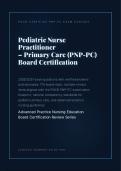
PNC B - C E RTI F I E D PNP- PC E X A M C ONTE NT
Pediatric Nurse
Practitioner
– Primary Care (PNP-PC)
Board Certification
2026/2027 exam questions with verified answers
and rationales: 175 board-style, multiple-choice
items aligned with the PNCB PNP-PC examination
blueprint, national competency standards for
pediatric primary care, and advanced practice
nursing guidelines.
Advanced Practice Nursing Education
Board Certification Review Series
2 0 2 0 2 7 E X A M I N ATI O N E D I TI O N
,PEDIATRIC NURSE PRACTITIONER - PRIMARY CARE (PNP-PC) BOARD CERTIFICATION 175 Questions
PEDIATRIC NURSE PRACTITIONER - PRIMARY CARE
(PNP-PC) BOARD CERTIFICATION
2026/2027 Exam Questions with Verified Answers & Rationales
PNCB-Certified PNP-PC Exam Content | Aligned with the PNCB PNP-PC Examination Blueprint,
National Competency Standards for Pediatric Primary Care, and Advanced Practice Nursing Guidelines (2026/2027
Edition)
Section 1: Health Promotion, Anticipatory Guidance, & Developmental Surveillance
Q1: A 2-week-old newborn is seen for a health supervision visit. According to the AAP Bright Futures
periodicity schedule, which well-child visits are recommended during the first year of life after the
newborn visit?
A. Visits at 1, 2, 4, 6, 9, and 12 months of age
B. Visits at 2, 4, 8, and 12 months of age only
C. Visits at 1, 3, 6, and 12 months of age only *[CORRECT]*
D. Visits at 2, 5, 8, 10, and 12 months of age
Correct Answer: C
Rationale: Per the AAP Bright Futures/AAP periodicity schedule, health supervision visits after the
newborn visit occur at 1, 2, 4, 6, 9, and 12 months. This high-frequency schedule supports growth
monitoring, developmental surveillance, and vaccine administration per the PNCB PNP-PC Health
Promotion domain. The other options omit required visits (such as the 1-month and 9-month visits) and
deviate from the guideline schedule.
Q2: At which well-child visits does the AAP recommend routine autism spectrum disorder (ASD)
screening with a validated tool such as the Modified Checklist for Autism in Toddlers, Revised
(M-CHAT-R)?
A. 12 and 36 months of age
B. 18 and 24 months of age *[CORRECT]*
C. 15 and 30 months of age
D. 9 and 18 months of age
Correct Answer: B
Rationale: The AAP recommends universal ASD-specific screening at 18 and 24 months using a validated
instrument such as the M-CHAT-R/F, because these ages allow reliable detection of core ASD features and
permit early intervention. The 9-, 18-, and 30-month visits are the recommended intervals for general
developmental screening (ASQ, PEDS), not ASD-specific screening. PNCB expects the PNP to distinguish
developmental screening from ASD-specific screening intervals.
COMPLETE BOARD EXAMINATION - WITH ANSWERS & RATIONALES 1
,PEDIATRIC NURSE PRACTITIONER - PRIMARY CARE (PNP-PC) BOARD CERTIFICATION 175 Questions
Q3: A 9-month-old infant is evaluated at a well-child visit. Which gross and fine motor milestone pair is
expected at this age?
A. Rolls front to back and transfers objects hand to hand
B. Walks independently and uses a neat pincer grasp
C. Sits without support and raking grasp only
D. Pulls to stand and develops an immature pincer grasp *[CORRECT]*
Correct Answer: D
Rationale: By 9 months, expected milestones include pulling to stand, crawling, and an emerging immature
(inferior) pincer grasp, with a neat pincer grasp developing by 12 months. Rolling and transfer of objects are
4-6 month skills, walking independently is expected near 12-15 months, and sitting without support emerges
by 6 months. Milestone timing is a core PNCB PNP-PC Developmental Surveillance competency.
Q4: A 24-month-old boy who previously used 2-word phrases and kicked a ball now has entirely stopped
speaking and no longer makes eye contact during play. What is the most appropriate next step?
A. Urgent referral for developmental evaluation because loss of previously attained skills is a red
flag *[CORRECT]*
B. Reassurance and recheck at the 30-month visit because toddlers commonly have transient speech
pauses
C. Reassure the family that boys develop language later than girls and follow up in 6 months
D. Order an immediate brain MRI to evaluate for structural disease
Correct Answer: A
Rationale: Regression or loss of previously acquired developmental skills at any age is a red flag requiring
prompt referral for comprehensive developmental evaluation, often with audiometry and ASD assessment.
Waiting is contraindicated because regression suggests conditions such as ASD, epileptic encephalopathy, or
other neurodevelopmental disease. MRI is not the first step and may be normal; delay violates the AAP
surveillance principle that regression is never a normal variant.
Q5: During a 4-month well-child visit, which anticipatory guidance topic is most appropriate for this
developmental stage?
A. Toilet training readiness and limit setting for tantrums
B. Introducing low-allergen finger foods and cup drinking
C. Tummy time while awake, prevention of falls from changing tables, and safe sleep on a firm
surface without soft bedding *[CORRECT]*
D. Stranger safety and street-crossing rules
Correct Answer: C
Rationale: Four-month anticipatory guidance emphasizes supervised tummy time, fall prevention from
elevations, safe sleep environment, and beginning routines, matching the infant's pre-mobile stage per Bright
Futures. Toilet training is addressed at 18-24 months, solids and cup drinking near 6 months, and stranger or
traffic safety in later childhood. Tailoring guidance to stage-specific injury risks is a PNCB Anticipatory
Guidance blueprint objective.
COMPLETE BOARD EXAMINATION - WITH ANSWERS & RATIONALES 2
, PEDIATRIC NURSE PRACTITIONER - PRIMARY CARE (PNP-PC) BOARD CERTIFICATION 175 Questions
Q6: Which developmental screening tool uses parent report and is recommended by the AAP for general
developmental screening at the 9-, 18-, and 30-month visits?
A. Bayley Scales of Infant Development
B. Vineland Adaptive Behavior Scales
C. Ages and Stages Questionnaire (ASQ-3) *[CORRECT]*
D. Gesell Developmental Schedules
Correct Answer: C
Rationale: The ASQ-3 is a validated parent-completed developmental screening tool recommended by the
AAP for routine developmental screening at 9, 18, and 30 months. The Bayley Scales and Gesell Schedules
are diagnostic assessment instruments administered by trained examiners, and the Vineland measures
adaptive behavior rather than serving as a primary care screen. PNCB requires distinguishing screening tools
from diagnostic evaluations.
Q7: What is the primary purpose of the Denver II developmental screening test in pediatric primary care?
A. It establishes a definitive diagnosis of intellectual disability
B. It provides a structured screen of gross motor, fine motor-adaptive, language, and personal-social
domains to identify children needing further evaluation *[CORRECT]*
C. It replaces developmental surveillance during health supervision visits
D. It quantifies intelligence quotient for school placement
Correct Answer: B
Rationale: The Denver II screens four domains (gross motor, fine motor-adaptive, language,
personal-social) and flags children who require more comprehensive evaluation; it is a screening, not
diagnostic, instrument. Developmental surveillance remains an ongoing process at every visit and is never
replaced by a single screen. IQ testing for placement is outside the scope of the PNP and of this tool.
Q8: A parent asks how to reduce the risk of sudden infant death syndrome (SIDS) for her 2-month-old.
Which recommendation should the PNP provide?
A. Place the infant prone for sleep to prevent aspiration
B. Share a bed with the infant to ease nighttime feeding
C. Keep the infant's room warm with an extra comforter in the crib
D. Place the infant supine on a firm sleep surface in the parents' room without soft objects or loose
bedding *[CORRECT]*
Correct Answer: D
Rationale: AAP safe sleep guidance recommends supine positioning on a firm sleep surface, room-sharing
without bed-sharing, and elimination of soft bedding, pillows, and comforters to reduce SIDS and
sleep-related death risk. Prone positioning increases SIDS risk, aspiration concerns are unfounded given
normal airway protective reflexes, and overheating plus loose bedding are recognized hazards. This is core
PNCB newborn anticipatory guidance content.
COMPLETE BOARD EXAMINATION - WITH ANSWERS & RATIONALES 3
Pediatric Nurse
Practitioner
– Primary Care (PNP-PC)
Board Certification
2026/2027 exam questions with verified answers
and rationales: 175 board-style, multiple-choice
items aligned with the PNCB PNP-PC examination
blueprint, national competency standards for
pediatric primary care, and advanced practice
nursing guidelines.
Advanced Practice Nursing Education
Board Certification Review Series
2 0 2 0 2 7 E X A M I N ATI O N E D I TI O N
,PEDIATRIC NURSE PRACTITIONER - PRIMARY CARE (PNP-PC) BOARD CERTIFICATION 175 Questions
PEDIATRIC NURSE PRACTITIONER - PRIMARY CARE
(PNP-PC) BOARD CERTIFICATION
2026/2027 Exam Questions with Verified Answers & Rationales
PNCB-Certified PNP-PC Exam Content | Aligned with the PNCB PNP-PC Examination Blueprint,
National Competency Standards for Pediatric Primary Care, and Advanced Practice Nursing Guidelines (2026/2027
Edition)
Section 1: Health Promotion, Anticipatory Guidance, & Developmental Surveillance
Q1: A 2-week-old newborn is seen for a health supervision visit. According to the AAP Bright Futures
periodicity schedule, which well-child visits are recommended during the first year of life after the
newborn visit?
A. Visits at 1, 2, 4, 6, 9, and 12 months of age
B. Visits at 2, 4, 8, and 12 months of age only
C. Visits at 1, 3, 6, and 12 months of age only *[CORRECT]*
D. Visits at 2, 5, 8, 10, and 12 months of age
Correct Answer: C
Rationale: Per the AAP Bright Futures/AAP periodicity schedule, health supervision visits after the
newborn visit occur at 1, 2, 4, 6, 9, and 12 months. This high-frequency schedule supports growth
monitoring, developmental surveillance, and vaccine administration per the PNCB PNP-PC Health
Promotion domain. The other options omit required visits (such as the 1-month and 9-month visits) and
deviate from the guideline schedule.
Q2: At which well-child visits does the AAP recommend routine autism spectrum disorder (ASD)
screening with a validated tool such as the Modified Checklist for Autism in Toddlers, Revised
(M-CHAT-R)?
A. 12 and 36 months of age
B. 18 and 24 months of age *[CORRECT]*
C. 15 and 30 months of age
D. 9 and 18 months of age
Correct Answer: B
Rationale: The AAP recommends universal ASD-specific screening at 18 and 24 months using a validated
instrument such as the M-CHAT-R/F, because these ages allow reliable detection of core ASD features and
permit early intervention. The 9-, 18-, and 30-month visits are the recommended intervals for general
developmental screening (ASQ, PEDS), not ASD-specific screening. PNCB expects the PNP to distinguish
developmental screening from ASD-specific screening intervals.
COMPLETE BOARD EXAMINATION - WITH ANSWERS & RATIONALES 1
,PEDIATRIC NURSE PRACTITIONER - PRIMARY CARE (PNP-PC) BOARD CERTIFICATION 175 Questions
Q3: A 9-month-old infant is evaluated at a well-child visit. Which gross and fine motor milestone pair is
expected at this age?
A. Rolls front to back and transfers objects hand to hand
B. Walks independently and uses a neat pincer grasp
C. Sits without support and raking grasp only
D. Pulls to stand and develops an immature pincer grasp *[CORRECT]*
Correct Answer: D
Rationale: By 9 months, expected milestones include pulling to stand, crawling, and an emerging immature
(inferior) pincer grasp, with a neat pincer grasp developing by 12 months. Rolling and transfer of objects are
4-6 month skills, walking independently is expected near 12-15 months, and sitting without support emerges
by 6 months. Milestone timing is a core PNCB PNP-PC Developmental Surveillance competency.
Q4: A 24-month-old boy who previously used 2-word phrases and kicked a ball now has entirely stopped
speaking and no longer makes eye contact during play. What is the most appropriate next step?
A. Urgent referral for developmental evaluation because loss of previously attained skills is a red
flag *[CORRECT]*
B. Reassurance and recheck at the 30-month visit because toddlers commonly have transient speech
pauses
C. Reassure the family that boys develop language later than girls and follow up in 6 months
D. Order an immediate brain MRI to evaluate for structural disease
Correct Answer: A
Rationale: Regression or loss of previously acquired developmental skills at any age is a red flag requiring
prompt referral for comprehensive developmental evaluation, often with audiometry and ASD assessment.
Waiting is contraindicated because regression suggests conditions such as ASD, epileptic encephalopathy, or
other neurodevelopmental disease. MRI is not the first step and may be normal; delay violates the AAP
surveillance principle that regression is never a normal variant.
Q5: During a 4-month well-child visit, which anticipatory guidance topic is most appropriate for this
developmental stage?
A. Toilet training readiness and limit setting for tantrums
B. Introducing low-allergen finger foods and cup drinking
C. Tummy time while awake, prevention of falls from changing tables, and safe sleep on a firm
surface without soft bedding *[CORRECT]*
D. Stranger safety and street-crossing rules
Correct Answer: C
Rationale: Four-month anticipatory guidance emphasizes supervised tummy time, fall prevention from
elevations, safe sleep environment, and beginning routines, matching the infant's pre-mobile stage per Bright
Futures. Toilet training is addressed at 18-24 months, solids and cup drinking near 6 months, and stranger or
traffic safety in later childhood. Tailoring guidance to stage-specific injury risks is a PNCB Anticipatory
Guidance blueprint objective.
COMPLETE BOARD EXAMINATION - WITH ANSWERS & RATIONALES 2
, PEDIATRIC NURSE PRACTITIONER - PRIMARY CARE (PNP-PC) BOARD CERTIFICATION 175 Questions
Q6: Which developmental screening tool uses parent report and is recommended by the AAP for general
developmental screening at the 9-, 18-, and 30-month visits?
A. Bayley Scales of Infant Development
B. Vineland Adaptive Behavior Scales
C. Ages and Stages Questionnaire (ASQ-3) *[CORRECT]*
D. Gesell Developmental Schedules
Correct Answer: C
Rationale: The ASQ-3 is a validated parent-completed developmental screening tool recommended by the
AAP for routine developmental screening at 9, 18, and 30 months. The Bayley Scales and Gesell Schedules
are diagnostic assessment instruments administered by trained examiners, and the Vineland measures
adaptive behavior rather than serving as a primary care screen. PNCB requires distinguishing screening tools
from diagnostic evaluations.
Q7: What is the primary purpose of the Denver II developmental screening test in pediatric primary care?
A. It establishes a definitive diagnosis of intellectual disability
B. It provides a structured screen of gross motor, fine motor-adaptive, language, and personal-social
domains to identify children needing further evaluation *[CORRECT]*
C. It replaces developmental surveillance during health supervision visits
D. It quantifies intelligence quotient for school placement
Correct Answer: B
Rationale: The Denver II screens four domains (gross motor, fine motor-adaptive, language,
personal-social) and flags children who require more comprehensive evaluation; it is a screening, not
diagnostic, instrument. Developmental surveillance remains an ongoing process at every visit and is never
replaced by a single screen. IQ testing for placement is outside the scope of the PNP and of this tool.
Q8: A parent asks how to reduce the risk of sudden infant death syndrome (SIDS) for her 2-month-old.
Which recommendation should the PNP provide?
A. Place the infant prone for sleep to prevent aspiration
B. Share a bed with the infant to ease nighttime feeding
C. Keep the infant's room warm with an extra comforter in the crib
D. Place the infant supine on a firm sleep surface in the parents' room without soft objects or loose
bedding *[CORRECT]*
Correct Answer: D
Rationale: AAP safe sleep guidance recommends supine positioning on a firm sleep surface, room-sharing
without bed-sharing, and elimination of soft bedding, pillows, and comforters to reduce SIDS and
sleep-related death risk. Prone positioning increases SIDS risk, aspiration concerns are unfounded given
normal airway protective reflexes, and overheating plus loose bedding are recognized hazards. This is core
PNCB newborn anticipatory guidance content.
COMPLETE BOARD EXAMINATION - WITH ANSWERS & RATIONALES 3

