

Escrito por estudiantes que aprobaron Inmediatamente disponible después del pago Leer en línea o como PDF ¿Documento equivocado? Cámbialo gratis 4,6 TrustPilot
logo-home
Document preview thumbnail
Vista previa 2 fuera de 7 páginas
Examen

ACT Science Questions and Answers | ACT Science Test Prep, Biology, Chemistry, Physics, Earth Science, Scientific Method, Experiments, Graphs, Variables & Data Analysis | A+ Graded | Latest Updated 2026/2027 | Instant Download

Document preview thumbnail
Vista previa 2 fuera de 7 páginas

# ACT Science Questions and Answers | A+ Graded | Latest Updated 2026/2027 | Instant Download Prepare for the **ACT Science section** with this comprehensive collection of **ACT Science Questions and Answers** covering essential biology, chemistry, physics, earth science, scientific investigation, experimental design, measurement, data interpretation, formulas, graphs, correlations, variables, and fundamental scientific concepts. This ACT Science study resource is designed for students who want to strengthen their knowledge of core science concepts while reviewing the terminology and reasoning skills needed for **ACT Science test preparation**. The material combines **ACT Science questions and answers, science vocabulary, scientific method concepts, laboratory measurements, biology fundamentals, chemistry principles, physics concepts, earth science, metric conversions, experimental variables, graphs, correlations, and scientific data analysis**. ## ACT Science Topics Covered ### Scientific Method & Experimental Design Review fundamental experimental-design concepts, including: * Independent variable * Dependent variable * Control group * Constants * Experimental subjects * Scientific measurements * Variables * Positive correlation * Negative correlation * Direct variation * Inverse variation * Experimental observations * Data interpretation * Scientific evidence * Cause and effect * Research variables * Experimental controls Understand how scientists design experiments, identify variables, compare groups, interpret results, and recognize relationships between variables. ## Biology & Life Science The biology section covers essential concepts frequently relevant to science-based standardized-test preparation, including: * Photosynthesis * Cellular respiration * Glucose * Oxygen * Carbon dioxide * Water * Amino acids * Proteins * Fatty acids * Lipids * Monosaccharides * Nucleotides * DNA * Gametes * Haploid cells * Diploid cells * Alleles * Dominant traits * Recessive traits * Heterozygous * Homozygous * Genotype * Phenotype * Traits * Sex-linked traits * Autotrophs * Producers * Consumers * Heterotrophs * Decomposers * Detritivores * Cell walls * Plant cells * Fungi * Cholesterol * Cellulose * Amoeba * Organisms * Genus * Species * Binomial nomenclature * Predators * Prey * Reptiles * Amphibians * Endotherms * Organs ### Photosynthesis Review the reactants and products of photosynthesis, including **carbon dioxide, water, sunlight, glucose, and oxygen**, as well as the photosynthesis equation. ### Genetics Review foundational genetics vocabulary such as **alleles, dominant traits, recessive traits, homozygous, heterozygous, genotype, phenotype, traits, gametes, and sex-linked traits**. ### Ecology Study ecological relationships involving **producers, consumers, predators, prey, decomposers, detritivores, autotrophs, and organic matter**. ## Chemistry The chemistry material includes fundamental concepts involving: * Acids * Bases * pH * Alkaline solutions * Reactants * Products * Chemical reactions * Chemical reactivity * Catalysts * Limiting reactants * Solubility * Solutions * Solvents * Aqueous solutions * Elements * Polymers * Alloys * Density * Conservation of mass * Melting point * Boiling point * Condensation * Evaporation * States of matter * Molecular processes * Chemical energy Review the **Law of Conservation of Mass**, chemical reaction terminology, limiting reactants, catalysts, solubility, solutions, and phase changes. ### Atomic Structure Study the three major subatomic particles: * Protons * Neutrons * Electrons Review their locations and electrical charges, including the atomic nucleus and electron region. ## Physics The physics content includes important concepts such as: * Gravity * Force * Mass * Acceleration * Kinetic energy * Potential energy * Positive slope * Negative slope * Pressure * Gas movement * Liquid movement * Conductivity * Resistivity * Frequency * Wavelength * Thermal energy * Buoyancy * Density ### Physics Formulas & Relationships Review the relationship: **Force = mass × acceleration** The resource also covers the relationship between **frequency and wavelength**, including how changes in frequency relate to wavelength. ### Energy Review: * Kinetic energy * Potential energy * Thermal energy * Molecular motion * Temperature * Heat transfer ## Earth & Environmental Science The resource also incorporates fundamental earth and environmental science concepts, including: * Weathering * Erosion * Rock breakdown * Soil * Earth's materials * Atmospheric concepts * Environmental relationships * Scientific observation ## Measurement & Laboratory Equipment Review common scientific instruments and what they measure: * Balance → mass * Graduated cylinder → volume * pH meter → pH * Thermometer → temperature * Metric ruler → length * Calorimeter → thermal energy * Light microscope → microscopic objects * Telescope → distant objects This section is useful for students reviewing **ACT Science measurement questions and laboratory equipment vocabulary**. ## Metric System & Conversions The material covers essential metric conversions, including: * Millimeters * Meters * Milliliters * Liters * Milligrams * Grams * Kilograms Review the relationship between larger and smaller metric units and decimal movement during conversions. Important conversions include: * 1 meter = 1,000 millimeters * 1 liter = 1,000 milliliters * 1 gram = 1,000 milligrams * 1 kilogram = 1,000 grams The material also includes the **King Henry Died Drinking Chocolate Milk** metric-system mnemonic. ## Scientific Calculations Review important scientific calculation concepts including: * Density * Percent error * Force * Mass * Volume * Temperature * Metric conversions * Significant digits * Measurement units * Experimental values * Accepted values ### Percent Error The resource includes the percent-error relationship involving the **accepted value and measured value**. ## Significant Figures Review significant-digit rules involving: * Nonzero numbers * Zeros between nonzero numbers * Trailing zeros after decimal points * Placeholder zeros * Counting numbers * Defined constants * Measurement precision ## States of Matter Study important phase-change terminology: * Melting * Melting point * Boiling * Boiling point * Condensation * Evaporation * Solid * Liquid * Gas The resource includes the melting point of ice and boiling point of water, as well as fundamental relationships between temperature and molecular motion. ## Density & Buoyancy Review how **density** affects whether an object floats, sinks, or remains suspended in a fluid. The material includes: **Density = mass / volume** and reviews the relationship between object density and fluid density. ## Waves Review the relationship between: * Frequency * Wavelength Understand the inverse relationship between frequency and wavelength as presented in the study material. ## Temperature & Molecular Motion Review how increasing temperature affects: * Kinetic energy * Molecular speed * Particle movement The material also covers temperature scales and important phase-change temperatures. ## ACT Science Test-Taking Strategies In addition to science content, this resource includes useful **ACT Science strategy concepts**, including: * Reading science passages efficiently * Identifying important terms * Underlining key information * Recognizing abbreviations * Identifying Latin names * Reading charts and graphs * Identifying what is being measured * Connecting questions to figures * Using answer choices for clarification * Eliminating incorrect answers * Checking units of measurement * Interpreting graphs * Recognizing positive and negative slopes * Using experimental data * Identifying variables * Comparing experimental results The material emphasizes careful attention to **units, graphs, tables, variables, scientific terminology, and answer-choice elimination**. ## Important ACT Science Vocabulary Key vocabulary covered includes: **independent variable, dependent variable, control group, constant, positive correlation, negative correlation, pH, photosynthesis, cellular respiration, allele, genotype, phenotype, heterozygous, homozygous, gametes, catalyst, reactant, product, limiting reactant, solubility, chemical reactivity, kinetic energy, potential energy, density, conductivity, resistivity, amino acids, fatty acids, nucleotides, autotroph, producer, consumer, decomposer, endotherm, viscosity, solvent, solution, aqueous, alloy, polymer, element, erosion, weathering, predator, prey, genus, species, and organ**. ## Ideal For ACT Science Preparation This resource is useful for: * ACT Science preparation * ACT Science review * ACT Science test prep * ACT Science study sessions * ACT Biology review * ACT Chemistry review * ACT Physics review * ACT Earth Science review * ACT scientific-method preparation * ACT science vocabulary review * ACT graph and data interpretation * ACT experimental-design review * ACT science formula review * ACT science terminology * High school science students * College admission test preparation * Students reviewing core science concepts * Students preparing for science assessments ## Why This ACT Science Resource Is Valuable * Covers multiple science disciplines * Includes biology, chemistry, physics, and earth science concepts * Reviews experimental design and scientific method * Includes science vocabulary and definitions * Covers laboratory instruments and measurements * Reviews formulas and scientific relationships * Includes metric-system conversions * Covers significant figures * Reviews density and buoyancy * Covers phase changes and temperature * Includes genetics and cellular biology * Reviews chemistry and atomic structure * Includes ACT Science strategy material * Provides questions and corresponding answers * Convenient **Instant Download** ## ACT Science Search Topics This resource is relevant to searches for **ACT Science Questions and Answers, ACT Science Study Guide, ACT Science Test Prep, ACT Science Preparation, ACT Science Review, ACT Biology Questions, ACT Chemistry Questions, ACT Physics Questions, ACT Earth Science Questions, ACT Science Vocabulary, ACT Scientific Method, ACT Experimental Design, ACT Science Graphs, ACT Science Data Analysis, ACT Science Variables, ACT Science Formulas, ACT Science Measurement, ACT Science Practice, ACT 2026 Science, ACT 2027 Science, ACT Science Test Questions, and ACT Science Answers**. Whether you are reviewing **biology, chemistry, physics, environmental science, scientific investigation, experimental variables, graphs, measurements, formulas, or fundamental science vocabulary**, this resource provides a concentrated study reference for ACT Science preparation.

Vista previa del contenido

Science Biology Life Science


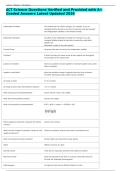
ACT Science Questions Verified and Provided with A+
Graded Answers Latest Updated 2026


Independent Variable The variable that the scientist changes. (For example, if you are
changing fertilizer brands to see which causes the most plant growth,
the independent variable is the fertilizer brand.)


Dependent Variable the effect of the independent variable (For example, if you are
changing fertilizer brands to see which causes the most plant
growth, the
dependent variable is the plant growth)

Control Group the group that does not receive the independent variable.


Constant A factor that stays the same across all test subjects and throughout
the duration of the experiment


positive correlation when two variables increase together or decrease together (also called
direct variation)


negative correlation when two variables change in opposite directions (one increases,
the other decreases) (also called inverse variation)


pH range of acids 0-7 (7 is neutral)


pH range of bases (also called alkaline solutions) 7-14 (7 is neutral)


What reactants go into photosynthesis? Carbon dioxide, water, and sunlight


What does photosynthesis produce? glucose and oxygen


What is the equation for photosynthesis? 6CO2 + 6H20 + sunlight --> C6H12O6 + 6O2


What subatomic particles comprise the atomic protons and neutrons
nucleus?


What are the charges of protons, neutrons, and Protons are positive, neutrons are neutral, and electrons are
negative electrons?


What is the general principle of gravity? Smaller objects are attracted to larger objects


Allele different versions of a gene


Dominant traits Traits that are expressed whenever their alleles are present


Recessive traits traits that typically do not show in a person unless both genes for
the trait are inherited (homozygous)


Heterozygous An organism that has two different alleles for a trait

, Homozygous An organism that has two identical alleles for a trait


Genotype An organism's genetic makeup, or allele combinations.


Phenotype The physical characteristics of an organism (the physical result of
the genotype. for example, brown hair)


Trait A physical characteristic


How many millimeters are in a meter? 1000 millimeters


Amoeba a unicellular organism with a nucleus


Law of Conservation of Mass Matter is neither created nor destroyed


kinetic energy the energy an object has due to its motion


potential energy stored energy


catalyst substance that speeds up the rate of a chemical reaction


Proton Positively charged particle in the nucleus of an atom


Neutron A small particle in the nucleus of the atom, with no electrical charge


Electron negatively charged particle; located outside the atomic nucleus


Products The elements or compounds produced by a chemical reaction.


Reactants A starting material in a chemical reaction


Gametes reproductive cells (sperm and egg)


Order of planets Sun, Mercury, Venus, Earth, Mars, Jupiter, Saturn, Uranus, Neptune


limiting reactant (reagent) any reactant that is used up first in a chemical reaction; it determines
the amount of product that can be formed in the reaction


Solubility the ability of one substance to dissolve in another at a
given temperature and pressure


Genus group of closely related species; the first part of the scientific name
in binomial nomenclature


Species A group of similar organisms that can breed and produce fertile
offspring; the second part of the scientific name in
binomial
nomenclature

chemical reactivity Tendency of a substance to engage in chemical reactions.


cellular respiration Process that releases energy by breaking down glucose and other food
molecules in the presence of oxygen


erosion and weathering Processes by which rock, sand, and soil are broken down and carried
away

Información del documento

Subido en
6 de septiembre de 2026
Número de páginas
7
Escrito en
2026/2027
Tipo
Examen
Contiene
Preguntas y respuestas
$16.29

¿Documento equivocado? Cámbialo gratis Dentro de los 14 días posteriores a la compra y antes de descargarlo, puedes elegir otro documento. Puedes gastar el importe de nuevo.
Escrito por estudiantes que aprobaron
Inmediatamente disponible después del pago
Leer en línea o como PDF

Seller avatar
Los indicadores de reputación están sujetos a la cantidad de artículos vendidos por una tarifa y las reseñas que ha recibido por esos documentos. Hay tres niveles: Bronce, Plata y Oro. Cuanto mayor reputación, más podrás confiar en la calidad del trabajo del vendedor.
Vendido
449
Seguidores
310
Artículos
8994
Última venta
1 hora hace


Por qué los estudiantes eligen Stuvia

Creado por compañeros estudiantes, verificado por reseñas

Calidad en la que puedes confiar: escrito por estudiantes que aprobaron y evaluado por otros que han usado estos resúmenes.

¿No estás satisfecho? Elige otro documento

¡No te preocupes! Puedes elegir directamente otro documento que se ajuste mejor a lo que buscas.

Paga como quieras, empieza a estudiar al instante

Sin suscripción, sin compromisos. Paga como estés acostumbrado con tarjeta de crédito y descarga tu documento PDF inmediatamente.

Student with book image

“Comprado, descargado y aprobado. Así de fácil puede ser.”

Alisha Student

Preguntas frecuentes
