
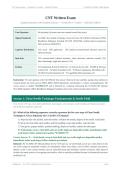
CNT Written Exam — Verified & A+ Graded — 2026/2027 Edition CCAOM / NCCAOM / OSHA Aligned
CNT Written Exam
Updated Questions with Complete Answers — Verified & A+ Graded — 2026/2027 Edition
Total Questions 60 (including 10 pretest items not counted toward final score)
Aligned Standards CCAOM Clean Needle Technique Course & Exam; NCCAOM Certification; OSHA
Bloodborne Pathogens Standard (29 CFR 1910.1030); evidence-based acupuncture
safety protocols (2026/2027)
Cognitive Distribution 25% recall · 50% application · 25% analysis (scenario-based infection control &
safety decisions)
Item Style 75% scenario-based (clinical situations, safety decisions, infection control); 25%
direct knowledge; single best answer (A–D)
Sections S1 Fundamentals & Sterile Field (12) · S2 Adverse Events (10) · S3 BBP & Infection
Control (10) · S4 Safety Procedures (10) · S5 Moxa/Cupping/Gua Sha/Adjunct (8) ·
S6 Office/Travel/Community (5) · S7 Legal/Ethical/Documentation (5)
Instructions: For each question, select the SINGLE best answer. Read each stem carefully, paying close attention to
scenario details, key terms such as FIRST, BEST, MOST appropriate, and absolute vs. relative contraindications. The
correct answer is marked *[CORRECT]* and is followed by a rationale referencing the CCAOM CNT Manual,
NCCAOM standards, OSHA Bloodborne Pathogens Standard, and current evidence-based safety literature.
Section 1: Clean Needle Technique Fundamentals & Sterile Field
Tests the five CNT steps, clean-field establishment, hand hygiene, skin antisepsis, needle handling, sterilization principles,
and disinfectant regulatory approvals.
Q1: Which of the following sequences correctly represents the five core steps of Clean Needle
Technique (CNT) as defined by the CCAOM CNT Manual?
A. Wipe the skin with alcohol, insert the needle, withdraw the needle, dispose of the needle, wash hands
B. Set up the clean field, open needles, perform needling, recap used needles, wipe the table
C. Don gloves, prepare needles, perform needling, dispose of needles, sanitize the table paper
D. Wash hands, set up a clean field, only use sterile single-use disposable needles, immediately isolate
used sharps, follow standard precautions *[CORRECT]*
Correct Answer: D — Wash hands, set up a clean field, only use sterile single-use disposable needles,
immediately isolate used sharps, follow standard precautions
Rationale: The CCAOM CNT Manual defines the five CNT steps as: (1) wash hands, (2) set up a clean field, (3) only
use sterile single-use disposable needles, (4) immediately isolate used sharps, and (5) follow standard precautions.
Options A and C omit critical elements such as clean-field setup and immediate isolation of sharps, while option B
includes the unsafe practice of recapping used needles, which is explicitly prohibited because it dramatically increases
needlestick risk.
Confidential — For CNT Certification Exam Preparation Page 1
,CNT Written Exam — Verified & A+ Graded — 2026/2027 Edition CCAOM / NCCAOM / OSHA Aligned
Q2: A practitioner is preparing to needle a patient in a treatment room with a counter, a rolling tray,
and a treatment table. Which arrangement best demonstrates the proper establishment of a clean
field as required by CNT standards?
A. Placing opened needle packs, an alcohol prep pad, and cotton balls directly on the uncovered counter
where charts and pens are also kept
B. Spreading a single disposable clean field (or clean paper towel) on a freshly wiped surface, placing
only sterile supplies on it, and using it for only one patient at a time *[CORRECT]*
C. Using the same fabric cloth drape used for the previous patient, since the patient was not bleeding
D. Storing used needles temporarily on the clean field until the treatment session is complete, then moving
them to a sharps container
Correct Answer: B — Spreading a single disposable clean field (or clean paper towel) on a freshly wiped
surface, placing only sterile supplies on it, and using it for only one patient at a time
Rationale: A clean field is an area established with a clean barrier (such as a disposable clean field or paper towel) on
a disinfected surface, holding only sterile supplies, and used for only ONE patient at a time. Option A contaminates the
field with nonsterile items, option C reuses linens between patients (a violation of CNT standards), and option D
contaminates the clean field with used sharps, which must be immediately isolated in an approved sharps container.
Q3: A practitioner arrives at the clinic with visibly clean hands and plans to perform routine
acupuncture. According to CNT and CDC hand-hygiene guidance, which action is most appropriate
immediately before needle insertion?
A. Skipping handwashing because the hands appear clean and no blood is anticipated
B. Applying an alcohol-based hand sanitizer and immediately touching the patient's skin
C. Washing hands once at the start of the shift and relying on gloves for each patient thereafter
D. Washing hands with soap and water (or using an alcohol-based sanitizer if hands are not visibly
soiled) immediately before needle insertion, then handling only sterile needles *[CORRECT]*
Correct Answer: D — Washing hands with soap and water (or using an alcohol-based sanitizer if hands
are not visibly soiled) immediately before needle insertion, then handling only sterile needles
Rationale: Hand hygiene immediately before needle insertion is a critical CNT step. If hands are not visibly soiled, an
alcohol-based sanitizer is acceptable; if visibly soiled, soap and water is required. Option A violates the mandatory
hand-hygiene step, option B omits the critical 'dry hands' moment that allows microbial transfer to the patient, and
option C fails to perform patient-specific hand hygiene, which is required for every patient encounter per CCAOM
standards.
Confidential — For CNT Certification Exam Preparation Page 2
, CNT Written Exam — Verified & A+ Graded — 2026/2027 Edition CCAOM / NCCAOM / OSHA Aligned
Q4: Which antiseptic is considered the standard, appropriate skin preparation for routine
acupuncture needle insertion according to the CCAOM CNT Manual?
A. 70% isopropyl alcohol using a single-use alcohol prep pad, wiped once and allowed to air dry
*[CORRECT]*
B. Povidone-iodine (Betadine) applied in a wide circular motion
C. Hydrogen peroxide applied liberally to the point and surrounding skin
D. Chlorhexidine gluconate scrub for every acupuncture point
Correct Answer: A — 70% isopropyl alcohol using a single-use alcohol prep pad, wiped once and allowed
to air dry
Rationale: The CNT Manual identifies 70% alcohol (typically isopropyl alcohol) applied with a single-use prep pad as
the standard antiseptic for routine acupuncture needling. Povidone-iodine and hydrogen peroxide are not the
CNT-recommended routine skin antiseptics, and chlorhexidine is specifically NOT the best product for routine
needling because of skin irritation concerns and lack of demonstrated superiority over alcohol for this purpose.
Q5: A student asks why chlorhexidine is not recommended as the routine antiseptic for acupuncture
point preparation. Which explanation is most accurate?
A. Chlorhexidine is NOT the best product for routine needling; 70% alcohol is the CNT standard,
and chlorhexidine is reserved for specific clinical situations where its use is medically indicated
*[CORRECT]*
B. Chlorhexidine is too expensive and is reserved exclusively for surgical procedures
C. Chlorhexidine is contraindicated in all patients over the age of 65
D. Chlorhexidine has been banned by the FDA for use in any healthcare setting
Correct Answer: A — Chlorhexidine is NOT the best product for routine needling; 70% alcohol is the
CNT standard, and chlorhexidine is reserved for specific clinical situations where its use is medically
indicated
Rationale: The CCAOM CNT Manual explicitly states that chlorhexidine is NOT the best product for routine
acupuncture needling. Alcohol (70%) is the recommended antiseptic. Chlorhexidine is not banned and may be
appropriate in specific medical contexts, but routine use for acupuncture points is not supported by CNT standards,
and excessive use increases risk of skin irritation and antimicrobial resistance.
Confidential — For CNT Certification Exam Preparation Page 3
CNT Written Exam
Updated Questions with Complete Answers — Verified & A+ Graded — 2026/2027 Edition
Total Questions 60 (including 10 pretest items not counted toward final score)
Aligned Standards CCAOM Clean Needle Technique Course & Exam; NCCAOM Certification; OSHA
Bloodborne Pathogens Standard (29 CFR 1910.1030); evidence-based acupuncture
safety protocols (2026/2027)
Cognitive Distribution 25% recall · 50% application · 25% analysis (scenario-based infection control &
safety decisions)
Item Style 75% scenario-based (clinical situations, safety decisions, infection control); 25%
direct knowledge; single best answer (A–D)
Sections S1 Fundamentals & Sterile Field (12) · S2 Adverse Events (10) · S3 BBP & Infection
Control (10) · S4 Safety Procedures (10) · S5 Moxa/Cupping/Gua Sha/Adjunct (8) ·
S6 Office/Travel/Community (5) · S7 Legal/Ethical/Documentation (5)
Instructions: For each question, select the SINGLE best answer. Read each stem carefully, paying close attention to
scenario details, key terms such as FIRST, BEST, MOST appropriate, and absolute vs. relative contraindications. The
correct answer is marked *[CORRECT]* and is followed by a rationale referencing the CCAOM CNT Manual,
NCCAOM standards, OSHA Bloodborne Pathogens Standard, and current evidence-based safety literature.
Section 1: Clean Needle Technique Fundamentals & Sterile Field
Tests the five CNT steps, clean-field establishment, hand hygiene, skin antisepsis, needle handling, sterilization principles,
and disinfectant regulatory approvals.
Q1: Which of the following sequences correctly represents the five core steps of Clean Needle
Technique (CNT) as defined by the CCAOM CNT Manual?
A. Wipe the skin with alcohol, insert the needle, withdraw the needle, dispose of the needle, wash hands
B. Set up the clean field, open needles, perform needling, recap used needles, wipe the table
C. Don gloves, prepare needles, perform needling, dispose of needles, sanitize the table paper
D. Wash hands, set up a clean field, only use sterile single-use disposable needles, immediately isolate
used sharps, follow standard precautions *[CORRECT]*
Correct Answer: D — Wash hands, set up a clean field, only use sterile single-use disposable needles,
immediately isolate used sharps, follow standard precautions
Rationale: The CCAOM CNT Manual defines the five CNT steps as: (1) wash hands, (2) set up a clean field, (3) only
use sterile single-use disposable needles, (4) immediately isolate used sharps, and (5) follow standard precautions.
Options A and C omit critical elements such as clean-field setup and immediate isolation of sharps, while option B
includes the unsafe practice of recapping used needles, which is explicitly prohibited because it dramatically increases
needlestick risk.
Confidential — For CNT Certification Exam Preparation Page 1
,CNT Written Exam — Verified & A+ Graded — 2026/2027 Edition CCAOM / NCCAOM / OSHA Aligned
Q2: A practitioner is preparing to needle a patient in a treatment room with a counter, a rolling tray,
and a treatment table. Which arrangement best demonstrates the proper establishment of a clean
field as required by CNT standards?
A. Placing opened needle packs, an alcohol prep pad, and cotton balls directly on the uncovered counter
where charts and pens are also kept
B. Spreading a single disposable clean field (or clean paper towel) on a freshly wiped surface, placing
only sterile supplies on it, and using it for only one patient at a time *[CORRECT]*
C. Using the same fabric cloth drape used for the previous patient, since the patient was not bleeding
D. Storing used needles temporarily on the clean field until the treatment session is complete, then moving
them to a sharps container
Correct Answer: B — Spreading a single disposable clean field (or clean paper towel) on a freshly wiped
surface, placing only sterile supplies on it, and using it for only one patient at a time
Rationale: A clean field is an area established with a clean barrier (such as a disposable clean field or paper towel) on
a disinfected surface, holding only sterile supplies, and used for only ONE patient at a time. Option A contaminates the
field with nonsterile items, option C reuses linens between patients (a violation of CNT standards), and option D
contaminates the clean field with used sharps, which must be immediately isolated in an approved sharps container.
Q3: A practitioner arrives at the clinic with visibly clean hands and plans to perform routine
acupuncture. According to CNT and CDC hand-hygiene guidance, which action is most appropriate
immediately before needle insertion?
A. Skipping handwashing because the hands appear clean and no blood is anticipated
B. Applying an alcohol-based hand sanitizer and immediately touching the patient's skin
C. Washing hands once at the start of the shift and relying on gloves for each patient thereafter
D. Washing hands with soap and water (or using an alcohol-based sanitizer if hands are not visibly
soiled) immediately before needle insertion, then handling only sterile needles *[CORRECT]*
Correct Answer: D — Washing hands with soap and water (or using an alcohol-based sanitizer if hands
are not visibly soiled) immediately before needle insertion, then handling only sterile needles
Rationale: Hand hygiene immediately before needle insertion is a critical CNT step. If hands are not visibly soiled, an
alcohol-based sanitizer is acceptable; if visibly soiled, soap and water is required. Option A violates the mandatory
hand-hygiene step, option B omits the critical 'dry hands' moment that allows microbial transfer to the patient, and
option C fails to perform patient-specific hand hygiene, which is required for every patient encounter per CCAOM
standards.
Confidential — For CNT Certification Exam Preparation Page 2
, CNT Written Exam — Verified & A+ Graded — 2026/2027 Edition CCAOM / NCCAOM / OSHA Aligned
Q4: Which antiseptic is considered the standard, appropriate skin preparation for routine
acupuncture needle insertion according to the CCAOM CNT Manual?
A. 70% isopropyl alcohol using a single-use alcohol prep pad, wiped once and allowed to air dry
*[CORRECT]*
B. Povidone-iodine (Betadine) applied in a wide circular motion
C. Hydrogen peroxide applied liberally to the point and surrounding skin
D. Chlorhexidine gluconate scrub for every acupuncture point
Correct Answer: A — 70% isopropyl alcohol using a single-use alcohol prep pad, wiped once and allowed
to air dry
Rationale: The CNT Manual identifies 70% alcohol (typically isopropyl alcohol) applied with a single-use prep pad as
the standard antiseptic for routine acupuncture needling. Povidone-iodine and hydrogen peroxide are not the
CNT-recommended routine skin antiseptics, and chlorhexidine is specifically NOT the best product for routine
needling because of skin irritation concerns and lack of demonstrated superiority over alcohol for this purpose.
Q5: A student asks why chlorhexidine is not recommended as the routine antiseptic for acupuncture
point preparation. Which explanation is most accurate?
A. Chlorhexidine is NOT the best product for routine needling; 70% alcohol is the CNT standard,
and chlorhexidine is reserved for specific clinical situations where its use is medically indicated
*[CORRECT]*
B. Chlorhexidine is too expensive and is reserved exclusively for surgical procedures
C. Chlorhexidine is contraindicated in all patients over the age of 65
D. Chlorhexidine has been banned by the FDA for use in any healthcare setting
Correct Answer: A — Chlorhexidine is NOT the best product for routine needling; 70% alcohol is the
CNT standard, and chlorhexidine is reserved for specific clinical situations where its use is medically
indicated
Rationale: The CCAOM CNT Manual explicitly states that chlorhexidine is NOT the best product for routine
acupuncture needling. Alcohol (70%) is the recommended antiseptic. Chlorhexidine is not banned and may be
appropriate in specific medical contexts, but routine use for acupuncture points is not supported by CNT standards,
and excessive use increases risk of skin irritation and antimicrobial resistance.
Confidential — For CNT Certification Exam Preparation Page 3

