
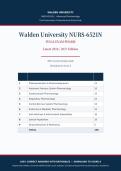
WALDEN UNIVERSITY
NURS-6521N | Advanced Pharmacology
Final Examination Comprehensive Study Guide
Walden University NURS-6521N
FINAL EXAM PHARM
Latest Edition
100% Correct Study Guide
Download to Score A
Sectio
Topic #Q
n
1 Pharmacokinetics & Pharmacodynamics 15
2 Autonomic Nervous System Pharmacology 10
3 Cardiovascular Pharmacology 15
4 Respiratory Pharmacology 10
5 Central Nervous System Pharmacology 15
6 Endocrine & Metabolic Pharmacology 10
7 Anti-Infectives & Antimicrobial Stewardship 10
8 Special Populations 10
9 Drug Interactions & Monitoring 5
TOTAL 100
100% CORRECT ANSWERS WITH RATIONALES | DOWNLOAD TO SCORE A
Aligned with Walden University NURS-6521N Course Syllabus & Evidence-Based Pharmacotherapeutics Guidelines
, Cognitive Level Distribution: 20% Recall | 50% Application | 30% Analysis
Question Style: 75% Scenario-Based | 25% Direct Knowledge
Question Format: 4-option MCQ (A-D), One Best Answer
Special Inclusions: 15 Clinical Scenarios | 15 Adverse Effects/Interactions/Monitoring | 10
Calculation-Based Items
Each Item Includes: Stem, 4 Options, Correct Answer Marker, Evidence-Based Rationale
This study guide is designed for graduate nursing students preparing for the Walden University
NURS-6521N Advanced Pharmacology Final Examination. All answers and rationales reflect
current evidence-based pharmacotherapeutics guidelines.
,WALDEN UNIVERSITY | NURS-6521N FINAL EXAM STUDY GUIDE Edition
Section 1: Pharmacokinetics & Pharmacodynamics
15 Questions | Aligned with Walden University NURS-6521N curriculum
ADME principles, bioavailability, CYP450 system, receptor pharmacology, dose-response,
half-life, steady state, loading and maintenance dose calculations.
Q1. A patient receives a drug via the intravenous (IV) route. Which pharmacokinetic phase
is completely bypassed by this route of administration?
A. Distribution
B. Metabolism
C. Absorption [CORRECT]
D. Excretion
Correct Answer: C
Rationale:
The intravenous (IV) route delivers drug directly into systemic circulation, completely bypassing the
absorption phase. Distribution, metabolism, and excretion still occur normally. IV administration
yields 100% bioavailability, which serves as the reference standard for calculating oral
bioavailability of other formulations.
Q2. Which of the following metabolic reactions is classified as a Phase II conjugation
reaction?
A. Oxidation via CYP3A4
B. Reduction of nitro groups
C. Glucuronidation [CORRECT]
D. Hydrolysis by esterases
Correct Answer: C
Rationale:
Phase II reactions are conjugation reactions that add a polar moiety to the drug or its Phase I
metabolite, including glucuronidation, sulfation, acetylation, glutathione conjugation, and amino
acid conjugation. Oxidation, reduction, and hydrolysis are Phase I reactions that modify the drug
through exposure of functional groups or addition/removal of small atoms.
Q3. A 68-year-old patient taking warfarin 5 mg daily for atrial fibrillation has an INR of 8.5
with no bleeding. The patient recently started cimetidine for gastroesophageal reflux. What
is the mechanism of this drug interaction?
Aligned with Walden NURS-6521N curriculum and evidence-based pharmacotherapeutics guidelines. Page 3
, WALDEN UNIVERSITY | NURS-6521N FINAL EXAM STUDY GUIDE Edition
A. Cimetidine displaces warfarin from plasma protein binding sites
B. Cimetidine inhibits CYP2C9 metabolism of warfarin [CORRECT]
C. Cimetidine enhances warfarin absorption in the GI tract
D. Cimetidine induces CYP3A4, increasing warfarin effect
Correct Answer: B
Rationale:
Cimetidine is a potent nonselective inhibitor of CYP1A2, CYP2C9, and CYP3A4. The S-enantiomer of
warfarin (the more potent enantiomer) is metabolized by CYP2C9; inhibition leads to elevated INR.
The interaction is metabolic, not protein-binding displacement (a common misconception;
displacement effects are transient and clinically minor). Options C and D describe mechanistically
incorrect directions.
Q4. A drug with a half-life of 8 hours is administered once daily. Approximately how long
will it take to reach steady-state plasma concentrations?
A. 8 hours
B. 24 hours
C. 40 hours [CORRECT]
D. 80 hours
Correct Answer: C
Rationale:
Steady state is reached in approximately 4 to 5 half-lives regardless of dosing interval. With a t1/2 of
8 hours: 5 x 8 = 40 hours. Dosing frequency affects peak-to-trough fluctuation but does not change
the time to reach steady state. About 94% of steady state is achieved at 4 half-lives and 97% at 5
half-lives.
Q5. A drug has a volume of distribution (Vd) of 50 L and an elimination rate constant (k) of
0.1 hr-1. Calculate the drug’s clearance (Cl).
A. 0.5 L/hr
B. 5 L/hr [CORRECT]
C. 50 L/hr
D. 500 L/hr
Correct Answer: B
Rationale:
Clearance is calculated as Cl = Vd x k = 50 L x 0.1 hr-1 = 5 L/hr. This fundamental pharmacokinetic
relationship describes the volume of plasma cleared of drug per unit time. Understanding this
relationship is essential for calculating maintenance doses and adjusting for renal or hepatic
impairment.
Aligned with Walden NURS-6521N curriculum and evidence-based pharmacotherapeutics guidelines. Page 4
NURS-6521N | Advanced Pharmacology
Final Examination Comprehensive Study Guide
Walden University NURS-6521N
FINAL EXAM PHARM
Latest Edition
100% Correct Study Guide
Download to Score A
Sectio
Topic #Q
n
1 Pharmacokinetics & Pharmacodynamics 15
2 Autonomic Nervous System Pharmacology 10
3 Cardiovascular Pharmacology 15
4 Respiratory Pharmacology 10
5 Central Nervous System Pharmacology 15
6 Endocrine & Metabolic Pharmacology 10
7 Anti-Infectives & Antimicrobial Stewardship 10
8 Special Populations 10
9 Drug Interactions & Monitoring 5
TOTAL 100
100% CORRECT ANSWERS WITH RATIONALES | DOWNLOAD TO SCORE A
Aligned with Walden University NURS-6521N Course Syllabus & Evidence-Based Pharmacotherapeutics Guidelines
, Cognitive Level Distribution: 20% Recall | 50% Application | 30% Analysis
Question Style: 75% Scenario-Based | 25% Direct Knowledge
Question Format: 4-option MCQ (A-D), One Best Answer
Special Inclusions: 15 Clinical Scenarios | 15 Adverse Effects/Interactions/Monitoring | 10
Calculation-Based Items
Each Item Includes: Stem, 4 Options, Correct Answer Marker, Evidence-Based Rationale
This study guide is designed for graduate nursing students preparing for the Walden University
NURS-6521N Advanced Pharmacology Final Examination. All answers and rationales reflect
current evidence-based pharmacotherapeutics guidelines.
,WALDEN UNIVERSITY | NURS-6521N FINAL EXAM STUDY GUIDE Edition
Section 1: Pharmacokinetics & Pharmacodynamics
15 Questions | Aligned with Walden University NURS-6521N curriculum
ADME principles, bioavailability, CYP450 system, receptor pharmacology, dose-response,
half-life, steady state, loading and maintenance dose calculations.
Q1. A patient receives a drug via the intravenous (IV) route. Which pharmacokinetic phase
is completely bypassed by this route of administration?
A. Distribution
B. Metabolism
C. Absorption [CORRECT]
D. Excretion
Correct Answer: C
Rationale:
The intravenous (IV) route delivers drug directly into systemic circulation, completely bypassing the
absorption phase. Distribution, metabolism, and excretion still occur normally. IV administration
yields 100% bioavailability, which serves as the reference standard for calculating oral
bioavailability of other formulations.
Q2. Which of the following metabolic reactions is classified as a Phase II conjugation
reaction?
A. Oxidation via CYP3A4
B. Reduction of nitro groups
C. Glucuronidation [CORRECT]
D. Hydrolysis by esterases
Correct Answer: C
Rationale:
Phase II reactions are conjugation reactions that add a polar moiety to the drug or its Phase I
metabolite, including glucuronidation, sulfation, acetylation, glutathione conjugation, and amino
acid conjugation. Oxidation, reduction, and hydrolysis are Phase I reactions that modify the drug
through exposure of functional groups or addition/removal of small atoms.
Q3. A 68-year-old patient taking warfarin 5 mg daily for atrial fibrillation has an INR of 8.5
with no bleeding. The patient recently started cimetidine for gastroesophageal reflux. What
is the mechanism of this drug interaction?
Aligned with Walden NURS-6521N curriculum and evidence-based pharmacotherapeutics guidelines. Page 3
, WALDEN UNIVERSITY | NURS-6521N FINAL EXAM STUDY GUIDE Edition
A. Cimetidine displaces warfarin from plasma protein binding sites
B. Cimetidine inhibits CYP2C9 metabolism of warfarin [CORRECT]
C. Cimetidine enhances warfarin absorption in the GI tract
D. Cimetidine induces CYP3A4, increasing warfarin effect
Correct Answer: B
Rationale:
Cimetidine is a potent nonselective inhibitor of CYP1A2, CYP2C9, and CYP3A4. The S-enantiomer of
warfarin (the more potent enantiomer) is metabolized by CYP2C9; inhibition leads to elevated INR.
The interaction is metabolic, not protein-binding displacement (a common misconception;
displacement effects are transient and clinically minor). Options C and D describe mechanistically
incorrect directions.
Q4. A drug with a half-life of 8 hours is administered once daily. Approximately how long
will it take to reach steady-state plasma concentrations?
A. 8 hours
B. 24 hours
C. 40 hours [CORRECT]
D. 80 hours
Correct Answer: C
Rationale:
Steady state is reached in approximately 4 to 5 half-lives regardless of dosing interval. With a t1/2 of
8 hours: 5 x 8 = 40 hours. Dosing frequency affects peak-to-trough fluctuation but does not change
the time to reach steady state. About 94% of steady state is achieved at 4 half-lives and 97% at 5
half-lives.
Q5. A drug has a volume of distribution (Vd) of 50 L and an elimination rate constant (k) of
0.1 hr-1. Calculate the drug’s clearance (Cl).
A. 0.5 L/hr
B. 5 L/hr [CORRECT]
C. 50 L/hr
D. 500 L/hr
Correct Answer: B
Rationale:
Clearance is calculated as Cl = Vd x k = 50 L x 0.1 hr-1 = 5 L/hr. This fundamental pharmacokinetic
relationship describes the volume of plasma cleared of drug per unit time. Understanding this
relationship is essential for calculating maintenance doses and adjusting for renal or hepatic
impairment.
Aligned with Walden NURS-6521N curriculum and evidence-based pharmacotherapeutics guidelines. Page 4

