
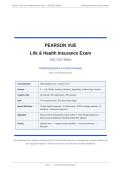
Pearson VUE Life & Health Insurance Exam — 2026/2027 Edition Verified Questions & Correct Answers
PEARSON VUE
Life & Health Insurance Exam
Edition
Verified Questions & Correct Answers
State Licensing Preparation
Total Questions 200 (multiple choice, 4 options A–D)
Sections 9 — Life, Health, Annuities, Medicare, Regulations, Underwriting, Taxation
Cognitive Mix 30% Recall | 50% Application | 20% Analysis
Style 75% Scenario-based | 25% Direct Knowledge
Special Inclusions 15 State-specific questions | 15 Replacement / §1035 exchange questions | 15
Suitability / best-interest questions
Alignment Pearson VUE Life & Health Content Outline + NAIC Model Regulations +
State Insurance Regulatory Standards (2026/2027 Edition)
Format Question stem → 4 options (correct marked) → Correct Answer key →
Rationale
For instructional use. Aligned with Pearson VUE Life & Health Insurance Licensing Exam Content Outlines and
state regulatory standards. Verify current rules with your state insurance department.
Page 1 | State Licensing Preparation
,Pearson VUE Life & Health Insurance Exam — 2026/2027 Edition Verified Questions & Correct Answers
TABLE OF CONTENTS
Section Topic Questions Count
1 Section 1: Life Insurance Basics & Policy Types Q1–Q30 30
2 Section 2: Life Insurance Provisions, Riders, & Options Q31–Q55 25
3 Section 3: Health Insurance Fundamentals & Policy Types Q56–Q85 30
4 Section 4: Health Insurance Provisions & Benefits Q86–Q110 25
5 Section 5: Annuities & Retirement Planning Q111–Q130 20
Section 6: Social Security, Medicare, & Government
6 Q131–Q145 15
Programs
7 Section 7: Insurance Law, Regulations, & Ethics Q146–Q170 25
Section 8: Underwriting, Risk Classification, & Policy
8 Q171–Q185 15
Issuance
9 Section 9: Taxation of Insurance Products Q186–Q200 15
Total — Q1–Q200 200
Cognitive Mix 30% Recall | 50% Application | 20% Analysis
Style 75% Scenario-based | 25% Direct Knowledge
Special Inclusions 15 State-specific | 15 Replacement / §1035 Exchange | 15 Suitability / Best
Interest
Question Format 4 options (A–D), ONE correct answer marked with *[CORRECT]*; Correct
Answer key + Rationale follows each question.
Page 2 | State Licensing Preparation
,Pearson VUE Life & Health Insurance Exam — 2026/2027 Edition Verified Questions & Correct Answers
SECTION 1
Section 1: Life Insurance Basics & Policy Types
Questions Q1–Q30 | 30 questions | Aligned with Pearson VUE Content Outline
Q1: Which of the following best describes the defining characteristic of annually renewable term (ART)
life insurance?
A. The death benefit decreases each year while premiums remain level.
B. The coverage renews each year without evidence of insurability, but the premium increases with the
insured's age. *[CORRECT]*
C. The policy accumulates cash value that can be borrowed against after the third year.
D. The premium is level for the entire term period and the death benefit varies with market performance.
Correct Answer: B
Rationale: Annually renewable term (ART) provides a level death benefit with premiums that increase each year as
the insured ages, while allowing renewal without proof of insurability. Pearson VUE content outline classifies this
under Term Life characteristics. Option A describes decreasing term, Option C describes whole life (cash value
accumulation), and Option D describes level premium term or variable life, none of which describe ART.
Q2: Marcus, age 32, recently married, wants to purchase life insurance to cover a 20-year mortgage of
$350,000. He is concerned about affordability now but expects income growth. Which policy type is MOST
suitable for his need?
A. Whole life insurance with a $350,000 death benefit, because cash value can offset future mortgage payments.
B. Decreasing term insurance with a 20-year term aligned to the mortgage amortization schedule.
*[CORRECT]*
C. Single premium whole life, because it eliminates future premium obligations.
D. Annually renewable term with a $350,000 level death benefit to age 95.
Correct Answer: B
Rationale: Decreasing term is designed so the death benefit declines along with an amortizing mortgage balance,
providing cost-effective coverage matched to the actual exposure. Pearson VUE outlines tie this to 'Term Life -
Decreasing Term' under policy type application. Option A is unnecessarily expensive for a temporary need, Option C
requires a large lump sum most 32-year-olds cannot fund, and Option D exposes Marcus to escalating premiums far
beyond the mortgage term.
Page 3 | State Licensing Preparation
, Pearson VUE Life & Health Insurance Exam — 2026/2027 Edition Verified Questions & Correct Answers
Q3: Which statement correctly describes the premium structure of a traditional whole life insurance
policy?
A. Premiums are flexible and may be increased, decreased, or skipped once the policy has cash value.
B. Premiums are level throughout the insured's lifetime and are calculated using a conservative mortality and
interest assumption. *[CORRECT]*
C. Premiums are tied to an external equity index subject to annual caps and participation rates.
D. Premiums are paid only until the policy's cash value equals the death benefit, typically within 7-10 years.
Correct Answer: B
Rationale: Traditional whole life charges a level premium for the insured's whole life based on conservative
assumptions; excess premium in early years builds cash value that subsidizes the higher mortality cost in later years.
Pearson VUE Life Insurance Basics content outline identifies this as the hallmark of 'Whole Life - Premium Structure.'
Options A, C, and D describe universal life, indexed universal life, and a modified endowment contract respectively.
Q4: In a traditional whole life policy, how does cash value accumulate relative to the death benefit over the
life of the contract?
A. Cash value remains constant while the death benefit increases with declared dividends.
B. Cash value grows tax-deferred and approaches the face amount at age 100, at which point the cash value
equals the death benefit. *[CORRECT]*
C. Cash value fluctuates daily based on the performance of a separate account invested in equities.
D. Cash value never accumulates; the policy only pays a death benefit if the insured dies before age 65.
Correct Answer: B
Rationale: Under the endowment-at-100 principle that governs traditional whole life, cash value grows on a schedule
defined in the policy contract and equals the face amount at age 100, which is why the insurer pays the face amount
whether the insured dies before 100 or survives to 100. Pearson VUE content outline lists this under 'Whole Life -
Cash Value Accumulation.' Option A describes a participating policy with dividend behavior but is incomplete; Option
C describes variable life; Option D is incorrect.
Q5: A young family with two children, age 28 and 30, has $80,000 annual household income and $250,000
in debt. They can afford approximately $50 per month for life insurance. Which of the following best
balances their need for substantial death benefit with affordability?
A. Whole life with a $500,000 death benefit, using policy loans to cover premium shortfalls.
B. A 20-year level term policy with a $500,000 death benefit on each spouse, supplemented by smaller whole
life policies later as income grows. *[CORRECT]*
C. A single premium variable life policy on the higher-earning spouse only.
D. Survivorship life on both spouses with a $1,000,000 death benefit payable at second death.
Correct Answer: B
Rationale: Level term offers the highest death benefit per premium dollar for a defined period that matches the
family's peak financial exposure (children's dependency years and debt payoff). Pearson VUE suitability standards
emphasize matching product to need, budget, and time horizon. Whole life at $500,000 would cost far more than
$50/month, single premium is unaffordable on this income, and survivorship life pays only at second death, leaving the
surviving spouse unprotected.
Page 4 | State Licensing Preparation
PEARSON VUE
Life & Health Insurance Exam
Edition
Verified Questions & Correct Answers
State Licensing Preparation
Total Questions 200 (multiple choice, 4 options A–D)
Sections 9 — Life, Health, Annuities, Medicare, Regulations, Underwriting, Taxation
Cognitive Mix 30% Recall | 50% Application | 20% Analysis
Style 75% Scenario-based | 25% Direct Knowledge
Special Inclusions 15 State-specific questions | 15 Replacement / §1035 exchange questions | 15
Suitability / best-interest questions
Alignment Pearson VUE Life & Health Content Outline + NAIC Model Regulations +
State Insurance Regulatory Standards (2026/2027 Edition)
Format Question stem → 4 options (correct marked) → Correct Answer key →
Rationale
For instructional use. Aligned with Pearson VUE Life & Health Insurance Licensing Exam Content Outlines and
state regulatory standards. Verify current rules with your state insurance department.
Page 1 | State Licensing Preparation
,Pearson VUE Life & Health Insurance Exam — 2026/2027 Edition Verified Questions & Correct Answers
TABLE OF CONTENTS
Section Topic Questions Count
1 Section 1: Life Insurance Basics & Policy Types Q1–Q30 30
2 Section 2: Life Insurance Provisions, Riders, & Options Q31–Q55 25
3 Section 3: Health Insurance Fundamentals & Policy Types Q56–Q85 30
4 Section 4: Health Insurance Provisions & Benefits Q86–Q110 25
5 Section 5: Annuities & Retirement Planning Q111–Q130 20
Section 6: Social Security, Medicare, & Government
6 Q131–Q145 15
Programs
7 Section 7: Insurance Law, Regulations, & Ethics Q146–Q170 25
Section 8: Underwriting, Risk Classification, & Policy
8 Q171–Q185 15
Issuance
9 Section 9: Taxation of Insurance Products Q186–Q200 15
Total — Q1–Q200 200
Cognitive Mix 30% Recall | 50% Application | 20% Analysis
Style 75% Scenario-based | 25% Direct Knowledge
Special Inclusions 15 State-specific | 15 Replacement / §1035 Exchange | 15 Suitability / Best
Interest
Question Format 4 options (A–D), ONE correct answer marked with *[CORRECT]*; Correct
Answer key + Rationale follows each question.
Page 2 | State Licensing Preparation
,Pearson VUE Life & Health Insurance Exam — 2026/2027 Edition Verified Questions & Correct Answers
SECTION 1
Section 1: Life Insurance Basics & Policy Types
Questions Q1–Q30 | 30 questions | Aligned with Pearson VUE Content Outline
Q1: Which of the following best describes the defining characteristic of annually renewable term (ART)
life insurance?
A. The death benefit decreases each year while premiums remain level.
B. The coverage renews each year without evidence of insurability, but the premium increases with the
insured's age. *[CORRECT]*
C. The policy accumulates cash value that can be borrowed against after the third year.
D. The premium is level for the entire term period and the death benefit varies with market performance.
Correct Answer: B
Rationale: Annually renewable term (ART) provides a level death benefit with premiums that increase each year as
the insured ages, while allowing renewal without proof of insurability. Pearson VUE content outline classifies this
under Term Life characteristics. Option A describes decreasing term, Option C describes whole life (cash value
accumulation), and Option D describes level premium term or variable life, none of which describe ART.
Q2: Marcus, age 32, recently married, wants to purchase life insurance to cover a 20-year mortgage of
$350,000. He is concerned about affordability now but expects income growth. Which policy type is MOST
suitable for his need?
A. Whole life insurance with a $350,000 death benefit, because cash value can offset future mortgage payments.
B. Decreasing term insurance with a 20-year term aligned to the mortgage amortization schedule.
*[CORRECT]*
C. Single premium whole life, because it eliminates future premium obligations.
D. Annually renewable term with a $350,000 level death benefit to age 95.
Correct Answer: B
Rationale: Decreasing term is designed so the death benefit declines along with an amortizing mortgage balance,
providing cost-effective coverage matched to the actual exposure. Pearson VUE outlines tie this to 'Term Life -
Decreasing Term' under policy type application. Option A is unnecessarily expensive for a temporary need, Option C
requires a large lump sum most 32-year-olds cannot fund, and Option D exposes Marcus to escalating premiums far
beyond the mortgage term.
Page 3 | State Licensing Preparation
, Pearson VUE Life & Health Insurance Exam — 2026/2027 Edition Verified Questions & Correct Answers
Q3: Which statement correctly describes the premium structure of a traditional whole life insurance
policy?
A. Premiums are flexible and may be increased, decreased, or skipped once the policy has cash value.
B. Premiums are level throughout the insured's lifetime and are calculated using a conservative mortality and
interest assumption. *[CORRECT]*
C. Premiums are tied to an external equity index subject to annual caps and participation rates.
D. Premiums are paid only until the policy's cash value equals the death benefit, typically within 7-10 years.
Correct Answer: B
Rationale: Traditional whole life charges a level premium for the insured's whole life based on conservative
assumptions; excess premium in early years builds cash value that subsidizes the higher mortality cost in later years.
Pearson VUE Life Insurance Basics content outline identifies this as the hallmark of 'Whole Life - Premium Structure.'
Options A, C, and D describe universal life, indexed universal life, and a modified endowment contract respectively.
Q4: In a traditional whole life policy, how does cash value accumulate relative to the death benefit over the
life of the contract?
A. Cash value remains constant while the death benefit increases with declared dividends.
B. Cash value grows tax-deferred and approaches the face amount at age 100, at which point the cash value
equals the death benefit. *[CORRECT]*
C. Cash value fluctuates daily based on the performance of a separate account invested in equities.
D. Cash value never accumulates; the policy only pays a death benefit if the insured dies before age 65.
Correct Answer: B
Rationale: Under the endowment-at-100 principle that governs traditional whole life, cash value grows on a schedule
defined in the policy contract and equals the face amount at age 100, which is why the insurer pays the face amount
whether the insured dies before 100 or survives to 100. Pearson VUE content outline lists this under 'Whole Life -
Cash Value Accumulation.' Option A describes a participating policy with dividend behavior but is incomplete; Option
C describes variable life; Option D is incorrect.
Q5: A young family with two children, age 28 and 30, has $80,000 annual household income and $250,000
in debt. They can afford approximately $50 per month for life insurance. Which of the following best
balances their need for substantial death benefit with affordability?
A. Whole life with a $500,000 death benefit, using policy loans to cover premium shortfalls.
B. A 20-year level term policy with a $500,000 death benefit on each spouse, supplemented by smaller whole
life policies later as income grows. *[CORRECT]*
C. A single premium variable life policy on the higher-earning spouse only.
D. Survivorship life on both spouses with a $1,000,000 death benefit payable at second death.
Correct Answer: B
Rationale: Level term offers the highest death benefit per premium dollar for a defined period that matches the
family's peak financial exposure (children's dependency years and debt payoff). Pearson VUE suitability standards
emphasize matching product to need, budget, and time horizon. Whole life at $500,000 would cost far more than
$50/month, single premium is unaffordable on this income, and survivorship life pays only at second death, leaving the
surviving spouse unprotected.
Page 4 | State Licensing Preparation

