
• ¿Documento equivocado? Cámbialo gratis
  • Escrito por estudiantes que aprobaron
  • Inmediatamente disponible después del pago
  • Leer en línea o como PDF
Vender
¿Dónde estudias?
Tu idioma
Document preview thumbnail
Vista previa 4 fuera de 251 páginas
Examen

Massachusetts Psychology Jurisprudence Exam Questions And Correct Verified Solutions Latest Update This Year – Just Released.pdf

Document preview thumbnail
Vista previa 4 fuera de 251 páginas

Tap on **AVAILABLE IN BUNDLE/PACKAGE DEAL** to unlock free bonus exams – save more while you get what you need. # Massachusetts Psychology Jurisprudence EXAM QUESTIONS AND CORRECT VERIFIED SOLUTIONS LATEST UPDATE THIS YEAR – JUST RELEASED.pdf Prepare for the **Massachusetts Psychology Jurisprudence Examination** with comprehensive, state-specific study material covering Massachusetts psychology statutes, Board regulations, licensing and registration requirements, professional ethics, confidentiality, patient records, mandatory reporting, professional conduct, continuing education, disciplinary procedures, and other legal requirements governing the practice of psychology in the Commonwealth. The Massachusetts Board of Registration of Psychologists regulates the professional practice of psychology through Massachusetts statutes and Board regulations. Current official materials identify **251 CMR 1.00** concerning ethical standards, professional conduct, and disciplinary procedures; **251 CMR 3.00** concerning registration of psychologists; and **251 CMR 4.00** concerning continuing education. ## Exam Coverage * Massachusetts psychology licensing and registration laws * Massachusetts General Laws governing psychologists * Board of Registration of Psychologists authority and responsibilities * 251 CMR 1.00 ethical standards and professional conduct * 251 CMR 3.00 registration requirements * 251 CMR 4.00 continuing education requirements * Initial psychologist registration requirements * Examination and application procedures * Registration renewal and maintenance * Professional scope of psychology practice * Ethical standards and professional responsibilities * Psychologist-patient confidentiality * Access to and release of psychological records * Patient rights and informed consent * Mandatory reporting requirements * Child abuse and neglect reporting * Elder abuse and protection requirements * Protection of disabled persons * Professional boundaries and dual relationships * Competence and appropriate professional practice * Advertising and representations of professional qualifications * Telepsychology and technology-related practice considerations * Continuing education and professional development * Complaints, investigations, and disciplinary proceedings * Unprofessional conduct and prohibited practices * License restrictions, suspension, and revocation * Massachusetts-specific professional-practice scenarios ## Detailed Study Coverage The material begins with the **Massachusetts legal framework governing psychologists**, helping candidates understand how Massachusetts General Laws and Board regulations establish the requirements for lawful professional practice. A major focus is **251 CMR 1.00**, which establishes ethical standards, professional conduct requirements, and disciplinary procedures applicable to professional psychologists. Current M materials identify this regulation as part of the Board of Registration of Psychologists' governing regulations. Candidates should understand how ethical requirements apply to practical professional situations involving patients, colleagues, employers, professional organizations, and regulatory authorities. The resource provides detailed preparation on **251 CMR 3.00**, which governs registration requirements and procedures for professional psychologists. Questions may address eligibility, applications, examination requirements, documentation, registration status, and other regulatory requirements associated with becoming and remaining a registered psychologist in Massachusetts. **Psychology licensing and examination requirements** are covered through scenarios involving national examination requirements, Massachusetts-specific jurisprudence requirements, identification and application procedures, examination timing, and professional registration. Published Massachusetts jurisprudence materials state that psychology licensing candidates are required to take the Massachusetts Jurisprudence Examination in conjunction with the national psychology licensing examination. The historical Board notice describes the jurisprudence examination as approximately one hour with multiple-choice questions based on specified Massachusetts legal and regulatory content. The material addresses **psychologist-patient confidentiality**, including circumstances in which information must remain confidential and circumstances in which disclosure may be permitted or required by law. **Psychological records** receive significant attention. Candidates should understand professional responsibilities involving the creation, maintenance, access, release, and appropriate handling of patient records. The resource covers **informed consent and patient rights**, including communicating treatment information, respecting patient autonomy, documenting appropriate authorization, and recognizing circumstances in which additional legal considerations may apply. A substantial portion of preparation focuses on **professional ethics**. Candidates review ethical decision-making, professional competence, conflicts of interest, dual relationships, boundaries, truthful representations, patient welfare, and responsible professional conduct. The material includes **professional competence** scenarios requiring candidates to determine whether a psychologist possesses appropriate training, experience, and qualifications for a particular service or should obtain consultation, supervision, training, or referral. **Professional boundaries and dual relationships** are addressed through realistic scenarios involving personal relationships, financial interests, multiple roles, social interactions, and other circumstances that could impair professional objectivity or create risks for patients. The resource also addresses **advertising and professional representations**, including accurate presentation of credentials, professional qualifications, services, expertise, and other information communicated to current or prospective patients. ## Mandatory Reporting and Protective Laws Massachusetts jurisprudence preparation requires attention to laws extending beyond ordinary professional-licensing rules. Published Massachusetts psychology jurisprudence materials specifically identify statutes involving **elder abuse**, **protection of disabled persons**, and **child protection**, including the Massachusetts child-protection reporting framework. The material therefore prepares candidates to recognize situations involving suspected abuse, neglect, exploitation, or other circumstances requiring consideration of a psychologist's legal reporting responsibilities. **Child protection and mandated reporting** are addressed through scenarios involving suspected abuse or neglect, appropriate reporting channels, professional documentation, confidentiality exceptions, and the psychologist's responsibility to act when statutory reporting requirements are triggered. **Elder protection** preparation includes recognizing circumstances involving abuse, neglect, exploitation, and other conduct that may activate statutory responsibilities. The resource also covers protections involving **persons with disabilities**, emphasizing the importance of recognizing when Massachusetts law imposes reporting or protective responsibilities on professionals. ## Confidentiality and Disclosure Confidentiality is presented as a practical decision-making topic rather than merely a definition. Candidates should be prepared for scenarios asking whether information can be disclosed, whether patient authorization is necessary, whether an exception applies, what information should be released, and how the psychologist should document the decision. Questions may involve requests from patients, family members, attorneys, other healthcare professionals, employers, courts, insurers, or regulatory authorities. The material emphasizes careful differentiation between **ordinary confidentiality obligations and legally recognized exceptions**. ## Continuing Education Preparation includes **251 CMR 4.00**, which governs continuing education requirements for psychologists. The official Massachusetts psychology regulations page identifies 251 CMR 4 as the Board's continuing-education regulation. Candidates review continuing professional education, documentation, compliance responsibilities, renewal considerations, and the importance of maintaining professional competence throughout the registration period. ## Professional Conduct and Discipline The resource covers **disciplinary procedures and prohibited professional conduct**, including conduct that may result in regulatory scrutiny or Board action. Scenario-based questions may involve unethical behavior, incompetence, violations of confidentiality, improper representations, failure to meet professional obligations, inappropriate relationships, or other conduct inconsistent with Massachusetts requirements. Candidates should understand that professional discipline may arise from violations of statutes, regulations, ethical requirements, or other applicable professional obligations. ## Complaints and Regulatory Proceedings The material provides preparation for situations involving **complaints, investigations, hearings, and disciplinary action**. Candidates should understand the importance of responding appropriately to Board inquiries, maintaining accurate records, cooperating with lawful regulatory processes, and recognizing circumstances that may place a registration at risk. ## Telepsychology and Technology Modern professional practice increasingly involves electronic communications and remote services. The material therefore addresses telepsychology-related considerations from a jurisprudence perspective, including confidentiality, informed consent, documentation, professional competence, patient location, technology security, and compliance with applicable Massachusetts requirements. Candidates should verify current Board guidance whenever rules concerning remote practice or technology-based services are updated. ## Scenario-Based Preparation The resource emphasizes practical situations involving: * Initial psychologist registration * Massachusetts jurisprudence requirements * Renewal and continuing education * Confidentiality * Psychological records * Informed consent * Child-abuse reporting * Elder-abuse reporting * Protection of disabled persons * Professional boundaries * Dual relationships * Competence * Advertising * Patient communications * Complaints and investigations * Professional discipline * Ethical decision-making * Telepsychology These scenarios are designed to help candidates identify the applicable Massachusetts requirement and select the legally and professionally appropriate response. ## Current Regulatory Awareness Massachusetts maintains a dedicated official collection of psychologist statutes and regulations. The current Board materials identify **251 CMR 1, 251 CMR 3, and 251 CMR 4** as the principal psychologist regulations. The Massachusetts Code of Regulations is subject to amendment, so candidates should review the current version of applicable regulations before testing. The official M regulatory pages identify the Board of Registration of Psychologists as the regulatory authority for these psychologist rules. ## Important Note This resource is intended as **original exam-relevant preparation material** based on publicly available Massachusetts statutes, administrative regulations, Board materials, and established professional-ethics principles. It should **not** be represented as containing leaked, stolen, confidential, proprietary, or recalled questions from the Massachusetts psychology examination. “Correct verified solutions” refers to explanations developed from applicable public legal and professional sources and does not constitute an official Board answer key. Because statutes, regulations, Board policies, and examination requirements can change, candidates should verify the current Massachusetts requirements before relying on any specific legal provision. ## Ideal For This resource is suitable for psychologists seeking Massachusetts registration, candidates preparing for the Massachusetts psychology jurisprudence requirement, psychologists pursuing registration through an applicable pathway, and professionals reviewing Massachusetts-specific laws and ethical obligations. It is particularly useful for reviewing **251 CMR requirements, psychologist registration, ethics, confidentiality, records, mandatory reporting, continuing education, professional conduct, disciplinary procedures, and Massachusetts-specific legal scenarios** in a structured exam-focused format.

Vista previa del contenido

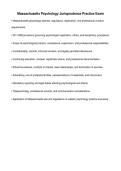
Massachusetts Psychology Jurisprudence Practice Exam

• Massachusetts psychology statutes, regulations, registration, and professional conduct

requirements.


• 251 CMR provisions governing psychologist registration, ethics, and disciplinary procedures.


• Scope of psychological practice, competence, supervision, and professional responsibilities.


• Confidentiality, records, informed consent, and legally permitted disclosures.


• Continuing education, renewal, registration status, and professional documentation.


• Ethical boundaries, conflicts of interest, dual relationships, and termination of services.


• Advertising, use of professional titles, representations of credentials, and misconduct.


• Mandatory reporting and legal duties affecting psychologists and clients.


• Telepsychology, professional records, and communication considerations.


• Application of Massachusetts law and regulations to realistic psychology practice scenarios.

,1. In a practical workplace scenario involving Application of Massachusetts law and

regulations to realistic psychology practice scenarios., what should the credentialed

professional do first?


A. Delegate the matter to any available person without considering scope, competence,

authorization, or supervision requirements.


B. Treat the requirement as optional unless an immediate complaint has already been filed.


C. Ignore the applicable rule whenever the client or customer requests a different approach.


D. Protect the client or public, maintain required records, and comply with the governing

licensing requirements rather than relying on informal custom.


Answer: D. Protect the client or public, maintain required records, and comply with the

governing licensing requirements rather than relying on informal custom.


Rationale: The best answer is based on compliance with the applicable licensing law or

administrative rule, the professional's authorized scope and competence, and the

overarching duty to protect the public. Exact requirements can change, so the current board

or agency rules should be consulted when preparing for an actual examination.

,2. During a licensing review, an applicant encounters an issue involving Advertising, use of

professional titles, representations of credentials, and misconduct.. Which response is most

appropriate under the applicable rules?


A. Treat the requirement as optional unless an immediate complaint has already been filed.


B. Ignore the applicable rule whenever the client or customer requests a different approach.


C. Assume that professional judgment automatically overrides all licensing, documentation,

and regulatory requirements.


D. Use the applicable regulatory source and professional judgment together, escalating or

referring the matter when the professional lacks authority or competence.


Answer: D. Use the applicable regulatory source and professional judgment together,

escalating or referring the matter when the professional lacks authority or competence.


Rationale: The best answer is based on compliance with the applicable licensing law or

administrative rule, the professional's authorized scope and competence, and the

overarching duty to protect the public. Exact requirements can change, so the current board

or agency rules should be consulted when preparing for an actual examination.

, 3. An applicant is preparing for licensure and studies Continuing education, renewal,

registration status, and professional documentation.. Which statement demonstrates the

strongest understanding of the applicable rules?


A. Use the applicable regulatory source and professional judgment together, escalating or

referring the matter when the professional lacks authority or competence.


B. Treat the requirement as optional unless an immediate complaint has already been filed.


C. Ignore the applicable rule whenever the client or customer requests a different approach.


D. Assume that professional judgment automatically overrides all licensing, documentation,

and regulatory requirements.


Answer: A. Use the applicable regulatory source and professional judgment together,

escalating or referring the matter when the professional lacks authority or competence.


Rationale: The best answer is based on compliance with the applicable licensing law or

administrative rule, the professional's authorized scope and competence, and the

overarching duty to protect the public. Exact requirements can change, so the current board

or agency rules should be consulted when preparing for an actual examination.

Información del documento

Subido en
2 de septiembre de 2026
Número de páginas
251
Escrito en
2026/2027
Tipo
Examen
Contiene
Preguntas y respuestas
$32.99

¿Documento equivocado? Cámbialo gratis Dentro de los 14 días posteriores a la compra y antes de descargarlo, puedes elegir otro documento. Puedes gastar el importe de nuevo.
Escrito por estudiantes que aprobaron
Inmediatamente disponible después del pago
Leer en línea o como PDF

Seller avatar
Los indicadores de reputación están sujetos a la cantidad de artículos vendidos por una tarifa y las reseñas que ha recibido por esos documentos. Hay tres niveles: Bronce, Plata y Oro. Cuanto mayor reputación, más podrás confiar en la calidad del trabajo del vendedor.
surepass
4.9
(396)
Vendido
6718
Seguidores
24
Artículos
4623
Última venta
3 días hace


Por qué los estudiantes eligen Stuvia

Creado por compañeros estudiantes, verificado por reseñas

Calidad en la que puedes confiar: escrito por estudiantes que aprobaron y evaluado por otros que han usado estos resúmenes.

¿No estás satisfecho? Elige otro documento

¡No te preocupes! Puedes elegir directamente otro documento que se ajuste mejor a lo que buscas.

Paga como quieras, empieza a estudiar al instante

Sin suscripción, sin compromisos. Paga como estés acostumbrado con tarjeta de crédito y descarga tu documento PDF inmediatamente.

Student with book image

“Comprado, descargado y aprobado. Así de fácil puede ser.”

Alisha Student

Preguntas frecuentes