

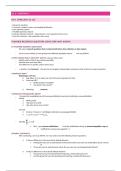
HS 3: CONTRAST
HC4: OPDELING VD LES
1. Research questions
2. Contrasts: notation, types, and sampling distribution
3. One planned contrast
4. Multiple planned contrasts
6. Pairwise planned contrasts - Tukey-Kramer is not evaluated in this course
5. Post hoc contrasts - Not evaluated in this course
PLANNED RESEARCH QUESTION USING ONE-WAY ANOVA.
BY PLANNED RESEARCH QUESTIONS
- We meant research questions that are determined before data collection or data analysis
- Goal is to test whether 2/more groups have different population means: one-way ANOVA
AFTER CONDUCTING A ONE-WAY ANOVA: what we often want?
- Identify which of the (4 eye-color) groups differ
- Estimate how much they differ
- Test differences in specific, theory-driven ways
- → Solution: Use Contrasts: they let you test targeted, interpretable comparisons that match the research questions
CONTRASTS WHY?
- Beperkingen vd F-test
o Zegt alleen er is ergens een verschil tussen de groepen (of niet)
o Maar zegt NIET
Welke groepen verschillen?
Hoe groot is dat verschil?
o Oplossing: contrasts.
CONTRASTS/VERGELIJKING WHAT?
- = Een gerichte vergelijking/verschil tussen gemiddelden (eventueel combinaties van gemiddelden)
- Inhoud
o Welk verschil
o Hoe groot is verschil
o Hoe zeker ben je over verschil
- Formeel:
o Contrast = lineaire (= rechtlijnig) combinatie van groepsgemiddelde
o c 1 y1 + c2 y 2+ ⋯+ c a y a
a
- Waarbij: ∑ c j=0
j=1
Die c j zijn contrast-coëfficiënten via die coëfficiënten druk je je wetenschappelijke vraag uit
Coëfficiënten moeten dus opgeteld = 0
EXAMPLE CONTRASTS
- After conducting a one-way ANOVA, we may want to test the following research questions:
o Is there a difference in the mean brand attitude between
Participants who saw an advertisement where the model’s eye color was visible (Blue, Brown, Green)
VS
Those who saw an advertisement where the eye color was not distinguishable (Down)?
o Is there a difference in mean brand attitude between
The group that saw the advertisement featuring a model with green eyes
And the group that saw the advertisement featuring a model with blue eyes?
,
, NOTATION
μ j is population mean of group j (with j = 1, . . . , a where a is the number of groups)
A contrast is a linear combination of population means:
- Waarbij contrast-coëfficienten optellen tot 0
o = Subject to the key constrain (=regel/voorwaarde):
INTERPRETATION:
- The values C j are contrast-coefficients (known, chosen by the researcher)
o Deze drukken je hypothese uit
o Bepalen welke groepen je vergelijkt
- A contrast represents a specific difference among the population means
- It allows us to translate a research question into a precise, testable comparison across the a groups
NIET data kiezen het contrast
WEL onderzoeker kiest het contrast
HYPOTHESES
- In a contrast analysis, the H0 is given by:
- H1 can be
o One-sided (i.e., H1 : γ > 0 or H1 : γ < 0)
OR
o Two-sided (i.e., H1 : γ̸ ≠ 0)
In practice, a contrast is estimated using the sample means:
CONTRASTS TYPES
PLANNED VS POST-HOC
- Planned contrasts (a priori):
o Specified before collecting/analyzing the data
o Based on theory
- Post Hoc Contrasts (a posteriori)
o Decided after inspecting the data
o Are exploratory contrasts:
Test the comparisons that become interesting after seeing the results or based on data patterns
o Risicovoller
Je gebruikt data 2X zowel om idee te krijgen + idee te testen onterecht “echte” patronen zien
PAIRWISE VS COMPLEX
- Pairwise contrast:
o = Compares 2 groups only.
o Coefficients focus on one mean VS another mean
o Example: Is there a difference in mean brand attitude between
The group that saw the advertisement featuring a model with green eyes
And the group that saw the advertisement featuring a model with blue eyes?
Contrast:
What are the contrast coefficients?:
Thus:
o !!! coefficienten zijn 1 en - 1
HC4: OPDELING VD LES
1. Research questions
2. Contrasts: notation, types, and sampling distribution
3. One planned contrast
4. Multiple planned contrasts
6. Pairwise planned contrasts - Tukey-Kramer is not evaluated in this course
5. Post hoc contrasts - Not evaluated in this course
PLANNED RESEARCH QUESTION USING ONE-WAY ANOVA.
BY PLANNED RESEARCH QUESTIONS
- We meant research questions that are determined before data collection or data analysis
- Goal is to test whether 2/more groups have different population means: one-way ANOVA
AFTER CONDUCTING A ONE-WAY ANOVA: what we often want?
- Identify which of the (4 eye-color) groups differ
- Estimate how much they differ
- Test differences in specific, theory-driven ways
- → Solution: Use Contrasts: they let you test targeted, interpretable comparisons that match the research questions
CONTRASTS WHY?
- Beperkingen vd F-test
o Zegt alleen er is ergens een verschil tussen de groepen (of niet)
o Maar zegt NIET
Welke groepen verschillen?
Hoe groot is dat verschil?
o Oplossing: contrasts.
CONTRASTS/VERGELIJKING WHAT?
- = Een gerichte vergelijking/verschil tussen gemiddelden (eventueel combinaties van gemiddelden)
- Inhoud
o Welk verschil
o Hoe groot is verschil
o Hoe zeker ben je over verschil
- Formeel:
o Contrast = lineaire (= rechtlijnig) combinatie van groepsgemiddelde
o c 1 y1 + c2 y 2+ ⋯+ c a y a
a
- Waarbij: ∑ c j=0
j=1
Die c j zijn contrast-coëfficiënten via die coëfficiënten druk je je wetenschappelijke vraag uit
Coëfficiënten moeten dus opgeteld = 0
EXAMPLE CONTRASTS
- After conducting a one-way ANOVA, we may want to test the following research questions:
o Is there a difference in the mean brand attitude between
Participants who saw an advertisement where the model’s eye color was visible (Blue, Brown, Green)
VS
Those who saw an advertisement where the eye color was not distinguishable (Down)?
o Is there a difference in mean brand attitude between
The group that saw the advertisement featuring a model with green eyes
And the group that saw the advertisement featuring a model with blue eyes?
,
, NOTATION
μ j is population mean of group j (with j = 1, . . . , a where a is the number of groups)
A contrast is a linear combination of population means:
- Waarbij contrast-coëfficienten optellen tot 0
o = Subject to the key constrain (=regel/voorwaarde):
INTERPRETATION:
- The values C j are contrast-coefficients (known, chosen by the researcher)
o Deze drukken je hypothese uit
o Bepalen welke groepen je vergelijkt
- A contrast represents a specific difference among the population means
- It allows us to translate a research question into a precise, testable comparison across the a groups
NIET data kiezen het contrast
WEL onderzoeker kiest het contrast
HYPOTHESES
- In a contrast analysis, the H0 is given by:
- H1 can be
o One-sided (i.e., H1 : γ > 0 or H1 : γ < 0)
OR
o Two-sided (i.e., H1 : γ̸ ≠ 0)
In practice, a contrast is estimated using the sample means:
CONTRASTS TYPES
PLANNED VS POST-HOC
- Planned contrasts (a priori):
o Specified before collecting/analyzing the data
o Based on theory
- Post Hoc Contrasts (a posteriori)
o Decided after inspecting the data
o Are exploratory contrasts:
Test the comparisons that become interesting after seeing the results or based on data patterns
o Risicovoller
Je gebruikt data 2X zowel om idee te krijgen + idee te testen onterecht “echte” patronen zien
PAIRWISE VS COMPLEX
- Pairwise contrast:
o = Compares 2 groups only.
o Coefficients focus on one mean VS another mean
o Example: Is there a difference in mean brand attitude between
The group that saw the advertisement featuring a model with green eyes
And the group that saw the advertisement featuring a model with blue eyes?
Contrast:
What are the contrast coefficients?:
Thus:
o !!! coefficienten zijn 1 en - 1

