
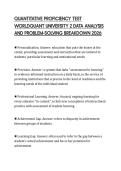
QUANTITATIVE PROFICIENCY TEST
WORLDQUANT UNIVERSITY 2 DATA ANALYSIS
AND PROBLEM-SOLVING BREAKDOWN 2026
◉ Personalization. Answer: education that puts the leaner at the
center, providing assessment and instruction that are tailored to
students' particular learning and motivational needs
◉ Precision. Answer: a system that links "assessment for learning"
to evidence-informed instruction on a daily basis, in the service of
providing instruction that is precise to the level of readiness and the
learning needs of the individual student
◉ Professional Learning. Answer: focused, ongoing learning for
every educator "in context", to link new conceptions of instructional
practice with assessment of student learning
◉ Achievement Gap. Answer: refers to disparity in achievement
between groups of students.
◉ Learning Gap. Answer: often used to refer to the gap between a
student's actual achievement and his or her potential for
achievement
, ◉ Idea of UDL. Answer: teaching strategies and pedagogical
materials and tools that respond to the special needs of a specific
student can be useful for all students, to provide access to the
curriculum for all students and to assist educators in designing
products and environments to make them accessible to everyone
◉ Core Concepts of UDL. Answer: 1. universality and equity 2.
flexibility and inclusiveness 3. appropriately designed space 4.
simplicity 5. safety
◉ Universality and Equity. Answer: to ensure that teaching is
tailored to draw on the strengths and meet the needs of all students
◉ Flexibility and Inclusiveness. Answer: a variety of teaching
strategies and pedagogical materials that are relevant, engaging and
responsive to their learning needs, make use of all the senses, vary in
form, level of difficulty and manner of presentation
◉ Appropriately Designed Space. Answer: learning environment
should ensure that all student have a clear line of sight, learning
materials are within comfortable reach of all students, and there is
adequate space for assisted devices or TA's
◉ Simplicity. Answer: teach can avoid complexity and minimize
distracting information by communicating consistent and achievable
expectations, collaborating with students, arranging information
WORLDQUANT UNIVERSITY 2 DATA ANALYSIS
AND PROBLEM-SOLVING BREAKDOWN 2026
◉ Personalization. Answer: education that puts the leaner at the
center, providing assessment and instruction that are tailored to
students' particular learning and motivational needs
◉ Precision. Answer: a system that links "assessment for learning"
to evidence-informed instruction on a daily basis, in the service of
providing instruction that is precise to the level of readiness and the
learning needs of the individual student
◉ Professional Learning. Answer: focused, ongoing learning for
every educator "in context", to link new conceptions of instructional
practice with assessment of student learning
◉ Achievement Gap. Answer: refers to disparity in achievement
between groups of students.
◉ Learning Gap. Answer: often used to refer to the gap between a
student's actual achievement and his or her potential for
achievement
, ◉ Idea of UDL. Answer: teaching strategies and pedagogical
materials and tools that respond to the special needs of a specific
student can be useful for all students, to provide access to the
curriculum for all students and to assist educators in designing
products and environments to make them accessible to everyone
◉ Core Concepts of UDL. Answer: 1. universality and equity 2.
flexibility and inclusiveness 3. appropriately designed space 4.
simplicity 5. safety
◉ Universality and Equity. Answer: to ensure that teaching is
tailored to draw on the strengths and meet the needs of all students
◉ Flexibility and Inclusiveness. Answer: a variety of teaching
strategies and pedagogical materials that are relevant, engaging and
responsive to their learning needs, make use of all the senses, vary in
form, level of difficulty and manner of presentation
◉ Appropriately Designed Space. Answer: learning environment
should ensure that all student have a clear line of sight, learning
materials are within comfortable reach of all students, and there is
adequate space for assisted devices or TA's
◉ Simplicity. Answer: teach can avoid complexity and minimize
distracting information by communicating consistent and achievable
expectations, collaborating with students, arranging information


