
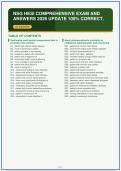
NSG HESI COMPREHENSIVE EXAM AND
ANSWERS 2026 UPDATE 100% CORRECT.
200 QUESTIONS
TABLE OF CONTENTS
Synthesize multi-system assessment data to Apply pharmacokinetic principles to
prioritize interventions medication administration and monitoring
Q1 - patient with chronic kidney disease Q21 - patient with chronic heart failure
Q2 - nurse is assessing a patient Q22 - assessment finding most reliably indicates
Q3 - ethical principle is most directly Q23 - During a blood transfusion, a
Q4 - postpartum patient who delivered 6 Q24 - patient with type 1 diabetes
Q5 - patient with a diagnosis of Q25 - ventilator setting change directly reduces
Q6 - community health nurse is planning Q26 - patient on a heparin drip
Q7 - nurse manager is evaluating the Q27 - assessment finding is most indicative
Q8 - patient with heart failure is Q28 - patient with cirrhosis and ascites
Q9 - nurse is caring for a Q29 - finding in a patient with
Q10 - assessment finding is most indicative Q30 - patient with bipolar disorder is
Q11 - patient with atrial fibrillation and Q31 - patient with acute pancreatitis develops
Q12 - assessment finding is most indicative Q32 - patient with chronic heart failure
Q13 - patient with chronic kidney disease Q33 - patient receiving vancomycin develops acute
Q14 - factor most significantly contributes to Q34 - laboratory value, when interpreted alongside
Q15 - patient with sepsis is prescribed Q35 - patient with type 2 diabetes
Q16 - medication should the nurse question Q36 - patient on mechanical ventilation develops
Q17 - patient with chronic obstructive pulmonary Q37 - finding is most consistent with
Q18 - assessment finding is most concerning Q38 - patient with a pulmonary embolism
Q19 - patient is receiving an IV Q39 - nursing intervention is most appropriate
Q20 - intervention is most effective in Q40 - patient is receiving a continuous
Page 1
,Evaluate ethical and legal dilemmas in Implement evidence-based strategies for
nursing practice health promotion and disease prevention
Q41 - patient with decompensated cirrhosis and Q81 - patient with chronic heart failure
Q42 - patient with diabetic ketoacidosis (DKA) Q82 - pharmacokinetic principle best explains the
Q43 - patient with a history of Q83 - patient is receiving a continuous
Q44 - patient is receiving a continuous Q84 - patient with type 2 diabetes
Q45 - patient with acute pancreatitis develops Q85 - patient with acute respiratory distress
Q46 - patient with acute kidney injury Q86 - patient on a medical-surgical unit
Q47 - patient with a pulmonary embolism Q87 - patient with cirrhosis and ascites
Q48 - patient with hyperthyroidism is scheduled Q88 - patient with a history of
Q49 - patient with chronic kidney disease Q89 - patient with a traumatic brain
Q50 - patient with a traumatic brain Q90 - patient with acute kidney injury
Q51 - patient with heart failure is Q91 - patient with acute decompensated heart
Q52 - nurse is caring for a Q92 - patient with diabetic ketoacidosis has
Q53 - patient with a history of Q93 - nurse is caring for a
Q54 - nurse is assessing a patient Q94 - patient with chronic kidney disease
Q55 - 3-year-old child is admitted with Q95 - patient with severe sepsis has
Q56 - patient with type 1 diabetes Q96 - patient is receiving a blood
Q57 - of the following is the Q97 - patient with a pulmonary embolism
Q58 - nurse is preparing to administer Q98 - patient with heart failure is
Q59 - patient with a history of Q99 - patient with acute pancreatitis has
Q60 - nurse is assessing a patient Q100 - patient with a new colostomy
Interpret laboratory and diagnostic data to NSG HESI Comprehensive Exam and
guide clinical decisions Answers 2026 Update 100% Correct.
Q61 - patient with heart failure is Q101 - patient with chronic heart failure
Q62 - nurse is interpreting an arterial Q102 - nurse is assessing a patient
Q63 - patient with a severe penicillin Q103 - nurse is delegating tasks to
Q64 - nurse is assessing a patient Q104 - community health nurse is analyzing
Q65 - patient is receiving a continuous Q105 - nurse is reviewing the medication
Q66 - patient with chronic kidney disease Q106 - nurse is providing end-of-life care
Q67 - patient is newly diagnosed with Q107 - nurse is caring for a
Q68 - nurse is preparing to administer Q108 - nurse manager is evaluating the
Q69 - patient is prescribed a drug Q109 - nurse is assessing a patient
Q70 - patient with atrial fibrillation is Q110 - community health nurse is planning
Q71 - client with a pulmonary embolism Q111 - client with acute pancreatitis develops
Q72 - nurse is evaluating the effectiveness Q112 - client with heart failure is
Q73 - client with severe sepsis has Q113 - client with a serum potassium
Q74 - nurse is reviewing the laboratory Q114 - client with chronic kidney disease
Q75 - client with type 2 diabetes Q115 - client with diabetic ketoacidosis is
Q76 - nurse is preparing to administer Q116 - client with acute respiratory distress
Q77 - client with cirrhosis and ascites Q117 - client with cirrhosis and ascites
Q78 - nurse is caring for a Q118 - client with sepsis is prescribed
Q79 - client is receiving a continuous Q119 - client with a new diagnosis
Q80 - nurse is reviewing the medical Q120 - client with a pulmonary embolism
Page 2
,Foundations of Nursing (HESI Advanced Nursing (HESI Comprehensive)
Comprehensive) Q161 - client with heart failure is
Q121 - patient with chronic obstructive pulmonary Q162 - client is receiving a continuous
Q122 - nurse is evaluating the effectiveness Q163 - client with chronic kidney disease
Q123 - client with a history of Q164 - nurse is caring for a
Q124 - patient with hyperthyroidism is taking Q165 - client with type 1 diabetes
Q125 - nurse in an emergency department Q166 - client with septic shock has
Q126 - patient with chronic kidney disease Q167 - client is prescribed a low-molecular-weight
Q127 - client with cirrhosis has ascites Q168 - client with a history of
Q128 - patient with a severe infection Q169 - client with a severe infection
Q129 - nurse is preparing to administer Q170 - client is receiving an intravenous
Q130 - patient with a history of Q171 - a patient with sepsis and
Q131 - patient with chronic kidney disease Q172 - patient with type 2 diabetes
Q132 - client is receiving a continuous Q173 - finding in a patient with
Q133 - nurse is assessing a patient Q174 - patient with heart failure with
Q134 - patient with heart failure is Q175 - ventilator setting adjustment is most
Q135 - nurse is providing discharge teaching Q176 - patient with a history of
Q136 - patient is receiving a blood Q177 - patient with a pulmonary embolism
Q137 - nurse is caring for a Q178 - assessment finding is most indicative
Q138 - client with a history of Q179 - patient with a new diagnosis
Q139 - patient is admitted with suspected Q180 - patient with a history of
Q140 - nurse is teaching a patient
Nursing (HESI Comprehensive) Review
Applied Nursing (HESI Comprehensive) Q181 - patient with diabetic ketoacidosis is
Q141 - patient with septic shock is Q182 - finding most clearly indicates that
Q142 - client with chronic kidney disease Q183 - patient with chronic heart failure
Q143 - nurse is caring for a Q184 - patient with acute pancreatitis develops
Q144 - patient with type 2 diabetes Q185 - patient is receiving a continuous
Q145 - nurse is evaluating the ECG Q186 - patient with chronic kidney disease
Q146 - nurse is reviewing the laboratory Q187 - patient on mechanical ventilation has
Q147 - patient with heart failure is Q188 - electrocardiographic change is most chara...
Q148 - nurse is preparing to administer Q189 - patient with acute liver failure
Q149 - patient on a ventilator has Q190 - patient with acute kidney injury
Q150 - nurse is caring for a Q191 - patient with severe sepsis and
Q151 - patient with chronic kidney disease Q192 - nurse is reviewing a patient's
Q152 - nurse is assessing a postpartum Q193 - patient with chronic kidney disease
Q153 - nurse is preparing to administer Q194 - patient with a new diagnosis
Q154 - patient with type 2 diabetes Q195 - nurse administers a dose of
Q155 - nurse is evaluating a patient's Q196 - patient is receiving a continuous
Q156 - nurse is delegating tasks to Q197 - nurse is preparing to administer
Q157 - nurse is providing discharge teaching Q198 - patient is prescribed ceftriaxone 1
Q158 - patient is receiving a continuous Q199 - patient with a history of
Q159 - community health nurse is planning Q200 - nurse is caring for a
Q160 - nurse is reviewing a patient's
Page 3
, Q1 SYNTHESIZE MULTI-SYSTEM ASSESSMENT DATA TO PRIORITIZE INTERVENTIONS
A patient with chronic kidney disease (stage IV) is prescribed a new medication
that is extensively metabolized by the liver. The patient also has hepatic
impairment. How should the nurse adjust the medication plan to ensure safety?
A. Administer the standard dose with increased monitoring
B. Reduce the dose and extend the dosing interval CORRECT
C. Skip the dose until hepatic function improves
D. Switch to a renally excreted alternative
RATIONALE: Both renal and hepatic impairment can alter drug metabolism and excretion. Dose
reduction and extended intervals prevent accumulation. Standard dosing risks toxicity; skipping is
inappropriate; switching may not be feasible.
Q2 SYNTHESIZE MULTI-SYSTEM ASSESSMENT DATA TO PRIORITIZE INTERVENTIONS
A nurse is assessing a patient with suspected hypovolemic shock. Which finding
would be an early, subtle indicator of inadequate tissue perfusion?
A. Blood pressure 90/60 mmHg
B. Heart rate 110 beats per minute CORRECT
C. Urine output 0.5 mL/kg/hr
D. Serum lactate 4 mmol/L
RATIONALE: Tachycardia is an early compensatory response to decreased stroke volume.
Hypotension occurs later; urine output decreases after renal perfusion is compromised; elevated
lactate indicates anaerobic metabolism, which is a later sign.
Page 4

