
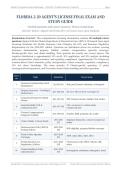
Florida 2-20 Agent's License Final Exam — 2026/2027 | Verified Answers | Graded A+ Page 1
FLORIDA 2-20 AGENT'S LICENSE FINAL EXAM AND
STUDY GUIDE
Verified Questions and Correct Answers | Newest Actual Exam
2026/2027 Edition | Aligned with Florida DFS 2-20 General Lines Agent Standards
Examination Overview: This comprehensive licensing examination contains 150 multiple-choice
questions aligned with the Florida Department of Financial Services (DFS) 2-20 General Lines Agent
Licensing Standards, the Florida Insurance Code (Chapters 624–632), and Insurance Regulatory
Requirements for the 2026/2027 edition. Questions are distributed across ten sections covering
insurance fundamentals, property, liability, workers' compensation, specialty coverages,
Florida-specific laws, and claims handling. Each question has exactly one correct answer. The
cognitive distribution is approximately 30% recall, 50% application, and 20% analysis (including
policy interpretation, claims scenarios, and regulatory compliance). Approximately 75% of items are
scenario-based (client situations, policy interpretation, claims scenarios, regulatory compliance);
25% test direct knowledge. The exam includes 20 Florida-specific questions, 15 policy
coverage/exclusion questions, and 10 scenario-based claims handling and ethics questions.
Secti
Topic Questions Focus Areas
on
Insurance Fundamentals & Risk
1 Q1–Q20 (20) Risk, peril, hazard, indemnity, subrogation
Management
Property Insurance — Dwelling &
2 Q21–Q40 (20) DP-1/2/3, HO-2/3/4/6/8, Coverages A-F
Homeowners
Commercial Property & Inland
3 Q41–Q55 (15) BPP, business income, builders' risk, bailees
Marine
General Liability (CGL & CGL, occurrence vs. claims-made,
4 Q56–Q75 (20)
Commercial Auto) commercial auto
Workers' Compensation &
5 Q76–Q90 (15) Benefits, EMR, premium calc, audits
Employers' Liability
Q91–Q100 Employee dishonesty, contract/commercial
6 Crime, Fidelity, & Surety Bonds
(10) bonds
Businessowners Policy (BOP) & Q101–Q110
7 BOP eligibility, property/liability coverages
Package Policies (10)
Flood & Other Specialty Q111–Q120
8 NFIP, cyber, E&O;, D&O;, EPLI
Coverages (10)
Florida-Specific Laws, Q121–Q140 FL Insurance Code, FHCF, Citizens, OIR,
9
Regulations, & Ethics (20) ethics
Claims Handling & Policy Q141–Q150
10 Investigation, settlement, subrogation, fraud
Administration (10)
Florida DFS 2-20 General Lines Agent | Insurance Code Chapter 624–632 Florida OIR | Newest Actual Exam 2026/2027 Edition
,Florida 2-20 Agent's License Final Exam — 2026/2027 | Verified Answers | Graded A+ Page 2
Section 1: Insurance Fundamentals & Risk Management
20 questions • Questions Q1–Q20
Q1: An insured's home is located in a high-crime neighborhood where theft is common. The
condition of the neighborhood that increases the frequency of theft losses is best classified
as which type of hazard?
A. Physical hazard
B. Moral hazard — a condition arising from a person's tendency to be dishonest or to
deliberately cause a loss; while high-crime neighborhoods are a physical hazard
(environmental), the question focuses on the neighborhood's effect on the insured's behavior,
which is moral hazard
C. Morale hazard (morral hazard) — a condition arising from a person's carelessness or
attitude toward loss because insurance is in place; high-crime areas tend to make insureds
less vigilant about locking doors, which is morale hazard *[CORRECT]*
D. A peril, not a hazard
Correct Answer: C
Rationale: A hazard is a condition that increases the frequency or severity of a loss. Morale hazard
(morral hazard) arises from a person's carelessness or indifference to loss because insurance protection
exists — e.g., failing to lock doors in a high-crime area because the insurance will pay. Physical hazard
relates to physical characteristics of the property (e.g., faulty wiring); moral hazard involves intentional
acts or dishonesty. Theft itself is the peril, not the hazard. Per Florida DFS curriculum, hazards are
classified as physical, moral, or morale.
Q2: A business installs a sprinkler system to reduce fire losses. Which risk management
technique is being used?
A. Avoidance
B. Loss reduction (risk reduction) — installing a sprinkler system does not eliminate the risk
of fire (avoidance) but reduces the severity of loss if a fire occurs. This is risk reduction,
which lowers the frequency or severity of losses *[CORRECT]*
C. Transfer
D. Retention
Correct Answer: B
Rationale: Risk reduction (loss reduction) involves implementing measures that reduce the frequency or
severity of a loss without eliminating the risk entirely. Installing sprinklers does not prevent fires
(avoidance would mean not operating the business), but it reduces damage if a fire occurs. Transfer shifts
the financial consequence to another party (typically through insurance). Retention means absorbing the
loss. Florida DFS standards distinguish these four primary risk management techniques, with reduction
focusing on minimizing loss severity.
Florida DFS 2-20 General Lines Agent | Insurance Code Chapter 624–632 Florida OIR | Newest Actual Exam 2026/2027 Edition
,Florida 2-20 Agent's License Final Exam — 2026/2027 | Verified Answers | Graded A+ Page 3
Q3: Which of the following is NOT one of the four primary methods of risk management?
A. Avoidance
B. Reduction
C. Transfer
D. Accumulation — this is NOT a risk management method. The four primary methods are
avoidance, reduction, transfer, and retention. Some sources add 'sharing' as a fifth, but
accumulation is not a recognized technique *[CORRECT]*
Correct Answer: D
Rationale: The four primary risk management methods recognized by Florida DFS are: (1) avoidance —
eliminating the exposure entirely; (2) reduction — minimizing frequency or severity; (3) transfer —
shifting the financial burden to another party (insurance is the most common form); (4) retention —
absorbing the loss. Sharing (a fifth method) distributes risk among multiple parties. Accumulation is not a
recognized method and would actually increase risk concentration.
Q4: An insured suffers a $50,000 loss to their home. The insurer pays $50,000 minus a $500
deductible. The principle that the insured should be restored to the same financial position
they were in before the loss — no better and no worse — is called:
A. Subrogation
B. Indemnity — the principle of indemnity states that insurance is designed to restore the
insured to the same financial position they occupied before the loss, no better and no worse.
The deductible helps prevent the insured from profiting from a loss *[CORRECT]*
C. Insurable interest
D. Utmost good faith
Correct Answer: B
Rationale: Indemnity is a fundamental insurance principle stating the insured should be restored to the
same financial position occupied before the loss — not enriched. The deductible enforces this by making
the insured share in the loss. Subrogation transfers the insured's right of recovery against a third party to
the insurer. Insurable interest requires the insured to suffer a financial loss from damage to the insured
property. Utmost good faith requires honest disclosure from both parties.
Q5: After paying a $30,000 claim for damage caused by a neighbor's negligence, the insurer
sues the neighbor to recover the amount paid. This legal right of the insurer to step into the
insured's position and seek recovery from the at-fault third party is called:
A. Indemnity
B. Subrogation — the insurer is subrogated to the insured's rights against the at-fault third
party, allowing the insurer to recover the amount paid. Subrogation prevents the insured
from collecting twice (from the insurer and from the responsible party) and holds the
at-fault party accountable *[CORRECT]*
C. Insurable interest
D. Adhesion
Correct Answer: B
Rationale: Subrogation is the insurer's right to step into the insured's position after paying a loss and seek
recovery from the at-fault third party. It serves three purposes: prevents the insured from collecting
twice, holds the responsible party accountable, and helps keep insurance premiums reasonable. The
insured must not impair the insurer's subrogation rights (e.g., by releasing the at-fault party). Indemnity,
insurable interest, and adhesion are other insurance principles but do not involve third-party recovery.
Florida DFS 2-20 General Lines Agent | Insurance Code Chapter 624–632 Florida OIR | Newest Actual Exam 2026/2027 Edition
, Florida 2-20 Agent's License Final Exam — 2026/2027 | Verified Answers | Graded A+ Page 4
Q6: A homeowner purchases a property insurance policy on a house they are buying but
have not yet closed on. At the time of purchase, they did not yet own the home. Which
principle has been violated?
A. Indemnity
B. Subrogation
C. Insurable interest — the insured must have a financial interest in the property being
insured at the time of loss (and at policy inception for property policies). Without
ownership, the buyer has no insurable interest and cannot validly insure the property
*[CORRECT]*
D. Utmost good faith
Correct Answer: C
Rationale: Insurable interest requires the insured to suffer a financial loss if the insured property is
damaged or destroyed. For property insurance, insurable interest must exist at policy inception AND at
the time of loss. The buyer who has not yet closed on the home does not have an ownership interest and
therefore has no insurable interest. For life insurance, insurable interest must exist only at policy
inception, not at the time of loss. Florida DFS requires insurable interest for any valid insurance contract.
Q7: An insurance contract is a contract of adhesion. This means:
A. Both parties have equal bargaining power
B. The insured must adhere to the terms as written by the insurer — insurance contracts are
drafted by the insurer and presented to the insured on a take-it-or-leave-it basis. The
insured has no opportunity to negotiate terms. Because of this, ambiguities are typically
interpreted in favor of the insured *[CORRECT]*
C. The insured may cancel at any time without penalty
D. The contract is void if the insured changes their mind
Correct Answer: B
Rationale: A contract of adhesion is one prepared by one party (the insurer) and accepted or rejected by
the other party (the insured) on a 'take-it-or-leave-it' basis. The insured cannot negotiate terms. Because of
this imbalance, courts interpret ambiguous policy language against the insurer (the drafter) under the
doctrine of contra proferentem. This is a key reason insurance agents must accurately explain policy
terms to applicants.
Q8: An insurance contract is aleatory. This means:
A. The contract is based on the principle of indemnity
B. The values exchanged are unequal — the insured may pay small premiums and receive a
large claim (or no claim), depending on whether a loss occurs. The outcome depends on
uncertain events, distinguishing aleatory contracts from commutative contracts where
values are roughly equal *[CORRECT]*
C. Both parties must act in utmost good faith
D. The contract is personal and cannot be transferred
Correct Answer: B
Rationale: An aleatory contract is one in which the values exchanged are not equal — the insured pays a
relatively small premium and may receive a much larger claim payment (or no payment if no loss occurs).
This contrasts with commutative contracts (e.g., most sales contracts) where the values exchanged are
roughly equal. Insurance is also a contract of adhesion (insurer drafts terms), utmost good faith (both
parties must disclose), and indemnity (no profit from loss).
Florida DFS 2-20 General Lines Agent | Insurance Code Chapter 624–632 Florida OIR | Newest Actual Exam 2026/2027 Edition
FLORIDA 2-20 AGENT'S LICENSE FINAL EXAM AND
STUDY GUIDE
Verified Questions and Correct Answers | Newest Actual Exam
2026/2027 Edition | Aligned with Florida DFS 2-20 General Lines Agent Standards
Examination Overview: This comprehensive licensing examination contains 150 multiple-choice
questions aligned with the Florida Department of Financial Services (DFS) 2-20 General Lines Agent
Licensing Standards, the Florida Insurance Code (Chapters 624–632), and Insurance Regulatory
Requirements for the 2026/2027 edition. Questions are distributed across ten sections covering
insurance fundamentals, property, liability, workers' compensation, specialty coverages,
Florida-specific laws, and claims handling. Each question has exactly one correct answer. The
cognitive distribution is approximately 30% recall, 50% application, and 20% analysis (including
policy interpretation, claims scenarios, and regulatory compliance). Approximately 75% of items are
scenario-based (client situations, policy interpretation, claims scenarios, regulatory compliance);
25% test direct knowledge. The exam includes 20 Florida-specific questions, 15 policy
coverage/exclusion questions, and 10 scenario-based claims handling and ethics questions.
Secti
Topic Questions Focus Areas
on
Insurance Fundamentals & Risk
1 Q1–Q20 (20) Risk, peril, hazard, indemnity, subrogation
Management
Property Insurance — Dwelling &
2 Q21–Q40 (20) DP-1/2/3, HO-2/3/4/6/8, Coverages A-F
Homeowners
Commercial Property & Inland
3 Q41–Q55 (15) BPP, business income, builders' risk, bailees
Marine
General Liability (CGL & CGL, occurrence vs. claims-made,
4 Q56–Q75 (20)
Commercial Auto) commercial auto
Workers' Compensation &
5 Q76–Q90 (15) Benefits, EMR, premium calc, audits
Employers' Liability
Q91–Q100 Employee dishonesty, contract/commercial
6 Crime, Fidelity, & Surety Bonds
(10) bonds
Businessowners Policy (BOP) & Q101–Q110
7 BOP eligibility, property/liability coverages
Package Policies (10)
Flood & Other Specialty Q111–Q120
8 NFIP, cyber, E&O;, D&O;, EPLI
Coverages (10)
Florida-Specific Laws, Q121–Q140 FL Insurance Code, FHCF, Citizens, OIR,
9
Regulations, & Ethics (20) ethics
Claims Handling & Policy Q141–Q150
10 Investigation, settlement, subrogation, fraud
Administration (10)
Florida DFS 2-20 General Lines Agent | Insurance Code Chapter 624–632 Florida OIR | Newest Actual Exam 2026/2027 Edition
,Florida 2-20 Agent's License Final Exam — 2026/2027 | Verified Answers | Graded A+ Page 2
Section 1: Insurance Fundamentals & Risk Management
20 questions • Questions Q1–Q20
Q1: An insured's home is located in a high-crime neighborhood where theft is common. The
condition of the neighborhood that increases the frequency of theft losses is best classified
as which type of hazard?
A. Physical hazard
B. Moral hazard — a condition arising from a person's tendency to be dishonest or to
deliberately cause a loss; while high-crime neighborhoods are a physical hazard
(environmental), the question focuses on the neighborhood's effect on the insured's behavior,
which is moral hazard
C. Morale hazard (morral hazard) — a condition arising from a person's carelessness or
attitude toward loss because insurance is in place; high-crime areas tend to make insureds
less vigilant about locking doors, which is morale hazard *[CORRECT]*
D. A peril, not a hazard
Correct Answer: C
Rationale: A hazard is a condition that increases the frequency or severity of a loss. Morale hazard
(morral hazard) arises from a person's carelessness or indifference to loss because insurance protection
exists — e.g., failing to lock doors in a high-crime area because the insurance will pay. Physical hazard
relates to physical characteristics of the property (e.g., faulty wiring); moral hazard involves intentional
acts or dishonesty. Theft itself is the peril, not the hazard. Per Florida DFS curriculum, hazards are
classified as physical, moral, or morale.
Q2: A business installs a sprinkler system to reduce fire losses. Which risk management
technique is being used?
A. Avoidance
B. Loss reduction (risk reduction) — installing a sprinkler system does not eliminate the risk
of fire (avoidance) but reduces the severity of loss if a fire occurs. This is risk reduction,
which lowers the frequency or severity of losses *[CORRECT]*
C. Transfer
D. Retention
Correct Answer: B
Rationale: Risk reduction (loss reduction) involves implementing measures that reduce the frequency or
severity of a loss without eliminating the risk entirely. Installing sprinklers does not prevent fires
(avoidance would mean not operating the business), but it reduces damage if a fire occurs. Transfer shifts
the financial consequence to another party (typically through insurance). Retention means absorbing the
loss. Florida DFS standards distinguish these four primary risk management techniques, with reduction
focusing on minimizing loss severity.
Florida DFS 2-20 General Lines Agent | Insurance Code Chapter 624–632 Florida OIR | Newest Actual Exam 2026/2027 Edition
,Florida 2-20 Agent's License Final Exam — 2026/2027 | Verified Answers | Graded A+ Page 3
Q3: Which of the following is NOT one of the four primary methods of risk management?
A. Avoidance
B. Reduction
C. Transfer
D. Accumulation — this is NOT a risk management method. The four primary methods are
avoidance, reduction, transfer, and retention. Some sources add 'sharing' as a fifth, but
accumulation is not a recognized technique *[CORRECT]*
Correct Answer: D
Rationale: The four primary risk management methods recognized by Florida DFS are: (1) avoidance —
eliminating the exposure entirely; (2) reduction — minimizing frequency or severity; (3) transfer —
shifting the financial burden to another party (insurance is the most common form); (4) retention —
absorbing the loss. Sharing (a fifth method) distributes risk among multiple parties. Accumulation is not a
recognized method and would actually increase risk concentration.
Q4: An insured suffers a $50,000 loss to their home. The insurer pays $50,000 minus a $500
deductible. The principle that the insured should be restored to the same financial position
they were in before the loss — no better and no worse — is called:
A. Subrogation
B. Indemnity — the principle of indemnity states that insurance is designed to restore the
insured to the same financial position they occupied before the loss, no better and no worse.
The deductible helps prevent the insured from profiting from a loss *[CORRECT]*
C. Insurable interest
D. Utmost good faith
Correct Answer: B
Rationale: Indemnity is a fundamental insurance principle stating the insured should be restored to the
same financial position occupied before the loss — not enriched. The deductible enforces this by making
the insured share in the loss. Subrogation transfers the insured's right of recovery against a third party to
the insurer. Insurable interest requires the insured to suffer a financial loss from damage to the insured
property. Utmost good faith requires honest disclosure from both parties.
Q5: After paying a $30,000 claim for damage caused by a neighbor's negligence, the insurer
sues the neighbor to recover the amount paid. This legal right of the insurer to step into the
insured's position and seek recovery from the at-fault third party is called:
A. Indemnity
B. Subrogation — the insurer is subrogated to the insured's rights against the at-fault third
party, allowing the insurer to recover the amount paid. Subrogation prevents the insured
from collecting twice (from the insurer and from the responsible party) and holds the
at-fault party accountable *[CORRECT]*
C. Insurable interest
D. Adhesion
Correct Answer: B
Rationale: Subrogation is the insurer's right to step into the insured's position after paying a loss and seek
recovery from the at-fault third party. It serves three purposes: prevents the insured from collecting
twice, holds the responsible party accountable, and helps keep insurance premiums reasonable. The
insured must not impair the insurer's subrogation rights (e.g., by releasing the at-fault party). Indemnity,
insurable interest, and adhesion are other insurance principles but do not involve third-party recovery.
Florida DFS 2-20 General Lines Agent | Insurance Code Chapter 624–632 Florida OIR | Newest Actual Exam 2026/2027 Edition
, Florida 2-20 Agent's License Final Exam — 2026/2027 | Verified Answers | Graded A+ Page 4
Q6: A homeowner purchases a property insurance policy on a house they are buying but
have not yet closed on. At the time of purchase, they did not yet own the home. Which
principle has been violated?
A. Indemnity
B. Subrogation
C. Insurable interest — the insured must have a financial interest in the property being
insured at the time of loss (and at policy inception for property policies). Without
ownership, the buyer has no insurable interest and cannot validly insure the property
*[CORRECT]*
D. Utmost good faith
Correct Answer: C
Rationale: Insurable interest requires the insured to suffer a financial loss if the insured property is
damaged or destroyed. For property insurance, insurable interest must exist at policy inception AND at
the time of loss. The buyer who has not yet closed on the home does not have an ownership interest and
therefore has no insurable interest. For life insurance, insurable interest must exist only at policy
inception, not at the time of loss. Florida DFS requires insurable interest for any valid insurance contract.
Q7: An insurance contract is a contract of adhesion. This means:
A. Both parties have equal bargaining power
B. The insured must adhere to the terms as written by the insurer — insurance contracts are
drafted by the insurer and presented to the insured on a take-it-or-leave-it basis. The
insured has no opportunity to negotiate terms. Because of this, ambiguities are typically
interpreted in favor of the insured *[CORRECT]*
C. The insured may cancel at any time without penalty
D. The contract is void if the insured changes their mind
Correct Answer: B
Rationale: A contract of adhesion is one prepared by one party (the insurer) and accepted or rejected by
the other party (the insured) on a 'take-it-or-leave-it' basis. The insured cannot negotiate terms. Because of
this imbalance, courts interpret ambiguous policy language against the insurer (the drafter) under the
doctrine of contra proferentem. This is a key reason insurance agents must accurately explain policy
terms to applicants.
Q8: An insurance contract is aleatory. This means:
A. The contract is based on the principle of indemnity
B. The values exchanged are unequal — the insured may pay small premiums and receive a
large claim (or no claim), depending on whether a loss occurs. The outcome depends on
uncertain events, distinguishing aleatory contracts from commutative contracts where
values are roughly equal *[CORRECT]*
C. Both parties must act in utmost good faith
D. The contract is personal and cannot be transferred
Correct Answer: B
Rationale: An aleatory contract is one in which the values exchanged are not equal — the insured pays a
relatively small premium and may receive a much larger claim payment (or no payment if no loss occurs).
This contrasts with commutative contracts (e.g., most sales contracts) where the values exchanged are
roughly equal. Insurance is also a contract of adhesion (insurer drafts terms), utmost good faith (both
parties must disclose), and indemnity (no profit from loss).
Florida DFS 2-20 General Lines Agent | Insurance Code Chapter 624–632 Florida OIR | Newest Actual Exam 2026/2027 Edition

