

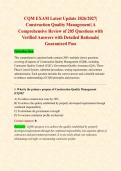
CQM EXAM Latest Update 2026/2027|
Construction Quality Management| A
Comprehensive Review of 205 Questions with
Verified Answers with Detailed Rationale|
Guaranteed Pass
Introduction
This comprehensive question bank contains 200+ multiple-choice questions
covering all aspects of Construction Quality Management (CQM), including
Contractor Quality Control (CQC), Government Quality Assurance (QA), Three-
Phase Control System, submittal procedures, testing requirements, and contract
administration. Each question includes the correct answer and a detailed rationale
to enhance understanding of CQM principles and practices.
1. What is the primary purpose of Construction Quality Management
(CQM)?
A) To reduce construction costs by 50%
B) To achieve the quality established by properly developed requirements through
combined responsibility
C) To eliminate all government oversight
D) To increase contractor profits exclusively
Correct Answer: B
Rationale: CQM's purpose is to achieve the quality established by properly
developed requirements through the combined responsibility, but separate efforts of
contractor and government personnel. It is not solely about cost reduction,
eliminating oversight, or maximizing contractor profits.
,2. Construction Quality Management is defined as the performance of tasks
that ensure construction is performed:
A) Only according to plans and specifications
B) According to plans and specifications, on time, within budget, and in a safe
work environment
C) Only on time and within budget
D) According to the contractor's preferred methods
Correct Answer: B
Rationale: CQM encompasses four key elements: according to plans and
specifications, on time, within a defined budget, and a safe work environment. This
comprehensive definition ensures all aspects of successful project completion are
addressed.
3. Partnering relationships in construction are based upon:
A) Strict contract enforcement
B) Building trust and dedication to common goals
C) Financial incentives only
D) Government dominance in decision-making
Correct Answer: B
Rationale: Effective partnering relationships are built on trust and dedication to
common goals. This collaborative approach fosters better communication,
problem-solving, and project outcomes compared to adversarial relationships.
4. Quality Assurance Personnel are responsible for:
A) Performing all construction work
B) Periodically verifying that the contractor's system of control is working
effectively
C) Hiring all subcontractors
D) Approving all financial transactions
,Correct Answer: B
Rationale: QA Personnel verify that the contractor's quality control system is
functioning effectively. They do not perform construction work, hire
subcontractors, or approve financial transactions.
5. An effective contractor quality control program will result in:
A) Increased rework and delays
B) Work done correctly the first time, earlier completion, reduced overhead, and
greater profits
C) Higher costs and lower quality
D) Reduced government oversight
Correct Answer: B
Rationale: Effective CQC incentivizes first-time quality, leading to earlier
completion, reduced field overhead costs, and greater profits. It is a positive
investment in quality.
6. The success or failure of all contractors is based upon:
A) Only the quality of materials used
B) The ability to control costs, finance work, estimate jobs, schedule work, and
maintain effective quality control
C) The number of employees
D) The size of their equipment fleet
Correct Answer: B
Rationale: Successful contractors must master multiple competencies: cost control,
financial management, job estimating, scheduling, and quality control. These
factors collectively determine contractor success.
7. Quality Assurance Personnel have the responsibility to:
, A) Complete the work themselves
B) Require contractors to maintain the quality specified in the plans and
specifications
C) Ignore quality issues
D) Accept any quality standard the contractor provides
Correct Answer: B
Rationale: QA Personnel must enforce contract requirements and ensure
contractors maintain the specified quality. They cannot perform the work or accept
substandard quality.
8. Inspection is defined as:
A) The process of financial auditing
B) The process by which ongoing and completed work is examined
C) The process of scheduling work
D) The process of hiring workers
Correct Answer: B
Rationale: Inspection specifically involves examining ongoing and completed work
to verify compliance with requirements. It is distinct from financial auditing,
scheduling, or hiring.
9. During the punch-out inspection of a project, Quality Assurance Personnel
must:
A) Complete all remaining work
B) Assure that the contractor prepares a punch-list and makes corrections
C) Accept the project as-is
D) Ignore any deficiencies
Correct Answer: B
Construction Quality Management| A
Comprehensive Review of 205 Questions with
Verified Answers with Detailed Rationale|
Guaranteed Pass
Introduction
This comprehensive question bank contains 200+ multiple-choice questions
covering all aspects of Construction Quality Management (CQM), including
Contractor Quality Control (CQC), Government Quality Assurance (QA), Three-
Phase Control System, submittal procedures, testing requirements, and contract
administration. Each question includes the correct answer and a detailed rationale
to enhance understanding of CQM principles and practices.
1. What is the primary purpose of Construction Quality Management
(CQM)?
A) To reduce construction costs by 50%
B) To achieve the quality established by properly developed requirements through
combined responsibility
C) To eliminate all government oversight
D) To increase contractor profits exclusively
Correct Answer: B
Rationale: CQM's purpose is to achieve the quality established by properly
developed requirements through the combined responsibility, but separate efforts of
contractor and government personnel. It is not solely about cost reduction,
eliminating oversight, or maximizing contractor profits.
,2. Construction Quality Management is defined as the performance of tasks
that ensure construction is performed:
A) Only according to plans and specifications
B) According to plans and specifications, on time, within budget, and in a safe
work environment
C) Only on time and within budget
D) According to the contractor's preferred methods
Correct Answer: B
Rationale: CQM encompasses four key elements: according to plans and
specifications, on time, within a defined budget, and a safe work environment. This
comprehensive definition ensures all aspects of successful project completion are
addressed.
3. Partnering relationships in construction are based upon:
A) Strict contract enforcement
B) Building trust and dedication to common goals
C) Financial incentives only
D) Government dominance in decision-making
Correct Answer: B
Rationale: Effective partnering relationships are built on trust and dedication to
common goals. This collaborative approach fosters better communication,
problem-solving, and project outcomes compared to adversarial relationships.
4. Quality Assurance Personnel are responsible for:
A) Performing all construction work
B) Periodically verifying that the contractor's system of control is working
effectively
C) Hiring all subcontractors
D) Approving all financial transactions
,Correct Answer: B
Rationale: QA Personnel verify that the contractor's quality control system is
functioning effectively. They do not perform construction work, hire
subcontractors, or approve financial transactions.
5. An effective contractor quality control program will result in:
A) Increased rework and delays
B) Work done correctly the first time, earlier completion, reduced overhead, and
greater profits
C) Higher costs and lower quality
D) Reduced government oversight
Correct Answer: B
Rationale: Effective CQC incentivizes first-time quality, leading to earlier
completion, reduced field overhead costs, and greater profits. It is a positive
investment in quality.
6. The success or failure of all contractors is based upon:
A) Only the quality of materials used
B) The ability to control costs, finance work, estimate jobs, schedule work, and
maintain effective quality control
C) The number of employees
D) The size of their equipment fleet
Correct Answer: B
Rationale: Successful contractors must master multiple competencies: cost control,
financial management, job estimating, scheduling, and quality control. These
factors collectively determine contractor success.
7. Quality Assurance Personnel have the responsibility to:
, A) Complete the work themselves
B) Require contractors to maintain the quality specified in the plans and
specifications
C) Ignore quality issues
D) Accept any quality standard the contractor provides
Correct Answer: B
Rationale: QA Personnel must enforce contract requirements and ensure
contractors maintain the specified quality. They cannot perform the work or accept
substandard quality.
8. Inspection is defined as:
A) The process of financial auditing
B) The process by which ongoing and completed work is examined
C) The process of scheduling work
D) The process of hiring workers
Correct Answer: B
Rationale: Inspection specifically involves examining ongoing and completed work
to verify compliance with requirements. It is distinct from financial auditing,
scheduling, or hiring.
9. During the punch-out inspection of a project, Quality Assurance Personnel
must:
A) Complete all remaining work
B) Assure that the contractor prepares a punch-list and makes corrections
C) Accept the project as-is
D) Ignore any deficiencies
Correct Answer: B

