
NUR 352 EXAM III | COMPREHENSIVE NURSING STUDY GUIDE,
PRACTICE QUESTIONS & ANSWERS 2026/2027
1 of 27
Definition
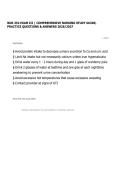
§ Avoid protein intake to decrease urinary excretion fo Ca and uric acid
§ Limit Na intake but not necessarily calcium unless true hypercalciuria
§ Drink water every 1 - 2 hours during day and 1 glass of cranberry juice
§ Drink 2 glasses of water at bedtime and one glas at each nighttime
awakening to prevent urine concentration
§ Avoid excessive hot temperatures that cause excessive sweating
§ Contact provider at signs of UTI
Give this one a go later!
Patient education for prevention of kidney stones
, § Acute Kidney Injury
Clinical manifestations (S/Sx):
· Diagnostic Labs and assessment: what is the most life-threatening imbalance in
AKI?
· Treatment: two big things to address caused by reduced filtration?
· Prevention and mortality:
· Medical Management: diet?
Nursing management: why check on skin care?
Ø End-Stage Kidney Disease (ESKD, ESRD)
§ Management:
· Acidosis, Ca, and Po:
· HTN:
· Seizures:
· Anemia:
· Nutrition:
§ Nutrition education: when to take meds
§ Complications:
§ Nursing Interventions:
· Fluid status:
· Nutritional status:
Immune System Health history
Don't know?
2 of 27
Term
Urine SG
Osmolality
GFR
, What is dilute urine with a fixed specific gravity (about 1.010) or fixed
osmolality (about 300 mOsm/L)
Give this one a go later!
SG: 1.005 -1.035
Osmolality 50 to 1200 mOsm/kg
GFR 90-120
= inability to concentrate and dilute the urine, common sign of early kidney
diesase
§ more severe manifestation of other neuro symptoms
· S/Sx: Problems with attention, concentration, memory issues, Irritable, depression,
slow movement
§ Monitor fluid stats and electrolytes
§ Retaining anal sphincter because of rectal catheter post op, and retraining anal
sphincter for handling liquid
§ Dietary: avoid gas-forming foods that may cause stress incontinence
§ Acute intermittent: 6ish times per day at home
§ Continuous ambulatory (CAPD): patients do own exchanges 4 -6 times per day
§ Continuous cyclic: cycles overnight, fewer exchanges during day. M
Complications: peritonitis (cloudy fluid), leakage, bleeding
Don't know?
3 of 27
Definition

