CRITICAL THINKING EXAM QUESTIONS AND
ANSWERS
2026-2027 COMPREHENSIVE COMPETENCY TEST BANK
Subject: Cognitive Logic, Argumentation, Mind Mapping, & Scientific Validity
This academic test bank is programmatically mapped to the verified lecture and exam records of the Critical Thinking
curriculum. It serves as a rigorous testing instrument designed to evaluate analytical reasoning, logical structure
diagramming, bias mitigation, and scientific research design. It features 50 high-quality, case-grounded questions
distributed systematically across all major weeks and learning modules.
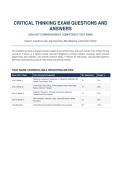
TEST BANK CURRICULUM & WEIGHTING MATRIX
Exam Unit / Week Core Concepts Evaluated No. Questions Weight %
Reflective Judgment, Subjective vs. Objective, Marketer/HR
Unit I (Week 1) 10 20%
Needs, Confirmation Bias
Case Study Data Sifting, Quincy Apparel Case, Mind Map
Unit II (Week 3) 15 30%
Basics, Decision Fatigue
Argument Diagrams, Premise/Conclusion Indicators,
Unit III (Week 4) 11 22%
Unwarranted Assumptions
Mill's Methods, Inductive Logic, Internal/External Validity,
Unit IV (Week 7) 14 28%
Heuristics
Total Blueprint Comprehensive Analytical Competency Assessment 50 100%
,CRITICAL THINKING EXAM QUESTIONS AND ANSWERS 2026-2027 COMPREHENSIVE UPDATE EXAM
UNIT I: FOUNDATIONS OF CRITICAL THINKING & COGNITIVE BIASES
Question 1: Which of the following is a direct, long-term consequence of failing to practice critical
thinking, as identified in foundational cognitive studies?
A. A major gain in creative problem-solving capacities
B. A total loss of personal freedom in decision-making
C. Seamless personal success in corporate environments
D. A substantial increase in everyday organizational control
ANSWER ✔: B — A total loss of personal freedom in decision-making
Explanation: According to the source materials (Week 1, Question 1), a central consequence of NOT thinking
critically is a loss of personal freedom. When individuals do not critically analyze arguments and claims, they
passively accept the opinions, beliefs, and biases of others, thereby relinquishing their intellectual independence
and personal freedom. The other choices (greater control, personal success, greater creativity) are positive
outcomes associated with active critical thinking.
Question 2: Which of the following statements represents a purely subjective claim?
A. Staring directly at the sun will cause irreversible damage to your eyes.
B. On a standard baseball field, the center of the pitcher's mound is 59 feet from home plate.
C. You should not buy that specific vehicle because it is completely ugly.
D. Pit vipers can strike warm-blooded animals accurately even when in pitch darkness.
ANSWER ✔: C — You should not buy that specific vehicle because it is completely ugly
Explanation: Under logical analysis (Week 1, Question 2), a subjective claim is one whose truth or falsity
depends entirely on what people believe, feel, or prefer. Aesthetics, such as calling a car 'ugly,' are entirely
matter-of-opinion subjective claims. Conversely, options A, B, and D represent objective claims because their
truth can be empirically tested, measured, or proven independently of personal opinions or feelings.
Question 3: Critical thinking skills are highly vital to professional marketers primarily because
marketers are responsible for which of the following?
A. Designing perfect price points to extract maximum consumer profit
B. Generating sales revenue and designing highly effective marketing campaigns based on objective evidence
C. Picking aesthetically pleasing advertisements to promote the corporate brand
D. Locating the single most cost-effective channel of physical product distribution
ANSWER ✔: B — Generating sales revenue and designing highly effective marketing campaigns based
on objective evidence
Explanation: The source documents state that critical thinking is essential to marketers because they are directly
responsible for sales revenue and need to design effective marketing campaigns (Week 1, Question 3). To
achieve this, marketers must objectively analyze market data, avoid confirmation biases, and make strategic
decisions rather than relying on intuition or superficial advertisement preferences.
Professional Certification Series Page 2 of 17
, CRITICAL THINKING EXAM QUESTIONS AND ANSWERS 2026-2027 COMPREHENSIVE UPDATE EXAM
Question 4: Why are automatic or fast thought processes (System 1 thinking) not considered true
critical thinking?
A. Because they focus exclusively on long-term systemic consequences
B. Because they are always factually incorrect and logically invalid
C. Because they fail to integrate normal human emotions and physiological feelings
D. Because they are highly subject to personal bias, heuristics, and snap judgments
ANSWER ✔: D — Because they are highly subject to personal bias, heuristics, and snap judgments
Explanation: Automatic or fast cognitive processes (System 1) occur rapidly and sub-consciously, meaning they
bypass systematic, objective verification. Because of this, fast thinking is heavily subject to personal bias,
heuristics, and unexamined assumptions (Week 1, Question 4). Critical thinking requires deliberate, slow, and
analytical (System 2) processes to evaluate claims objectively.
Question 5: Critical thinking is highly critical to human resource (HR) professionals primarily because
of which organizational outcome?
A. HR decisions can be made rapidly without fear of being reviewed by senior executives.
B. HR professionals are solely responsible for determining annual pay increases.
C. HR decisions have direct, profound impacts on people's careers and livelihoods.
D. HR personnel must always locate a strict company policy to apply to every unique scenario.
ANSWER ✔: C — HR decisions have direct, profound impacts on people's careers and livelihoods
Explanation: In human resources, critical thinking is essential because HR decisions directly impact people's
careers (Week 1, Question 5). Decisions regarding hiring, firing, promotions, and disciplinary actions require
unbiased, objective evaluations of evidence to ensure fairness, legal compliance, and organizational success.
Question 6: Consider these two statements: 'The Wall Street Journal says that people should invest
heavily in stocks. Therefore, investing in stocks is a smart move.' Together, what do these two
statements constitute?
A. A scientific explanation of stock market growth
B. A logical argument where a premise supports a conclusion
C. Two independent, unrelated objective conclusions
D. No argument, as it represents a simple statement of fact
ANSWER ✔: B — A logical argument where a premise supports a conclusion
Explanation: In formal logic (Week 1, Question 6), an argument is a group of statements where some statements
(premises) are intended to support or establish another statement (the conclusion). Here, the assertion that the
Wall Street Journal advises stock investment is a premise designed to support the conclusion that 'investing in
stocks is a smart move.' Hence, it is a complete logical argument.
Professional Certification Series Page 3 of 17
ANSWERS
2026-2027 COMPREHENSIVE COMPETENCY TEST BANK
Subject: Cognitive Logic, Argumentation, Mind Mapping, & Scientific Validity
This academic test bank is programmatically mapped to the verified lecture and exam records of the Critical Thinking
curriculum. It serves as a rigorous testing instrument designed to evaluate analytical reasoning, logical structure
diagramming, bias mitigation, and scientific research design. It features 50 high-quality, case-grounded questions
distributed systematically across all major weeks and learning modules.
TEST BANK CURRICULUM & WEIGHTING MATRIX
Exam Unit / Week Core Concepts Evaluated No. Questions Weight %
Reflective Judgment, Subjective vs. Objective, Marketer/HR
Unit I (Week 1) 10 20%
Needs, Confirmation Bias
Case Study Data Sifting, Quincy Apparel Case, Mind Map
Unit II (Week 3) 15 30%
Basics, Decision Fatigue
Argument Diagrams, Premise/Conclusion Indicators,
Unit III (Week 4) 11 22%
Unwarranted Assumptions
Mill's Methods, Inductive Logic, Internal/External Validity,
Unit IV (Week 7) 14 28%
Heuristics
Total Blueprint Comprehensive Analytical Competency Assessment 50 100%
,CRITICAL THINKING EXAM QUESTIONS AND ANSWERS 2026-2027 COMPREHENSIVE UPDATE EXAM
UNIT I: FOUNDATIONS OF CRITICAL THINKING & COGNITIVE BIASES
Question 1: Which of the following is a direct, long-term consequence of failing to practice critical
thinking, as identified in foundational cognitive studies?
A. A major gain in creative problem-solving capacities
B. A total loss of personal freedom in decision-making
C. Seamless personal success in corporate environments
D. A substantial increase in everyday organizational control
ANSWER ✔: B — A total loss of personal freedom in decision-making
Explanation: According to the source materials (Week 1, Question 1), a central consequence of NOT thinking
critically is a loss of personal freedom. When individuals do not critically analyze arguments and claims, they
passively accept the opinions, beliefs, and biases of others, thereby relinquishing their intellectual independence
and personal freedom. The other choices (greater control, personal success, greater creativity) are positive
outcomes associated with active critical thinking.
Question 2: Which of the following statements represents a purely subjective claim?
A. Staring directly at the sun will cause irreversible damage to your eyes.
B. On a standard baseball field, the center of the pitcher's mound is 59 feet from home plate.
C. You should not buy that specific vehicle because it is completely ugly.
D. Pit vipers can strike warm-blooded animals accurately even when in pitch darkness.
ANSWER ✔: C — You should not buy that specific vehicle because it is completely ugly
Explanation: Under logical analysis (Week 1, Question 2), a subjective claim is one whose truth or falsity
depends entirely on what people believe, feel, or prefer. Aesthetics, such as calling a car 'ugly,' are entirely
matter-of-opinion subjective claims. Conversely, options A, B, and D represent objective claims because their
truth can be empirically tested, measured, or proven independently of personal opinions or feelings.
Question 3: Critical thinking skills are highly vital to professional marketers primarily because
marketers are responsible for which of the following?
A. Designing perfect price points to extract maximum consumer profit
B. Generating sales revenue and designing highly effective marketing campaigns based on objective evidence
C. Picking aesthetically pleasing advertisements to promote the corporate brand
D. Locating the single most cost-effective channel of physical product distribution
ANSWER ✔: B — Generating sales revenue and designing highly effective marketing campaigns based
on objective evidence
Explanation: The source documents state that critical thinking is essential to marketers because they are directly
responsible for sales revenue and need to design effective marketing campaigns (Week 1, Question 3). To
achieve this, marketers must objectively analyze market data, avoid confirmation biases, and make strategic
decisions rather than relying on intuition or superficial advertisement preferences.
Professional Certification Series Page 2 of 17
, CRITICAL THINKING EXAM QUESTIONS AND ANSWERS 2026-2027 COMPREHENSIVE UPDATE EXAM
Question 4: Why are automatic or fast thought processes (System 1 thinking) not considered true
critical thinking?
A. Because they focus exclusively on long-term systemic consequences
B. Because they are always factually incorrect and logically invalid
C. Because they fail to integrate normal human emotions and physiological feelings
D. Because they are highly subject to personal bias, heuristics, and snap judgments
ANSWER ✔: D — Because they are highly subject to personal bias, heuristics, and snap judgments
Explanation: Automatic or fast cognitive processes (System 1) occur rapidly and sub-consciously, meaning they
bypass systematic, objective verification. Because of this, fast thinking is heavily subject to personal bias,
heuristics, and unexamined assumptions (Week 1, Question 4). Critical thinking requires deliberate, slow, and
analytical (System 2) processes to evaluate claims objectively.
Question 5: Critical thinking is highly critical to human resource (HR) professionals primarily because
of which organizational outcome?
A. HR decisions can be made rapidly without fear of being reviewed by senior executives.
B. HR professionals are solely responsible for determining annual pay increases.
C. HR decisions have direct, profound impacts on people's careers and livelihoods.
D. HR personnel must always locate a strict company policy to apply to every unique scenario.
ANSWER ✔: C — HR decisions have direct, profound impacts on people's careers and livelihoods
Explanation: In human resources, critical thinking is essential because HR decisions directly impact people's
careers (Week 1, Question 5). Decisions regarding hiring, firing, promotions, and disciplinary actions require
unbiased, objective evaluations of evidence to ensure fairness, legal compliance, and organizational success.
Question 6: Consider these two statements: 'The Wall Street Journal says that people should invest
heavily in stocks. Therefore, investing in stocks is a smart move.' Together, what do these two
statements constitute?
A. A scientific explanation of stock market growth
B. A logical argument where a premise supports a conclusion
C. Two independent, unrelated objective conclusions
D. No argument, as it represents a simple statement of fact
ANSWER ✔: B — A logical argument where a premise supports a conclusion
Explanation: In formal logic (Week 1, Question 6), an argument is a group of statements where some statements
(premises) are intended to support or establish another statement (the conclusion). Here, the assertion that the
Wall Street Journal advises stock investment is a premise designed to support the conclusion that 'investing in
stocks is a smart move.' Hence, it is a complete logical argument.
Professional Certification Series Page 3 of 17