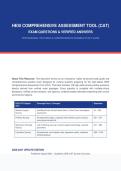
HESI COMPREHENSIVE ASSESSMENT TOOL (CAT)
EXAM QUESTIONS & VERIFIED ANSWERS
PROFESSIONAL TEST BANK & COMPREHENSIVE NURSING STUDY GUIDE
About This Resource: This document serves as an exhaustive, highly structured study guide and
comprehensive practice exam designed for nursing students preparing for the high-stakes HESI
Comprehensive Assessment Tool (CAT). This bank includes 100 high-yield clinical practice questions
directly derived from verified exam passages. Every question is complete with multiple-choice
distractors, verified correct answers, and rigorous, evidence-based rationales explaining both correct
and incorrect options.
HESI CAT Subject Coverage Focus / Concepts Questions
Area
Medical-Surgical Acid-Base/Fluids, Renal/Cardiac failure, Critical Care, Neurological Q1 - Q50
Nursing assessment
Pediatric Nursing Developmental stages, congenital heart disease, pyloric stenosis, Q51 - Q70
acute glomerulonephritis
Maternity & Perinatal L&D monitoring, post-op C-section/vaginal hemorrhage, neonatal Q71 - Q85
Nursing parameters
Psychiatric Nursing Schizophrenia, manic bipolar state, depression safety, substance Q86 - Q100
withdrawal/abuse
2026-2027 UPDATE EDITION
Published: August 2026 | Guided by HESI CAT Source Curriculum
,Format: Print-Ready Static PDF Review Manual
,HESI CAT STUDY GUIDE & COMPREHENSIVE EXAM PREP 2026-2027 EDITION
HESI CAT EXAM: STRATEGY & KEY CONCEPT REVIEW
The HESI Comprehensive Assessment Tool (CAT) is a computerized, adaptive examination designed to
evaluate a nursing student's readiness for the NCLEX-RN. Because the exam is adaptive, questions change in
difficulty based on the candidate's previous responses. The following section highlights critical concepts,
procedures, and commonly confused topics that are frequently tested and represent the core of this test bank.
Key Clinical Procedures & Interventions
• Sustained Maximal Inspiration (Incentive Spirometry): Postoperatively, clients must be taught to inhale
deeply and slowly over 3 to 5 seconds to expand the alveoli fully and prevent atelectasis. Forceful exhalation is
incorrect.
• Uterine Fundal Massage: In postpartum hemorrhage caused by uterine atony (evidenced by a boggy,
unpalpable fundus), the nurse's first and most immediate intervention must be to massage the fundus gently at
the level of the umbilicus.
• Chain of Custody for Forensic Evidence: Following a sexual assault, physical evidence must be kept in the
nurse's physical possession or locked securely at all times. Any handoff must be directly to law enforcement to
preserve legal admissibility.
• Intradermal Injections (Mantoux/TB Test): The needle must be inserted at a 5 to 15-degree angle with the
bevel pointing up. The nurse should observe for a localized intradermal bleb (wheal) and must never massage
the site.
Commonly Confused Clinical Concepts
1. Subjective vs. Objective Data: Subjective data are what the client reports about themselves (e.g., feeling
warm, nauseated, or anxious). Objective data are concrete, observable, or measurable parameters obtained by
the nurse during a physical assessment (e.g., blood pressure, heart rate, or a skin rash).
2. Acute Renal Failure (ARF) Fluid Management: Fluid allowance during the oliguric phase of ARF is strictly
calculated as: Previous 24-hour urine output + 500 to 600 ml (insensible losses). Encouraging fluids to
'flush' the kidneys during oliguria is a critical error that can precipitate life-threatening pulmonary edema.
3. Methergine and Blood Pressure: Methylergonovine (Methergine) is a potent vasoconstrictor used to
manage postpartum hemorrhage. It is strictly contraindicated in clients with hypertension or preeclampsia
because it can precipitate hypertensive crisis, stroke, or myocardial infarction.
4. Heparin Mechanism: Heparin does not dissolve existing thrombi. It is an anticoagulant that prevents the
growth of existing clots and stops new clots from forming. Only thrombolytics (such as alteplase) dissolve clots.
This content is strictly grounded in the HESI source curriculum. Page 3
, HESI CAT STUDY GUIDE & COMPREHENSIVE EXAM PREP 2026-2027 EDITION
COMPREHENSIVE PRACTICE EXAM (100 QUESTIONS)
Subject areas are integrated throughout to simulate the computer-adaptive testing environment.
QUESTION 1 | MEDICAL-SURGICAL NURSING
1. A 59-year-old male client is brought to the emergency department and is assessed to have a Glasgow
Coma Scale (GCS) score of 3. Based on this assessment, how should the nurse characterize the client's
condition?
A. The client is experiencing a moderate increase in intracranial pressure (ICP).
B. The client has a good prognosis and a high likelihood of full recovery.
C. The client is conscious but is not oriented to time and place.
D. The client is in a deep coma and has a very poor prognosis.
ANSWER ■: D — The client is in a deep coma and has a very poor prognosis.
Rationale: The Glasgow Coma Scale (GCS) ranges from 3 to 15, measuring eye opening, verbal response, and
motor response. A score of 3 is the lowest possible score, representing a deep coma with no response, which
correlates with an extremely poor clinical prognosis. Increased ICP may be the cause, but a score of 3 directly
indicates coma. A score of 15 is a fully conscious, alert, and oriented patient.
QUESTION 2 | MATERNITY & PERINATAL NURSING
2. At a community health fair, a 50-year-old female client tells the nurse that she has an annual physical
exam that includes a professional breast exam and an annual mammogram. How should the nurse
respond to this client?
A. Encourage the woman to explore her latent fears about developing breast cancer.
B. Ask the woman if she performs monthly breast self-exams.
C. Commend the woman for strictly adhering to recommended cancer detection guidelines.
D. Advise the woman that mammograms are only needed every two years after age 50.
ANSWER ■: B — Ask the woman if she performs monthly breast self-exams.
Rationale: While annual mammograms and professional clinical breast examinations are critical components of
breast health, secondary prevention also relies on breast self-examination (BSE). The nurse should assess
whether the client performs monthly BSE to detect any changes between professional screenings. Exploring
fears is premature since she is already highly compliant, and annual mammograms are recommended for women
of this age range.
This content is strictly grounded in the HESI source curriculum. Page 4
EXAM QUESTIONS & VERIFIED ANSWERS
PROFESSIONAL TEST BANK & COMPREHENSIVE NURSING STUDY GUIDE
About This Resource: This document serves as an exhaustive, highly structured study guide and
comprehensive practice exam designed for nursing students preparing for the high-stakes HESI
Comprehensive Assessment Tool (CAT). This bank includes 100 high-yield clinical practice questions
directly derived from verified exam passages. Every question is complete with multiple-choice
distractors, verified correct answers, and rigorous, evidence-based rationales explaining both correct
and incorrect options.
HESI CAT Subject Coverage Focus / Concepts Questions
Area
Medical-Surgical Acid-Base/Fluids, Renal/Cardiac failure, Critical Care, Neurological Q1 - Q50
Nursing assessment
Pediatric Nursing Developmental stages, congenital heart disease, pyloric stenosis, Q51 - Q70
acute glomerulonephritis
Maternity & Perinatal L&D monitoring, post-op C-section/vaginal hemorrhage, neonatal Q71 - Q85
Nursing parameters
Psychiatric Nursing Schizophrenia, manic bipolar state, depression safety, substance Q86 - Q100
withdrawal/abuse
2026-2027 UPDATE EDITION
Published: August 2026 | Guided by HESI CAT Source Curriculum
,Format: Print-Ready Static PDF Review Manual
,HESI CAT STUDY GUIDE & COMPREHENSIVE EXAM PREP 2026-2027 EDITION
HESI CAT EXAM: STRATEGY & KEY CONCEPT REVIEW
The HESI Comprehensive Assessment Tool (CAT) is a computerized, adaptive examination designed to
evaluate a nursing student's readiness for the NCLEX-RN. Because the exam is adaptive, questions change in
difficulty based on the candidate's previous responses. The following section highlights critical concepts,
procedures, and commonly confused topics that are frequently tested and represent the core of this test bank.
Key Clinical Procedures & Interventions
• Sustained Maximal Inspiration (Incentive Spirometry): Postoperatively, clients must be taught to inhale
deeply and slowly over 3 to 5 seconds to expand the alveoli fully and prevent atelectasis. Forceful exhalation is
incorrect.
• Uterine Fundal Massage: In postpartum hemorrhage caused by uterine atony (evidenced by a boggy,
unpalpable fundus), the nurse's first and most immediate intervention must be to massage the fundus gently at
the level of the umbilicus.
• Chain of Custody for Forensic Evidence: Following a sexual assault, physical evidence must be kept in the
nurse's physical possession or locked securely at all times. Any handoff must be directly to law enforcement to
preserve legal admissibility.
• Intradermal Injections (Mantoux/TB Test): The needle must be inserted at a 5 to 15-degree angle with the
bevel pointing up. The nurse should observe for a localized intradermal bleb (wheal) and must never massage
the site.
Commonly Confused Clinical Concepts
1. Subjective vs. Objective Data: Subjective data are what the client reports about themselves (e.g., feeling
warm, nauseated, or anxious). Objective data are concrete, observable, or measurable parameters obtained by
the nurse during a physical assessment (e.g., blood pressure, heart rate, or a skin rash).
2. Acute Renal Failure (ARF) Fluid Management: Fluid allowance during the oliguric phase of ARF is strictly
calculated as: Previous 24-hour urine output + 500 to 600 ml (insensible losses). Encouraging fluids to
'flush' the kidneys during oliguria is a critical error that can precipitate life-threatening pulmonary edema.
3. Methergine and Blood Pressure: Methylergonovine (Methergine) is a potent vasoconstrictor used to
manage postpartum hemorrhage. It is strictly contraindicated in clients with hypertension or preeclampsia
because it can precipitate hypertensive crisis, stroke, or myocardial infarction.
4. Heparin Mechanism: Heparin does not dissolve existing thrombi. It is an anticoagulant that prevents the
growth of existing clots and stops new clots from forming. Only thrombolytics (such as alteplase) dissolve clots.
This content is strictly grounded in the HESI source curriculum. Page 3
, HESI CAT STUDY GUIDE & COMPREHENSIVE EXAM PREP 2026-2027 EDITION
COMPREHENSIVE PRACTICE EXAM (100 QUESTIONS)
Subject areas are integrated throughout to simulate the computer-adaptive testing environment.
QUESTION 1 | MEDICAL-SURGICAL NURSING
1. A 59-year-old male client is brought to the emergency department and is assessed to have a Glasgow
Coma Scale (GCS) score of 3. Based on this assessment, how should the nurse characterize the client's
condition?
A. The client is experiencing a moderate increase in intracranial pressure (ICP).
B. The client has a good prognosis and a high likelihood of full recovery.
C. The client is conscious but is not oriented to time and place.
D. The client is in a deep coma and has a very poor prognosis.
ANSWER ■: D — The client is in a deep coma and has a very poor prognosis.
Rationale: The Glasgow Coma Scale (GCS) ranges from 3 to 15, measuring eye opening, verbal response, and
motor response. A score of 3 is the lowest possible score, representing a deep coma with no response, which
correlates with an extremely poor clinical prognosis. Increased ICP may be the cause, but a score of 3 directly
indicates coma. A score of 15 is a fully conscious, alert, and oriented patient.
QUESTION 2 | MATERNITY & PERINATAL NURSING
2. At a community health fair, a 50-year-old female client tells the nurse that she has an annual physical
exam that includes a professional breast exam and an annual mammogram. How should the nurse
respond to this client?
A. Encourage the woman to explore her latent fears about developing breast cancer.
B. Ask the woman if she performs monthly breast self-exams.
C. Commend the woman for strictly adhering to recommended cancer detection guidelines.
D. Advise the woman that mammograms are only needed every two years after age 50.
ANSWER ■: B — Ask the woman if she performs monthly breast self-exams.
Rationale: While annual mammograms and professional clinical breast examinations are critical components of
breast health, secondary prevention also relies on breast self-examination (BSE). The nurse should assess
whether the client performs monthly BSE to detect any changes between professional screenings. Exploring
fears is premature since she is already highly compliant, and annual mammograms are recommended for women
of this age range.
This content is strictly grounded in the HESI source curriculum. Page 4