

STOTT PILATES WRITTEN EXAM | 2026/2027 Edition Merrithew™ Stott Pilates Certification
STOTT PILATES WRITTEN EXAM
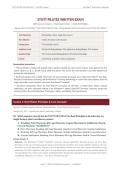
100% Correct Answers | Real Exam Format | 2026/2027 Edition
Aligned with the Merrithew™ Stott Pilates Official Written Testing Blueprint and Examination Format (2026/2027 Edition)
Total Questions 200 (multiple choice, single best answer)
Time Allowed 3 hours 30 minutes (210 minutes)
Passing Score 75% (150/200 correct)
Cognitive Levels 25% Recall | 50% Application | 25% Analysis
Question Style 70% Scenario-based | 30% Direct Knowledge
Format Closed-book, proctored, written examination
Examination Instructions
• This examination contains 200 multiple-choice questions divided into nine content sections. Each question has four
answer choices (A, B, C, D) and exactly ONE best answer. The answer key with rationales is provided beneath each
question for study purposes.
• Read each question stem carefully. Many items are scenario-based and require you to apply Stott Pilates™ Five Basic
Principles, biomechanical reasoning, and the Merrithew™ teaching methodology to a real-world client situation. Select the
single option that is most consistent with current Stott Pilates™ standards.
• Anatomical terminology follows the Stott Pilates™ convention: all references to neutral spine, imprint, scapular
stabilization, and pelvic placement conform to the Merrithew™ Manual (2026/2027 Revision). Apparatus spring-color
references follow the current Merrithew™ Reformer, Cadillac, and Stability Chair specifications.
Section 1: Stott Pilates Principles & Core Concepts
Five Basic Principles, Imprint vs. Neutral, Anatomical Planes, Muscle Slings, Breath Mechanics
Questions Q1–Q25 | Cognitive mix: Recall / Application / Analysis
Q1. Which sequence correctly lists the STOTT PILATES® Five Basic Principles in the order they are
taught during a client’s introductory session?
A. Breathing, Pelvic Placement, Rib Cage Placement, Scapular Movement & Stabilization, Head &
Cervical Placement *[CORRECT]*
B. Pelvic Placement, Breathing, Rib Cage Placement, Head & Cervical Placement, Scapular Stabilization
C. Breathing, Rib Cage Placement, Pelvic Placement, Scapular Stabilization, Head & Cervical Placement
D. Scapular Stabilization, Breathing, Pelvic Placement, Rib Cage Placement, Head & Cervical Placement
Correct Answer: A
Rationale: The Merrithew™ STOTT PILATES® Instructor Manual (2026/2027 Revision) presents the Five Basic
Principles in this exact teaching sequence because each principle establishes the proximal stability needed for the next:
breath first to set the deep system, then pelvic and rib placement to anchor the torso, then scapular and finally cervical
positioning. The other sequences either place rib cage before pelvic placement (which removes the proximal anchor the
rib cage depends on) or begin with scapular stabilization before breath (which destabilizes the thorax before the breath is
established). [Blueprint ref: Section 1 – Five Basic Principles, Recall]
Page 1 | Official Certification Examination | Confidential
,STOTT PILATES WRITTEN EXAM | 2026/2027 Edition Merrithew™ Stott Pilates Certification
Q2. A new client is taught the STOTT PILATES® breathing pattern. Which cue most accurately reflects
the contemporary STOTT® three-dimensional breath instruction?
A. Inhale through the nose and exhale through pursed lips while drawing the navel forcefully to the spine
B. Inhale through the nose directing breath into the lateral and posterior aspects of the ribcage;
exhale through the lips allowing the ribs to soften and close in and down *[CORRECT]*
C. Inhale through the mouth to expand the chest maximally, then exhale through the nose while pushing the
abdominal wall outward
D. Inhale and exhale exclusively through the nose while maintaining a braced, hard abdominal wall
throughout the breath cycle
Correct Answer: B
Rationale: STOTT PILATES® uses a 3-D lateral/posterior costal breath: nasal inhalation expands the ribcage laterally
and posteriorly (mobilizing the often-rigid thoracic spine), and oral exhalation allows the ribs to artfully close
(DOWN-IN) while engaging the deep abdominals. This differs from classical Pilates’ forceful navel-to-spine brace and
from chest-breathing through the mouth. The 3-D breath supports oxygenation, thoracic mobility, and deep core
recruitment simultaneously. [Blueprint ref: Section 1 – Breathing Principle, Application]
Q3. A 35-year-old postnatal client (10 weeks postpartum, vaginal delivery) is performing the Hundred on
the mat with both legs in table-top. Which pelvic placement is the STOTT® default for this exercise in this
population?
A. Neutral spine, because neutral maintains natural lumbar lordosis and protects the discs
B. Imprint, because the legs are unloaded from the floor and imprint recruits the obliques to stabilize
against shear *[CORRECT]*
C. Neither; she should be supine with the spine in extension to counter the thoracic kyphosis of nursing
D. A forced posterior pelvic tilt sustained by maximal gluteal contraction to fix the pelvis
Correct Answer: B
Rationale: STOTT® teaches that whenever the feet leave the support of the floor (table-top, 90/90, or legs extending), the
load on the lumbar spine increases and the pelvis is placed in a slight imprint to recruit the obliques and prevent the hip
flexors from pulling the lumbar into extension. Neutral is reserved for closed-chain or supported-foot positions.
Postpartum clients further benefit from imprint’s activation of the lower abdominals and pelvic floor. Forcing a maximal
posterior tilt or gluteal brace is non-STOTT® and creates excessive compression. [Blueprint ref: Section 1 – Pelvic
Placement, Application]
Q4. During supine footwork on the Reformer, an instructor cues a client to “maintain a neutral spine
while keeping the lower ribs softly connected to the mat.” Which STOTT® principle is the cue primarily
reinforcing?
A. Pelvic Placement, because rib position always mirrors pelvic position
B. Rib Cage Placement, because the ribcage must remain connected to the pelvis through the
abdominal wall to prevent thoracic extension and lumbar compensation *[CORRECT]*
C. Breathing, because rib connection is exclusively a respiratory cue
D. Head & Cervical Placement, because the ribs dictate head position in supine
Correct Answer: B
Rationale: The Rib Cage Placement principle states that the ribcage must remain in line with the pelvis — specifically, the
lower ribs should not “pop” or extend away from the mat during limb load. This is achieved through abdominal
(especially oblique) engagement. Disconnection of the ribs is a primary compensation pattern that drives lumbar
extension. Breathing and pelvic placement are related but secondary in this specific cue. [Blueprint ref: Section 1 – Rib
Cage Placement, Application]
Page 2 | Official Certification Examination | Confidential
,STOTT PILATES WRITTEN EXAM | 2026/2027 Edition Merrithew™ Stott Pilates Certification
Q5. A client performing the Hundred keeps elevating and protracting the shoulders when lifting the head
and arms. Which scapular action is the instructor aiming to cue?
A. Scapular depression and stabilization against elevation and protraction *[CORRECT]*
B. Scapular elevation to counter the forward head posture
C. Scapular protraction to maintain contact with the anterior chest wall
D. Scapular anterior tilt to deepen the abdominal curl
Correct Answer: A
Rationale: The Scapular Movement & Stabilization principle identifies the ideal resting position of the scapulae as
neutral (with slight upward rotation on the thorax). When the arms and head lift during the Hundred, the upper trapezius
and levator scapulae commonly dominate, producing elevation and protraction. The correct cue is to depress and stabilize
the scapulae, recruiting the lower trapezius and serratus anterior. Elevation, protraction, or anterior tilt would reinforce
the very dysfunction the principle is designed to prevent. [Blueprint ref: Section 1 – Scapular Stabilization, Application]
Q6. A tall client with a long cervical spine is set up for the Hundred on the mat with a small head cushion.
The instructor observes the chin jamming into the chest. Which modification aligns with the STOTT®
Head & Cervical Placement principle?
A. Remove the cushion entirely to promote cervical flexion from a flat surface
B. Add a second, firmer cushion (head pad stack) so the cervical spine maintains its natural curve
and the head is supported in line with the thoracic spine *[CORRECT]*
C. Place a rolled towel under the cervical spine only, leaving the occiput unsupported to encourage
posterior neck activation
D. No modification is needed; a jammed chin is the desired end-range cervical flexion in STOTT®
Correct Answer: B
Rationale: The Head & Cervical Placement principle states that the cervical spine should continue the curve initiated in
the thoracic spine — neither over-flexed (chin jam) nor extended. Clients with longer necks or a larger occiput require a
stacked cushion system to keep the head supported in line. Removing support, partial support, or accepting chin-jam are
direct violations of the principle and increase risk of cervical strain and vertebral artery compression. [Blueprint ref:
Section 1 – Head & Cervical Placement, Application]
Q7. Which of the following is the STOTT® definition of “imprint” as applied to pelvic placement?
A. A maximal posterior pelvic tilt that flattens the lumbar spine against the mat for the duration of the
session
B. A slight posterior pelvic tilt accompanied by a gentle engagement of the oblique abdominals, used
to recruit deep stabilizers and protect the lumbar spine in loaded open-chain positions
*[CORRECT]*
C. A forced lumbar extension to counter a flat-back posture
D. An anterior pelvic tilt designed to enhance lumbar lordosis during exercise
Correct Answer: B
Rationale: STOTT® defines imprint as a gentle, slight posterior pelvic tilt produced by activation of the oblique
abdominals (not the gluteals). It is NOT a maximal flatten-and-hold position; it is a recruitment strategy used when the
legs are off the mat or when the lumbar spine requires additional stabilization. The Merrithew™ Manual explicitly warns
against gluteal-driven imprint, which compresses the sacrum and inhibits the deep system. [Blueprint ref: Section 1 –
Imprint vs. Neutral, Recall]
Q8. A healthy 28-year-old client is performing the Single Leg Stretch on the mat. Both feet cycle through
the air. According to STOTT® protocol, which pelvic placement should be cued and why?
Page 3 | Official Certification Examination | Confidential
, STOTT PILATES WRITTEN EXAM | 2026/2027 Edition Merrithew™ Stott Pilates Certification
A. Neutral spine, because the legs are cycling symmetrically
B. Imprint, because the non-supporting leg is unloaded from the floor and the lumbar spine requires
the oblique recruitment that imprint provides *[CORRECT]*
C. Neutral spine with a heavy gluteal squeeze to lock the pelvis
D. A slight anterior tilt to allow the psoas full excursion
Correct Answer: B
Rationale: Single Leg Stretch has both feet off the mat at all times (one in table-top, one extended). Because the legs are
unloaded, the hip flexors create extension torque on the lumbar spine. STOTT® protocol places the pelvis in imprint to
engage the obliques and stabilize against this torque. Neutral is reserved for foot-supported positions. Gluteal squeezing
or anterior tilt is non-STOTT® and would either compress the sacrum or exacerbate lumbar extension. [Blueprint ref:
Section 1 – Imprint vs. Neutral, Application]
Q9. A client with a known lumbar disc herniation (L4-L5, lateral, currently symptomatic) presents for a
session. The instructor is selecting a pelvic placement for supine footwork. Which choice best reflects the
STOTT® protocol for symptomatic disc pathology?
A. Neutral spine throughout, because neutral preserves the natural lordosis recommended for disc health
B. Sustained imprint and avoidance of loaded spinal flexion; the session should be reorganized
around neutral pelvic placement for stance and imprint for supine work, with flexion-based
abdominal series deferred entirely *[CORRECT]*
C. Heavy posterior tilt with both knees pulled to the chest to traction the lumbar spine
D. A sequence of repeated lumbar extensions to “reduce” the disc bulge
Correct Answer: B
Rationale: For a symptomatic disc herniation, the STOTT® protocol is to avoid loaded flexion (which increases posterior
disc pressure) and to prefer imprint only in unloaded neutral-pelvic positions or to substitute prone extension work. Spinal
flexion series (Roll Up, Hundred with feet down transitioning, etc.) are deferred until the client is asymptomatic with
physician clearance. Repeated extension without medical guidance, sustained heavy posterior tilt, or maximal traction is
outside scope of practice. [Blueprint ref: Section 1 – Imprint vs. Neutral, Analysis]
Q10. Which anatomical plane divides the body into left and right portions and contains movements such
as flexion and extension?
A. Frontal (coronal) plane
B. Transverse (horizontal) plane
C. Sagittal plane *[CORRECT]*
D. Oblique plane
Correct Answer: C
Rationale: The sagittal plane divides the body into left and right portions; movements occurring within this plane are
flexion and extension (e.g., hip flexion/extension in Footwork, cervical flexion in Hundred). The frontal plane divides front
from back (abduction/adduction); the transverse plane divides top from bottom (rotation). An oblique plane is any plane
not aligned to these three cardinal planes. [Blueprint ref: Section 1 – Anatomical Planes, Recall]
Q11. A client is performing Side Leg Kicks on the mat. The top leg performs a forward kick (anterior
swing) and a backward kick (posterior swing). Which plane of motion is dominant?
A. Frontal plane — abduction/adduction of the hip
B. Transverse plane — internal/external rotation of the hip
C. Sagittal plane — flexion and extension of the hip *[CORRECT]*
D. Oblique plane — combined adduction and rotation
Page 4 | Official Certification Examination | Confidential
STOTT PILATES WRITTEN EXAM
100% Correct Answers | Real Exam Format | 2026/2027 Edition
Aligned with the Merrithew™ Stott Pilates Official Written Testing Blueprint and Examination Format (2026/2027 Edition)
Total Questions 200 (multiple choice, single best answer)
Time Allowed 3 hours 30 minutes (210 minutes)
Passing Score 75% (150/200 correct)
Cognitive Levels 25% Recall | 50% Application | 25% Analysis
Question Style 70% Scenario-based | 30% Direct Knowledge
Format Closed-book, proctored, written examination
Examination Instructions
• This examination contains 200 multiple-choice questions divided into nine content sections. Each question has four
answer choices (A, B, C, D) and exactly ONE best answer. The answer key with rationales is provided beneath each
question for study purposes.
• Read each question stem carefully. Many items are scenario-based and require you to apply Stott Pilates™ Five Basic
Principles, biomechanical reasoning, and the Merrithew™ teaching methodology to a real-world client situation. Select the
single option that is most consistent with current Stott Pilates™ standards.
• Anatomical terminology follows the Stott Pilates™ convention: all references to neutral spine, imprint, scapular
stabilization, and pelvic placement conform to the Merrithew™ Manual (2026/2027 Revision). Apparatus spring-color
references follow the current Merrithew™ Reformer, Cadillac, and Stability Chair specifications.
Section 1: Stott Pilates Principles & Core Concepts
Five Basic Principles, Imprint vs. Neutral, Anatomical Planes, Muscle Slings, Breath Mechanics
Questions Q1–Q25 | Cognitive mix: Recall / Application / Analysis
Q1. Which sequence correctly lists the STOTT PILATES® Five Basic Principles in the order they are
taught during a client’s introductory session?
A. Breathing, Pelvic Placement, Rib Cage Placement, Scapular Movement & Stabilization, Head &
Cervical Placement *[CORRECT]*
B. Pelvic Placement, Breathing, Rib Cage Placement, Head & Cervical Placement, Scapular Stabilization
C. Breathing, Rib Cage Placement, Pelvic Placement, Scapular Stabilization, Head & Cervical Placement
D. Scapular Stabilization, Breathing, Pelvic Placement, Rib Cage Placement, Head & Cervical Placement
Correct Answer: A
Rationale: The Merrithew™ STOTT PILATES® Instructor Manual (2026/2027 Revision) presents the Five Basic
Principles in this exact teaching sequence because each principle establishes the proximal stability needed for the next:
breath first to set the deep system, then pelvic and rib placement to anchor the torso, then scapular and finally cervical
positioning. The other sequences either place rib cage before pelvic placement (which removes the proximal anchor the
rib cage depends on) or begin with scapular stabilization before breath (which destabilizes the thorax before the breath is
established). [Blueprint ref: Section 1 – Five Basic Principles, Recall]
Page 1 | Official Certification Examination | Confidential
,STOTT PILATES WRITTEN EXAM | 2026/2027 Edition Merrithew™ Stott Pilates Certification
Q2. A new client is taught the STOTT PILATES® breathing pattern. Which cue most accurately reflects
the contemporary STOTT® three-dimensional breath instruction?
A. Inhale through the nose and exhale through pursed lips while drawing the navel forcefully to the spine
B. Inhale through the nose directing breath into the lateral and posterior aspects of the ribcage;
exhale through the lips allowing the ribs to soften and close in and down *[CORRECT]*
C. Inhale through the mouth to expand the chest maximally, then exhale through the nose while pushing the
abdominal wall outward
D. Inhale and exhale exclusively through the nose while maintaining a braced, hard abdominal wall
throughout the breath cycle
Correct Answer: B
Rationale: STOTT PILATES® uses a 3-D lateral/posterior costal breath: nasal inhalation expands the ribcage laterally
and posteriorly (mobilizing the often-rigid thoracic spine), and oral exhalation allows the ribs to artfully close
(DOWN-IN) while engaging the deep abdominals. This differs from classical Pilates’ forceful navel-to-spine brace and
from chest-breathing through the mouth. The 3-D breath supports oxygenation, thoracic mobility, and deep core
recruitment simultaneously. [Blueprint ref: Section 1 – Breathing Principle, Application]
Q3. A 35-year-old postnatal client (10 weeks postpartum, vaginal delivery) is performing the Hundred on
the mat with both legs in table-top. Which pelvic placement is the STOTT® default for this exercise in this
population?
A. Neutral spine, because neutral maintains natural lumbar lordosis and protects the discs
B. Imprint, because the legs are unloaded from the floor and imprint recruits the obliques to stabilize
against shear *[CORRECT]*
C. Neither; she should be supine with the spine in extension to counter the thoracic kyphosis of nursing
D. A forced posterior pelvic tilt sustained by maximal gluteal contraction to fix the pelvis
Correct Answer: B
Rationale: STOTT® teaches that whenever the feet leave the support of the floor (table-top, 90/90, or legs extending), the
load on the lumbar spine increases and the pelvis is placed in a slight imprint to recruit the obliques and prevent the hip
flexors from pulling the lumbar into extension. Neutral is reserved for closed-chain or supported-foot positions.
Postpartum clients further benefit from imprint’s activation of the lower abdominals and pelvic floor. Forcing a maximal
posterior tilt or gluteal brace is non-STOTT® and creates excessive compression. [Blueprint ref: Section 1 – Pelvic
Placement, Application]
Q4. During supine footwork on the Reformer, an instructor cues a client to “maintain a neutral spine
while keeping the lower ribs softly connected to the mat.” Which STOTT® principle is the cue primarily
reinforcing?
A. Pelvic Placement, because rib position always mirrors pelvic position
B. Rib Cage Placement, because the ribcage must remain connected to the pelvis through the
abdominal wall to prevent thoracic extension and lumbar compensation *[CORRECT]*
C. Breathing, because rib connection is exclusively a respiratory cue
D. Head & Cervical Placement, because the ribs dictate head position in supine
Correct Answer: B
Rationale: The Rib Cage Placement principle states that the ribcage must remain in line with the pelvis — specifically, the
lower ribs should not “pop” or extend away from the mat during limb load. This is achieved through abdominal
(especially oblique) engagement. Disconnection of the ribs is a primary compensation pattern that drives lumbar
extension. Breathing and pelvic placement are related but secondary in this specific cue. [Blueprint ref: Section 1 – Rib
Cage Placement, Application]
Page 2 | Official Certification Examination | Confidential
,STOTT PILATES WRITTEN EXAM | 2026/2027 Edition Merrithew™ Stott Pilates Certification
Q5. A client performing the Hundred keeps elevating and protracting the shoulders when lifting the head
and arms. Which scapular action is the instructor aiming to cue?
A. Scapular depression and stabilization against elevation and protraction *[CORRECT]*
B. Scapular elevation to counter the forward head posture
C. Scapular protraction to maintain contact with the anterior chest wall
D. Scapular anterior tilt to deepen the abdominal curl
Correct Answer: A
Rationale: The Scapular Movement & Stabilization principle identifies the ideal resting position of the scapulae as
neutral (with slight upward rotation on the thorax). When the arms and head lift during the Hundred, the upper trapezius
and levator scapulae commonly dominate, producing elevation and protraction. The correct cue is to depress and stabilize
the scapulae, recruiting the lower trapezius and serratus anterior. Elevation, protraction, or anterior tilt would reinforce
the very dysfunction the principle is designed to prevent. [Blueprint ref: Section 1 – Scapular Stabilization, Application]
Q6. A tall client with a long cervical spine is set up for the Hundred on the mat with a small head cushion.
The instructor observes the chin jamming into the chest. Which modification aligns with the STOTT®
Head & Cervical Placement principle?
A. Remove the cushion entirely to promote cervical flexion from a flat surface
B. Add a second, firmer cushion (head pad stack) so the cervical spine maintains its natural curve
and the head is supported in line with the thoracic spine *[CORRECT]*
C. Place a rolled towel under the cervical spine only, leaving the occiput unsupported to encourage
posterior neck activation
D. No modification is needed; a jammed chin is the desired end-range cervical flexion in STOTT®
Correct Answer: B
Rationale: The Head & Cervical Placement principle states that the cervical spine should continue the curve initiated in
the thoracic spine — neither over-flexed (chin jam) nor extended. Clients with longer necks or a larger occiput require a
stacked cushion system to keep the head supported in line. Removing support, partial support, or accepting chin-jam are
direct violations of the principle and increase risk of cervical strain and vertebral artery compression. [Blueprint ref:
Section 1 – Head & Cervical Placement, Application]
Q7. Which of the following is the STOTT® definition of “imprint” as applied to pelvic placement?
A. A maximal posterior pelvic tilt that flattens the lumbar spine against the mat for the duration of the
session
B. A slight posterior pelvic tilt accompanied by a gentle engagement of the oblique abdominals, used
to recruit deep stabilizers and protect the lumbar spine in loaded open-chain positions
*[CORRECT]*
C. A forced lumbar extension to counter a flat-back posture
D. An anterior pelvic tilt designed to enhance lumbar lordosis during exercise
Correct Answer: B
Rationale: STOTT® defines imprint as a gentle, slight posterior pelvic tilt produced by activation of the oblique
abdominals (not the gluteals). It is NOT a maximal flatten-and-hold position; it is a recruitment strategy used when the
legs are off the mat or when the lumbar spine requires additional stabilization. The Merrithew™ Manual explicitly warns
against gluteal-driven imprint, which compresses the sacrum and inhibits the deep system. [Blueprint ref: Section 1 –
Imprint vs. Neutral, Recall]
Q8. A healthy 28-year-old client is performing the Single Leg Stretch on the mat. Both feet cycle through
the air. According to STOTT® protocol, which pelvic placement should be cued and why?
Page 3 | Official Certification Examination | Confidential
, STOTT PILATES WRITTEN EXAM | 2026/2027 Edition Merrithew™ Stott Pilates Certification
A. Neutral spine, because the legs are cycling symmetrically
B. Imprint, because the non-supporting leg is unloaded from the floor and the lumbar spine requires
the oblique recruitment that imprint provides *[CORRECT]*
C. Neutral spine with a heavy gluteal squeeze to lock the pelvis
D. A slight anterior tilt to allow the psoas full excursion
Correct Answer: B
Rationale: Single Leg Stretch has both feet off the mat at all times (one in table-top, one extended). Because the legs are
unloaded, the hip flexors create extension torque on the lumbar spine. STOTT® protocol places the pelvis in imprint to
engage the obliques and stabilize against this torque. Neutral is reserved for foot-supported positions. Gluteal squeezing
or anterior tilt is non-STOTT® and would either compress the sacrum or exacerbate lumbar extension. [Blueprint ref:
Section 1 – Imprint vs. Neutral, Application]
Q9. A client with a known lumbar disc herniation (L4-L5, lateral, currently symptomatic) presents for a
session. The instructor is selecting a pelvic placement for supine footwork. Which choice best reflects the
STOTT® protocol for symptomatic disc pathology?
A. Neutral spine throughout, because neutral preserves the natural lordosis recommended for disc health
B. Sustained imprint and avoidance of loaded spinal flexion; the session should be reorganized
around neutral pelvic placement for stance and imprint for supine work, with flexion-based
abdominal series deferred entirely *[CORRECT]*
C. Heavy posterior tilt with both knees pulled to the chest to traction the lumbar spine
D. A sequence of repeated lumbar extensions to “reduce” the disc bulge
Correct Answer: B
Rationale: For a symptomatic disc herniation, the STOTT® protocol is to avoid loaded flexion (which increases posterior
disc pressure) and to prefer imprint only in unloaded neutral-pelvic positions or to substitute prone extension work. Spinal
flexion series (Roll Up, Hundred with feet down transitioning, etc.) are deferred until the client is asymptomatic with
physician clearance. Repeated extension without medical guidance, sustained heavy posterior tilt, or maximal traction is
outside scope of practice. [Blueprint ref: Section 1 – Imprint vs. Neutral, Analysis]
Q10. Which anatomical plane divides the body into left and right portions and contains movements such
as flexion and extension?
A. Frontal (coronal) plane
B. Transverse (horizontal) plane
C. Sagittal plane *[CORRECT]*
D. Oblique plane
Correct Answer: C
Rationale: The sagittal plane divides the body into left and right portions; movements occurring within this plane are
flexion and extension (e.g., hip flexion/extension in Footwork, cervical flexion in Hundred). The frontal plane divides front
from back (abduction/adduction); the transverse plane divides top from bottom (rotation). An oblique plane is any plane
not aligned to these three cardinal planes. [Blueprint ref: Section 1 – Anatomical Planes, Recall]
Q11. A client is performing Side Leg Kicks on the mat. The top leg performs a forward kick (anterior
swing) and a backward kick (posterior swing). Which plane of motion is dominant?
A. Frontal plane — abduction/adduction of the hip
B. Transverse plane — internal/external rotation of the hip
C. Sagittal plane — flexion and extension of the hip *[CORRECT]*
D. Oblique plane — combined adduction and rotation
Page 4 | Official Certification Examination | Confidential

