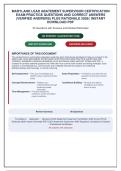
MARYLAND LEAD ABATEMENT SUPERVISOR CERTIFICATION
EXAM PRACTICE QUESTIONS AND CORRECT ANSWERS
(VERIFIED ANSWERS) PLUS RATIONALE 2026/| INSTANT
DOWNLOAD PDF
90 Questions with Answers and Detailed Rationales
100 PERCENT GUARANTEED PASS
INSTANT DOWNLOAD ANSWERS INCLUDED
IMPORTANCE OF THIS DOCUMENT
This comprehensive examination preparation guide has been meticulously developed to help you succeed in the
MARYLAND LEAD ABATEMENT SUPERVISOR CERTIFICATION EXAM PRACTICE QUESTIONS AND
CORRECT ANSWERS (VERIFIED ANSWERS) PLUS RATIONALE 2026/| INSTANT DOWNLOAD PDF. It
contains 90 carefully selected questions that reflect the most current exam content and testing strategies. Each
question is accompanied by a correct answer and a detailed rationale that explains the underlying
pathophysiology, pharmacology, or clinical reasoning.
Self-Assessment – Test your knowledge and Exam Preparation – Familiarize yourself with the
identify areas requiring further question format and content
study areas
Concept Reinforcement – Deepen your Confidence Building – Develop test-taking
understanding through strategies and reduce
evidence-based exam anxiety
rationales
Time Management – Practice answering
questions under simulated
exam conditions
Review Summary 90 Questions
Foundations - Application - Maryland LEAD Abatement Supervisor Certification AND Correct PLUS
Rationale 2026/ Instant Download PDF LEAD Abatement Supervision AND Regulatory Compliance Graduate
/ Professional Certification
All answers with rationales
,Table of Contents
Content Area Questions Key Topics
Lead-based Paint Activities 1-15 Abatement, Supervisor, Project, Paint, Determine
AND Regulations
LEAD Hazard Recognition 16-30 Abatement, Supervisor, Project, Building, Waste
AND RISK Assessment
LEAD Abatement Methods 31-45 Supervisor, Abatement, Project, Building, Maryland
AND Engineering Controls
Worker Protection AND 46-60 Supervisor, Abatement, Project, Building, LEAD DUST
Safety Practices
Interim Controls AND 61-75 Abatement, Supervisor, Project, Building, Paint
Clearance Procedures
Recordkeeping AND 76-90 Abatement, Project, Supervisor, Worker, Waste
Documentation
TOTAL 90 All questions include answers and detailed rationales
,Section A - Lead-based Paint Activities AND Regulations
Q1.
During a residential lead abatement in a pre-1978 row home, the supervisor must
determine whether the project falls under the Maryland Renovation, Repair, and Painting
(RRP) rule or the full Lead Abatement rule. Which condition would require full abatement
procedures rather than RRP?
A. The property owner intends to repaint the B. The project is a window replacement that
exterior after scraping loose paint. will disturb more than 6 square feet of lead
paint per room.
C. A licensed lead risk assessor identifies D. The renovation is performed by a certified
dust lead levels exceeding 40 µg/ft² on renovator who has completed
floors prior to any disturbance. EPA-accredited training.
Correct: C - A licensed lead risk assessor identifies dust lead levels exceeding 40 µg/ft²
on floors prior to any disturbance.
Rationale:Full abatement is required when a risk assessment identifies lead hazards (such
as dust levels above EPA clearance standards) that need permanent elimination. RRP applies
to renovations that disturb lead-based paint incidentally, not when a known hazard exists.
Window replacement and repainting are typical RRP activities, and certified renovator status
is an RRP requirement.
Why the other answers are wrong:
A. Exterior repainting with scraping is an RRP activity, not full abatement, unless a lead hazard
is already identified.
B. Window replacement is a renovation activity that falls under RRP, provided the work is
performed by certified renovators and containment is used.
D. Having a certified renovator is an RRP requirement, but it does not trigger full abatement;
full abatement is triggered by the presence of lead hazards.
Reference: Maryland Department of the Environment, Lead Abatement Regulations (COMAR 26.02.07);
EPA RRP Rule 40 CFR 745
Q2.
A lead abatement supervisor is planning a project to remove lead-based paint from a large
commercial building. The project will generate significant amounts of lead-contaminated
wastewater from wet scraping and pressure washing. Which disposal method is most
compliant with Maryland regulations?
A. Discharge the wastewater directly into the B. Collect the wastewater and test it for
municipal sewer system without treatment, lead; if below 5 ppm, discharge it to a storm
as it is a small volume. drain.
Page 3
, Section A - Lead-based Paint Activities AND Regulations
C. Collect the wastewater in a holding tank D. Evaporate the wastewater on-site and
and dispose of it as hazardous waste if it dispose of the dry residue as construction
fails TCLP, or obtain a permit for sewer debris.
discharge if it meets local pretreatment
standards.
Correct: C - Collect the wastewater in a holding tank and dispose of it as hazardous waste
if it fails TCLP, or obtain a permit for sewer discharge if it meets local pretreatment
standards.
Rationale:Lead-contaminated wastewater must be managed as a potential hazardous waste.
If it exhibits the toxicity characteristic (TCLP lead 5 mg/L), it must be disposed of as
hazardous waste. Alternatively, it may be discharged to a sanitary sewer if it meets local
pretreatment standards and a permit is obtained. Direct discharge to storm drains or
untreated sewer is prohibited. On-site evaporation may not be allowed and residue must be
tested.
Why the other answers are wrong:
A. Direct sewer discharge without treatment or permit is illegal; lead is a pollutant regulated
under the Clean Water Act.
B. Storm drains are not designed for industrial wastewater; lead must not be discharged to
stormwater systems.
D. Evaporation is not a recognized disposal method; it may create airborne lead hazards and
the residue still requires proper characterization.
Reference: 40 CFR Part 261 (TCLP); Maryland Department of the Environment, Water Management
Administration
Q3.
During a lead abatement project, a supervisor must select a HEPA vacuum for cleaning.
Which specification is critical to ensure the vacuum meets OSHA and EPA requirements
for lead dust?
A. The vacuum has a 10-gallon capacity for B. The vacuum is equipped with a HEPA
large debris. filter that captures 99.97% of particles at 0.3
microns.
C. The vacuum is labeled 'wet/dry' to handle D. The vacuum has a metal canister to
both dust and water. prevent static electricity.
Correct: B - The vacuum is equipped with a HEPA filter that captures 99.97% of particles at
0.3 microns.
Rationale:HEPA vacuums must be certified to capture 99.97% of particles at 0.3 microns to
effectively contain lead dust. Other features like capacity, wet/dry capability, or metal
construction are not the defining criteria for lead safety. OSHA and EPA explicitly require
HEPA filtration for vacuuming lead dust.
Page 4
EXAM PRACTICE QUESTIONS AND CORRECT ANSWERS
(VERIFIED ANSWERS) PLUS RATIONALE 2026/| INSTANT
DOWNLOAD PDF
90 Questions with Answers and Detailed Rationales
100 PERCENT GUARANTEED PASS
INSTANT DOWNLOAD ANSWERS INCLUDED
IMPORTANCE OF THIS DOCUMENT
This comprehensive examination preparation guide has been meticulously developed to help you succeed in the
MARYLAND LEAD ABATEMENT SUPERVISOR CERTIFICATION EXAM PRACTICE QUESTIONS AND
CORRECT ANSWERS (VERIFIED ANSWERS) PLUS RATIONALE 2026/| INSTANT DOWNLOAD PDF. It
contains 90 carefully selected questions that reflect the most current exam content and testing strategies. Each
question is accompanied by a correct answer and a detailed rationale that explains the underlying
pathophysiology, pharmacology, or clinical reasoning.
Self-Assessment – Test your knowledge and Exam Preparation – Familiarize yourself with the
identify areas requiring further question format and content
study areas
Concept Reinforcement – Deepen your Confidence Building – Develop test-taking
understanding through strategies and reduce
evidence-based exam anxiety
rationales
Time Management – Practice answering
questions under simulated
exam conditions
Review Summary 90 Questions
Foundations - Application - Maryland LEAD Abatement Supervisor Certification AND Correct PLUS
Rationale 2026/ Instant Download PDF LEAD Abatement Supervision AND Regulatory Compliance Graduate
/ Professional Certification
All answers with rationales
,Table of Contents
Content Area Questions Key Topics
Lead-based Paint Activities 1-15 Abatement, Supervisor, Project, Paint, Determine
AND Regulations
LEAD Hazard Recognition 16-30 Abatement, Supervisor, Project, Building, Waste
AND RISK Assessment
LEAD Abatement Methods 31-45 Supervisor, Abatement, Project, Building, Maryland
AND Engineering Controls
Worker Protection AND 46-60 Supervisor, Abatement, Project, Building, LEAD DUST
Safety Practices
Interim Controls AND 61-75 Abatement, Supervisor, Project, Building, Paint
Clearance Procedures
Recordkeeping AND 76-90 Abatement, Project, Supervisor, Worker, Waste
Documentation
TOTAL 90 All questions include answers and detailed rationales
,Section A - Lead-based Paint Activities AND Regulations
Q1.
During a residential lead abatement in a pre-1978 row home, the supervisor must
determine whether the project falls under the Maryland Renovation, Repair, and Painting
(RRP) rule or the full Lead Abatement rule. Which condition would require full abatement
procedures rather than RRP?
A. The property owner intends to repaint the B. The project is a window replacement that
exterior after scraping loose paint. will disturb more than 6 square feet of lead
paint per room.
C. A licensed lead risk assessor identifies D. The renovation is performed by a certified
dust lead levels exceeding 40 µg/ft² on renovator who has completed
floors prior to any disturbance. EPA-accredited training.
Correct: C - A licensed lead risk assessor identifies dust lead levels exceeding 40 µg/ft²
on floors prior to any disturbance.
Rationale:Full abatement is required when a risk assessment identifies lead hazards (such
as dust levels above EPA clearance standards) that need permanent elimination. RRP applies
to renovations that disturb lead-based paint incidentally, not when a known hazard exists.
Window replacement and repainting are typical RRP activities, and certified renovator status
is an RRP requirement.
Why the other answers are wrong:
A. Exterior repainting with scraping is an RRP activity, not full abatement, unless a lead hazard
is already identified.
B. Window replacement is a renovation activity that falls under RRP, provided the work is
performed by certified renovators and containment is used.
D. Having a certified renovator is an RRP requirement, but it does not trigger full abatement;
full abatement is triggered by the presence of lead hazards.
Reference: Maryland Department of the Environment, Lead Abatement Regulations (COMAR 26.02.07);
EPA RRP Rule 40 CFR 745
Q2.
A lead abatement supervisor is planning a project to remove lead-based paint from a large
commercial building. The project will generate significant amounts of lead-contaminated
wastewater from wet scraping and pressure washing. Which disposal method is most
compliant with Maryland regulations?
A. Discharge the wastewater directly into the B. Collect the wastewater and test it for
municipal sewer system without treatment, lead; if below 5 ppm, discharge it to a storm
as it is a small volume. drain.
Page 3
, Section A - Lead-based Paint Activities AND Regulations
C. Collect the wastewater in a holding tank D. Evaporate the wastewater on-site and
and dispose of it as hazardous waste if it dispose of the dry residue as construction
fails TCLP, or obtain a permit for sewer debris.
discharge if it meets local pretreatment
standards.
Correct: C - Collect the wastewater in a holding tank and dispose of it as hazardous waste
if it fails TCLP, or obtain a permit for sewer discharge if it meets local pretreatment
standards.
Rationale:Lead-contaminated wastewater must be managed as a potential hazardous waste.
If it exhibits the toxicity characteristic (TCLP lead 5 mg/L), it must be disposed of as
hazardous waste. Alternatively, it may be discharged to a sanitary sewer if it meets local
pretreatment standards and a permit is obtained. Direct discharge to storm drains or
untreated sewer is prohibited. On-site evaporation may not be allowed and residue must be
tested.
Why the other answers are wrong:
A. Direct sewer discharge without treatment or permit is illegal; lead is a pollutant regulated
under the Clean Water Act.
B. Storm drains are not designed for industrial wastewater; lead must not be discharged to
stormwater systems.
D. Evaporation is not a recognized disposal method; it may create airborne lead hazards and
the residue still requires proper characterization.
Reference: 40 CFR Part 261 (TCLP); Maryland Department of the Environment, Water Management
Administration
Q3.
During a lead abatement project, a supervisor must select a HEPA vacuum for cleaning.
Which specification is critical to ensure the vacuum meets OSHA and EPA requirements
for lead dust?
A. The vacuum has a 10-gallon capacity for B. The vacuum is equipped with a HEPA
large debris. filter that captures 99.97% of particles at 0.3
microns.
C. The vacuum is labeled 'wet/dry' to handle D. The vacuum has a metal canister to
both dust and water. prevent static electricity.
Correct: B - The vacuum is equipped with a HEPA filter that captures 99.97% of particles at
0.3 microns.
Rationale:HEPA vacuums must be certified to capture 99.97% of particles at 0.3 microns to
effectively contain lead dust. Other features like capacity, wet/dry capability, or metal
construction are not the defining criteria for lead safety. OSHA and EPA explicitly require
HEPA filtration for vacuuming lead dust.
Page 4