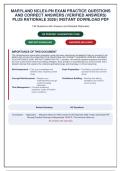
MARYLAND NCLEX-PN EXAM PRACTICE QUESTIONS
AND CORRECT ANSWERS (VERIFIED ANSWERS)
PLUS RATIONALE 2026/| INSTANT DOWNLOAD PDF
140 Questions with Answers and Detailed Rationales
100 PERCENT GUARANTEED PASS
INSTANT DOWNLOAD ANSWERS INCLUDED
IMPORTANCE OF THIS DOCUMENT
This comprehensive examination preparation guide has been meticulously developed to help you succeed in the
MARYLAND NCLEX-PN EXAM PRACTICE QUESTIONS AND CORRECT ANSWERS (VERIFIED ANSWERS)
PLUS RATIONALE 2026/| INSTANT DOWNLOAD PDF. It contains 140 carefully selected questions that reflect
the most current exam content and testing strategies. Each question is accompanied by a correct answer and a
detailed rationale that explains the underlying pathophysiology, pharmacology, or clinical reasoning.
Self-Assessment – Test your knowledge and Exam Preparation – Familiarize yourself with the
identify areas requiring further question format and content
study areas
Concept Reinforcement – Deepen your Confidence Building – Develop test-taking
understanding through strategies and reduce
evidence-based exam anxiety
rationales
Time Management – Practice answering
questions under simulated
exam conditions
Review Summary 140 Questions
Foundations - Application - Maryland Nclex-pn AND Correct PLUS Rationale 2026/ Instant Download PDF
Nursing Practical Nursing Undergraduate YEAR 3 / Pre-licensure Nclex-pn
All answers with rationales
,Table of Contents
Content Area Questions Key Topics
Management OF CARE 1-24 Finding, Indicates, Prescribed, Receiving, Immediate
Safety AND Infection Control 25-48 Finding, Indicates, Prescribed, Laboratory Value, Requires
Health Promotion AND 49-72 Prescribed, Disease, Indicates, Chronic, Teaching
Maintenance
Psychosocial Integrity 73-96 Medication, Finding, Receiving, Infusion, Results
Basic CARE AND Comfort 97-120 Finding, Receiving, Indicates, Laboratory, Blood
Pharmacological Therapies 121-140 Medication, Indicates, Hours, Teaching, Continuous
TOTAL 140 All questions include answers and detailed rationales
,Section A - Management OF CARE
Q1.
A client with a history of chronic alcohol use is admitted with confusion, ataxia, and
ophthalmoplegia. Which medication should the nurse anticipate administering first?
A. Thiamine 100 mg IV B. Lorazepam 2 mg IV
C. Naloxone 0.4 mg IV D. Dextrose 50% IV
Correct: A - Thiamine 100 mg IV
Rationale:The client likely has Wernicke encephalopathy, a medical emergency. Thiamine
must be given before any glucose-containing IV fluids to prevent precipitation of Korsakoff
syndrome. Lorazepam treats withdrawal but doesn't address the underlying deficiency.
Naloxone is for opioid overdose, and dextrose without thiamine can worsen the condition.
Why the other answers are wrong:
B. Lorazepam treats alcohol withdrawal symptoms but does not address the thiamine
deficiency causing the triad.
C. Naloxone is indicated for opioid overdose, not alcohol-induced encephalopathy.
D. Dextrose should be given only after thiamine to avoid precipitating Wernicke-Korsakoff
syndrome.
Reference: Lewis, S. M., et al. (2026). Medical-Surgical Nursing, 11th Ed., Ch. 10
Q2.
A nurse is reviewing the laboratory results of a client with chronic kidney disease. Which
finding would most warrant immediate intervention?
A. Potassium 6.2 mEq/L B. Hemoglobin 9.8 g/dL
C. Phosphorus 5.0 mg/dL D. Creatinine 2.8 mg/dL
Correct: A - Potassium 6.2 mEq/L
Rationale:Potassium of 6.2 mEq/L is critically high and can cause life-threatening cardiac
arrhythmias. The nurse should immediately notify the provider and prepare for interventions
such as calcium gluconate, insulin/glucose, or dialysis. While anemia, hyperphosphatemia,
and elevated creatinine are concerning, they do not pose the same immediate risk of cardiac
arrest.
Why the other answers are wrong:
B. Hemoglobin of 9.8 g/dL indicates anemia but is not an immediate life-threatening
emergency.
C. Phosphorus of 5.0 mg/dL is slightly elevated and requires dietary management, not
immediate action.
Page 3
, Section A - Management OF CARE
D. Creatinine of 2.8 mg/dL indicates renal impairment but is not an acute emergency.
Reference: Ignatavicius, D. D., & Workman, M. L. (2026). Medical-Surgical Nursing, 10th Ed., Ch. 56
Q3.
Which instruction should the nurse include when teaching a client about the use of an
albuterol metered-dose inhaler?
A. Shake the inhaler well before each use. B. Inhale slowly and deeply while pressing
the canister.
C. Wait at least 5 minutes between puffs. D. Use the inhaler only when symptoms
occur.
Correct: A - Shake the inhaler well before each use.
Rationale:Shaking the inhaler ensures proper mixing of the medication and propellant, which
is essential for consistent dosing. Slow inhalation is correct but should be coordinated with
pressing the canister, not necessarily 'slowly and deeply' as a separate step. Waiting 5
minutes between puffs is not standard; 1-2 minutes is typical. Albuterol is a rescue inhaler
and should be used as prescribed, not only when symptoms occur if a scheduled dose is
ordered.
Why the other answers are wrong:
B. Inhalation should be slow and deep, but the key is coordination with actuation; the statement
as written is incomplete.
C. The recommended interval between puffs is 1-2 minutes, not 5.
D. Clients with scheduled doses should take them regularly, not only when symptomatic.
Reference: Lilley, L. L., et al. (2026). Pharmacology for Nursing Care, 11th Ed., Ch. 34
Q4.
A nurse is assessing a client who is receiving a blood transfusion. Which finding indicates
the need to stop the transfusion immediately?
A. Temperature increase of 1°C B. Flank pain
C. Mild itching D. Anxiety
Correct: B - Flank pain
Rationale:Flank pain is a classic sign of acute hemolytic transfusion reaction, a medical
emergency requiring immediate discontinuation. A temperature increase of 1°C indicates a
febrile reaction, which also requires stopping but is less immediately life-threatening. Mild
itching may indicate an allergic reaction, but flank pain suggests hemolysis. Anxiety is
non-specific.
Why the other answers are wrong:
A. A temperature increase of 1°C is a febrile reaction but not as immediately life-threatening as
Page 4
AND CORRECT ANSWERS (VERIFIED ANSWERS)
PLUS RATIONALE 2026/| INSTANT DOWNLOAD PDF
140 Questions with Answers and Detailed Rationales
100 PERCENT GUARANTEED PASS
INSTANT DOWNLOAD ANSWERS INCLUDED
IMPORTANCE OF THIS DOCUMENT
This comprehensive examination preparation guide has been meticulously developed to help you succeed in the
MARYLAND NCLEX-PN EXAM PRACTICE QUESTIONS AND CORRECT ANSWERS (VERIFIED ANSWERS)
PLUS RATIONALE 2026/| INSTANT DOWNLOAD PDF. It contains 140 carefully selected questions that reflect
the most current exam content and testing strategies. Each question is accompanied by a correct answer and a
detailed rationale that explains the underlying pathophysiology, pharmacology, or clinical reasoning.
Self-Assessment – Test your knowledge and Exam Preparation – Familiarize yourself with the
identify areas requiring further question format and content
study areas
Concept Reinforcement – Deepen your Confidence Building – Develop test-taking
understanding through strategies and reduce
evidence-based exam anxiety
rationales
Time Management – Practice answering
questions under simulated
exam conditions
Review Summary 140 Questions
Foundations - Application - Maryland Nclex-pn AND Correct PLUS Rationale 2026/ Instant Download PDF
Nursing Practical Nursing Undergraduate YEAR 3 / Pre-licensure Nclex-pn
All answers with rationales
,Table of Contents
Content Area Questions Key Topics
Management OF CARE 1-24 Finding, Indicates, Prescribed, Receiving, Immediate
Safety AND Infection Control 25-48 Finding, Indicates, Prescribed, Laboratory Value, Requires
Health Promotion AND 49-72 Prescribed, Disease, Indicates, Chronic, Teaching
Maintenance
Psychosocial Integrity 73-96 Medication, Finding, Receiving, Infusion, Results
Basic CARE AND Comfort 97-120 Finding, Receiving, Indicates, Laboratory, Blood
Pharmacological Therapies 121-140 Medication, Indicates, Hours, Teaching, Continuous
TOTAL 140 All questions include answers and detailed rationales
,Section A - Management OF CARE
Q1.
A client with a history of chronic alcohol use is admitted with confusion, ataxia, and
ophthalmoplegia. Which medication should the nurse anticipate administering first?
A. Thiamine 100 mg IV B. Lorazepam 2 mg IV
C. Naloxone 0.4 mg IV D. Dextrose 50% IV
Correct: A - Thiamine 100 mg IV
Rationale:The client likely has Wernicke encephalopathy, a medical emergency. Thiamine
must be given before any glucose-containing IV fluids to prevent precipitation of Korsakoff
syndrome. Lorazepam treats withdrawal but doesn't address the underlying deficiency.
Naloxone is for opioid overdose, and dextrose without thiamine can worsen the condition.
Why the other answers are wrong:
B. Lorazepam treats alcohol withdrawal symptoms but does not address the thiamine
deficiency causing the triad.
C. Naloxone is indicated for opioid overdose, not alcohol-induced encephalopathy.
D. Dextrose should be given only after thiamine to avoid precipitating Wernicke-Korsakoff
syndrome.
Reference: Lewis, S. M., et al. (2026). Medical-Surgical Nursing, 11th Ed., Ch. 10
Q2.
A nurse is reviewing the laboratory results of a client with chronic kidney disease. Which
finding would most warrant immediate intervention?
A. Potassium 6.2 mEq/L B. Hemoglobin 9.8 g/dL
C. Phosphorus 5.0 mg/dL D. Creatinine 2.8 mg/dL
Correct: A - Potassium 6.2 mEq/L
Rationale:Potassium of 6.2 mEq/L is critically high and can cause life-threatening cardiac
arrhythmias. The nurse should immediately notify the provider and prepare for interventions
such as calcium gluconate, insulin/glucose, or dialysis. While anemia, hyperphosphatemia,
and elevated creatinine are concerning, they do not pose the same immediate risk of cardiac
arrest.
Why the other answers are wrong:
B. Hemoglobin of 9.8 g/dL indicates anemia but is not an immediate life-threatening
emergency.
C. Phosphorus of 5.0 mg/dL is slightly elevated and requires dietary management, not
immediate action.
Page 3
, Section A - Management OF CARE
D. Creatinine of 2.8 mg/dL indicates renal impairment but is not an acute emergency.
Reference: Ignatavicius, D. D., & Workman, M. L. (2026). Medical-Surgical Nursing, 10th Ed., Ch. 56
Q3.
Which instruction should the nurse include when teaching a client about the use of an
albuterol metered-dose inhaler?
A. Shake the inhaler well before each use. B. Inhale slowly and deeply while pressing
the canister.
C. Wait at least 5 minutes between puffs. D. Use the inhaler only when symptoms
occur.
Correct: A - Shake the inhaler well before each use.
Rationale:Shaking the inhaler ensures proper mixing of the medication and propellant, which
is essential for consistent dosing. Slow inhalation is correct but should be coordinated with
pressing the canister, not necessarily 'slowly and deeply' as a separate step. Waiting 5
minutes between puffs is not standard; 1-2 minutes is typical. Albuterol is a rescue inhaler
and should be used as prescribed, not only when symptoms occur if a scheduled dose is
ordered.
Why the other answers are wrong:
B. Inhalation should be slow and deep, but the key is coordination with actuation; the statement
as written is incomplete.
C. The recommended interval between puffs is 1-2 minutes, not 5.
D. Clients with scheduled doses should take them regularly, not only when symptomatic.
Reference: Lilley, L. L., et al. (2026). Pharmacology for Nursing Care, 11th Ed., Ch. 34
Q4.
A nurse is assessing a client who is receiving a blood transfusion. Which finding indicates
the need to stop the transfusion immediately?
A. Temperature increase of 1°C B. Flank pain
C. Mild itching D. Anxiety
Correct: B - Flank pain
Rationale:Flank pain is a classic sign of acute hemolytic transfusion reaction, a medical
emergency requiring immediate discontinuation. A temperature increase of 1°C indicates a
febrile reaction, which also requires stopping but is less immediately life-threatening. Mild
itching may indicate an allergic reaction, but flank pain suggests hemolysis. Anxiety is
non-specific.
Why the other answers are wrong:
A. A temperature increase of 1°C is a febrile reaction but not as immediately life-threatening as
Page 4