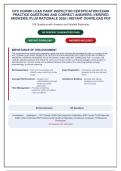
NYC DOHMH LEAD PAINT INSPECTOR CERTIFICATION EXAM
PRACTICE QUESTIONS AND CORRECT ANSWERS (VERIFIED
ANSWERS) PLUS RATIONALE 2026/| INSTANT DOWNLOAD PDF
109 Questions with Answers and Detailed Rationales
100 PERCENT GUARANTEED PASS
INSTANT DOWNLOAD ANSWERS INCLUDED
IMPORTANCE OF THIS DOCUMENT
This comprehensive examination preparation guide has been meticulously developed to help you succeed in the
NYC DOHMH LEAD PAINT INSPECTOR CERTIFICATION EXAM PRACTICE QUESTIONS AND CORRECT
ANSWERS (VERIFIED ANSWERS) PLUS RATIONALE 2026/| INSTANT DOWNLOAD PDF. It contains 109
carefully selected questions that reflect the most current exam content and testing strategies. Each question is
accompanied by a correct answer and a detailed rationale that explains the underlying pathophysiology,
pharmacology, or clinical reasoning.
Self-Assessment – Test your knowledge and Exam Preparation – Familiarize yourself with the
identify areas requiring further question format and content
study areas
Concept Reinforcement – Deepen your Confidence Building – Develop test-taking
understanding through strategies and reduce
evidence-based exam anxiety
rationales
Time Management – Practice answering
questions under simulated
exam conditions
Review Summary 109 Questions
Foundations - Application - NYC Dohmh LEAD Paint Inspector Certification AND Correct PLUS Rationale
2026/ Instant Download PDF Environmental Health & Regulatory Compliance Graduate / Professional
Certification
All answers with rationales
,Table of Contents
Content Area Questions Key Topics
Lead-based Paint Hazards 1-19 Inspector, Paint, Building, NYC Dohmh, Owner
AND Health Effects
Federal State AND Local 20-38 Paint, Lead-based, Window, Building, LEAD Abatement
Regulations EPA HUD NYC
Dohmh
Inspection Methods AND 39-57 Paint, Inspector, Building, Required, DUST WIPE
Equipment XRF Paint Testing
RISK Assessment AND 58-76 Paint, Inspector, Lead-based, Building, Required
Evaluation Procedures
LEAD Abatement AND 77-95 Inspector, Paint, Building, Owner, DUST WIPE
Containment Strategies
Record Keeping AND 96-109 Paint, Inspector, Sampling, Property, Appropriate
Reporting Requirements
TOTAL 109 All questions include answers and detailed rationales
,Section A - Lead-based Paint Hazards AND Health Effects
Q1.
In a pre-1980 residential building with a history of renovation, an XRF reading shows 1.2
mg/cm² of lead on a window sill. The building owner claims the surface was repainted
with lead-free paint. Under NYC DOHMH rules, what action is mandated?
A. Accept the reading as non-hazardous B. Require a laboratory analysis of paint
because it is below the federal threshold of chips to confirm the XRF result due to
2.0 mg/cm². substrate interference.
C. Treat the surface as lead-based paint and D. Re-test using a different XRF instrument
require immediate abatement. because readings above 1.0 mg/cm² are
unreliable.
Correct: B - Require a laboratory analysis of paint chips to confirm the XRF result due to
substrate interference.
Rationale:NYC DOHMH and HUD regulations require that any XRF reading above 1.0
mg/cm² but below the federal 'positive' threshold of 2.0 mg/cm² must be confirmed by
laboratory analysis to rule out false positives from substrate interference. Therefore, option B
is correct. Option A misinterprets the threshold; option C is premature without confirmation;
option D is not a standard procedure.
Why the other answers are wrong:
A. The federal threshold for positive lead is 1.0 mg/cm²; readings above that are considered
positive, but confirmation may be required.
C. Immediate abatement is not mandated until the presence of lead-based paint is confirmed.
D. Re-testing with a different instrument is not a regulatory requirement; confirmation is done
via laboratory analysis.
Reference: NYC DOHMH Local Law 1 of 2004 (amended 2019), HUD Guidelines Ch. 7
Q2.
A lead inspector is called to a unit where a child has elevated blood lead levels. The unit is
in a building constructed in 1965. During the inspection, the inspector finds deteriorated
paint on a door that tests positive for lead. What is the primary legal obligation of the
property owner under NYC Local Law 1?
A. Conduct annual visual inspections and B. Perform interim control measures within
dust wipe tests until the child's blood lead 30 days and abate the hazard within 90
level drops below 5 µg/dL. days.
C. Provide relocation assistance to the D. Notify the NYC DOHMH and submit a
family at the owner's expense. lead hazard reduction plan within 15 days.
Correct: D - Notify the NYC DOHMH and submit a lead hazard reduction plan within 15
Page 3
, Section A - Lead-based Paint Hazards AND Health Effects
days.
Rationale:Under NYC Local Law 1, when a child under 6 years of age has an elevated blood
lead level (5 µg/dL) and lives in a pre-1980 building, the owner must notify DOHMH and
submit a lead hazard reduction plan within 15 days. This triggers a series of required actions.
Option A is an ongoing requirement but not the immediate legal obligation; B is a possible
later step; C is not automatically required.
Why the other answers are wrong:
A. Annual inspections are required for units with lead-based paint, but the immediate obligation
is notification and plan submission.
B. Interim control and abatement may be part of the plan, but the first mandated step is
notification.
C. Relocation is not automatically required; it depends on the nature of the hazard and interim
controls.
Reference: NYC Local Law 1 of 2004, §27-2056.6
Q3.
During a clearance examination after lead abatement, you collect dust wipe samples. The
geometric mean of the floor samples is 35 µg/ft², and the maximum is 50 µg/ft². What is
the correct interpretation under HUD guidelines?
A. The clearance fails because the B. The clearance passes because the
geometric mean exceeds the 30 µg/ft² maximum is below the 40 µg/ft² hazard
standard. level.
C. The clearance fails because the D. The clearance passes because both the
maximum exceeds the 40 µg/ft² clearance geometric mean and maximum are below
level. the 80 µg/ft² standard.
Correct: C - The clearance fails because the maximum exceeds the 40 µg/ft² clearance
level.
Rationale:HUD clearance standards for floors require that the arithmetic mean (or geometric
mean, depending on protocol) must be 40 µg/ft² and the maximum must be 40 µg/ft² for
floors. Here, the maximum is 50 µg/ft², which exceeds the 40 µg/ft² clearance level, so the
clearance fails. Option A is incorrect because the standard is 40, not 30; B misstates the
maximum; D uses the wrong standard.
Why the other answers are wrong:
A. The geometric mean standard for floors is 40 µg/ft², not 30.
B. The maximum must also be 40 µg/ft²; 50 exceeds it.
D. The 80 µg/ft² standard applies to window sills, not floors.
Reference: HUD Guidelines for the Evaluation and Control of Lead-Based Paint Hazards in Housing
(2012), Ch. 8
Page 4
PRACTICE QUESTIONS AND CORRECT ANSWERS (VERIFIED
ANSWERS) PLUS RATIONALE 2026/| INSTANT DOWNLOAD PDF
109 Questions with Answers and Detailed Rationales
100 PERCENT GUARANTEED PASS
INSTANT DOWNLOAD ANSWERS INCLUDED
IMPORTANCE OF THIS DOCUMENT
This comprehensive examination preparation guide has been meticulously developed to help you succeed in the
NYC DOHMH LEAD PAINT INSPECTOR CERTIFICATION EXAM PRACTICE QUESTIONS AND CORRECT
ANSWERS (VERIFIED ANSWERS) PLUS RATIONALE 2026/| INSTANT DOWNLOAD PDF. It contains 109
carefully selected questions that reflect the most current exam content and testing strategies. Each question is
accompanied by a correct answer and a detailed rationale that explains the underlying pathophysiology,
pharmacology, or clinical reasoning.
Self-Assessment – Test your knowledge and Exam Preparation – Familiarize yourself with the
identify areas requiring further question format and content
study areas
Concept Reinforcement – Deepen your Confidence Building – Develop test-taking
understanding through strategies and reduce
evidence-based exam anxiety
rationales
Time Management – Practice answering
questions under simulated
exam conditions
Review Summary 109 Questions
Foundations - Application - NYC Dohmh LEAD Paint Inspector Certification AND Correct PLUS Rationale
2026/ Instant Download PDF Environmental Health & Regulatory Compliance Graduate / Professional
Certification
All answers with rationales
,Table of Contents
Content Area Questions Key Topics
Lead-based Paint Hazards 1-19 Inspector, Paint, Building, NYC Dohmh, Owner
AND Health Effects
Federal State AND Local 20-38 Paint, Lead-based, Window, Building, LEAD Abatement
Regulations EPA HUD NYC
Dohmh
Inspection Methods AND 39-57 Paint, Inspector, Building, Required, DUST WIPE
Equipment XRF Paint Testing
RISK Assessment AND 58-76 Paint, Inspector, Lead-based, Building, Required
Evaluation Procedures
LEAD Abatement AND 77-95 Inspector, Paint, Building, Owner, DUST WIPE
Containment Strategies
Record Keeping AND 96-109 Paint, Inspector, Sampling, Property, Appropriate
Reporting Requirements
TOTAL 109 All questions include answers and detailed rationales
,Section A - Lead-based Paint Hazards AND Health Effects
Q1.
In a pre-1980 residential building with a history of renovation, an XRF reading shows 1.2
mg/cm² of lead on a window sill. The building owner claims the surface was repainted
with lead-free paint. Under NYC DOHMH rules, what action is mandated?
A. Accept the reading as non-hazardous B. Require a laboratory analysis of paint
because it is below the federal threshold of chips to confirm the XRF result due to
2.0 mg/cm². substrate interference.
C. Treat the surface as lead-based paint and D. Re-test using a different XRF instrument
require immediate abatement. because readings above 1.0 mg/cm² are
unreliable.
Correct: B - Require a laboratory analysis of paint chips to confirm the XRF result due to
substrate interference.
Rationale:NYC DOHMH and HUD regulations require that any XRF reading above 1.0
mg/cm² but below the federal 'positive' threshold of 2.0 mg/cm² must be confirmed by
laboratory analysis to rule out false positives from substrate interference. Therefore, option B
is correct. Option A misinterprets the threshold; option C is premature without confirmation;
option D is not a standard procedure.
Why the other answers are wrong:
A. The federal threshold for positive lead is 1.0 mg/cm²; readings above that are considered
positive, but confirmation may be required.
C. Immediate abatement is not mandated until the presence of lead-based paint is confirmed.
D. Re-testing with a different instrument is not a regulatory requirement; confirmation is done
via laboratory analysis.
Reference: NYC DOHMH Local Law 1 of 2004 (amended 2019), HUD Guidelines Ch. 7
Q2.
A lead inspector is called to a unit where a child has elevated blood lead levels. The unit is
in a building constructed in 1965. During the inspection, the inspector finds deteriorated
paint on a door that tests positive for lead. What is the primary legal obligation of the
property owner under NYC Local Law 1?
A. Conduct annual visual inspections and B. Perform interim control measures within
dust wipe tests until the child's blood lead 30 days and abate the hazard within 90
level drops below 5 µg/dL. days.
C. Provide relocation assistance to the D. Notify the NYC DOHMH and submit a
family at the owner's expense. lead hazard reduction plan within 15 days.
Correct: D - Notify the NYC DOHMH and submit a lead hazard reduction plan within 15
Page 3
, Section A - Lead-based Paint Hazards AND Health Effects
days.
Rationale:Under NYC Local Law 1, when a child under 6 years of age has an elevated blood
lead level (5 µg/dL) and lives in a pre-1980 building, the owner must notify DOHMH and
submit a lead hazard reduction plan within 15 days. This triggers a series of required actions.
Option A is an ongoing requirement but not the immediate legal obligation; B is a possible
later step; C is not automatically required.
Why the other answers are wrong:
A. Annual inspections are required for units with lead-based paint, but the immediate obligation
is notification and plan submission.
B. Interim control and abatement may be part of the plan, but the first mandated step is
notification.
C. Relocation is not automatically required; it depends on the nature of the hazard and interim
controls.
Reference: NYC Local Law 1 of 2004, §27-2056.6
Q3.
During a clearance examination after lead abatement, you collect dust wipe samples. The
geometric mean of the floor samples is 35 µg/ft², and the maximum is 50 µg/ft². What is
the correct interpretation under HUD guidelines?
A. The clearance fails because the B. The clearance passes because the
geometric mean exceeds the 30 µg/ft² maximum is below the 40 µg/ft² hazard
standard. level.
C. The clearance fails because the D. The clearance passes because both the
maximum exceeds the 40 µg/ft² clearance geometric mean and maximum are below
level. the 80 µg/ft² standard.
Correct: C - The clearance fails because the maximum exceeds the 40 µg/ft² clearance
level.
Rationale:HUD clearance standards for floors require that the arithmetic mean (or geometric
mean, depending on protocol) must be 40 µg/ft² and the maximum must be 40 µg/ft² for
floors. Here, the maximum is 50 µg/ft², which exceeds the 40 µg/ft² clearance level, so the
clearance fails. Option A is incorrect because the standard is 40, not 30; B misstates the
maximum; D uses the wrong standard.
Why the other answers are wrong:
A. The geometric mean standard for floors is 40 µg/ft², not 30.
B. The maximum must also be 40 µg/ft²; 50 exceeds it.
D. The 80 µg/ft² standard applies to window sills, not floors.
Reference: HUD Guidelines for the Evaluation and Control of Lead-Based Paint Hazards in Housing
(2012), Ch. 8
Page 4