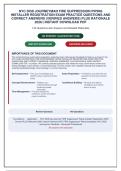
NYC DOB JOURNEYMAN FIRE SUPPRESSION PIPING
INSTALLER REGISTRATION EXAM PRACTICE QUESTIONS AND
CORRECT ANSWERS (VERIFIED ANSWERS) PLUS RATIONALE
2026/| INSTANT DOWNLOAD PDF
140 Questions with Answers and Detailed Rationales
100 PERCENT GUARANTEED PASS
INSTANT DOWNLOAD ANSWERS INCLUDED
IMPORTANCE OF THIS DOCUMENT
This comprehensive examination preparation guide has been meticulously developed to help you succeed in the
NYC DOB JOURNEYMAN FIRE SUPPRESSION PIPING INSTALLER REGISTRATION EXAM PRACTICE
QUESTIONS AND CORRECT ANSWERS (VERIFIED ANSWERS) PLUS RATIONALE 2026/| INSTANT
DOWNLOAD PDF. It contains 140 carefully selected questions that reflect the most current exam content and
testing strategies. Each question is accompanied by a correct answer and a detailed rationale that explains the
underlying pathophysiology, pharmacology, or clinical reasoning.
Self-Assessment – Test your knowledge and Exam Preparation – Familiarize yourself with the
identify areas requiring further question format and content
study areas
Concept Reinforcement – Deepen your Confidence Building – Develop test-taking
understanding through strategies and reduce
evidence-based exam anxiety
rationales
Time Management – Practice answering
questions under simulated
exam conditions
Review Summary 140 Questions
Foundations - Application - NYC DOB Journeyman FIRE Suppression Piping Installer Registration AND
Correct PLUS Rationale 2026/ Instant Download PDF FIRE Suppression Piping Installation NYC DOB
Journeyman Graduate / Advanced Professional
All answers with rationales
,Table of Contents
Content Area Questions Key Topics
Administrative Requirements 1-24 System, Sprinkler, Pressure, Building, FIRE Suppression
AND Licensing
FIRE Suppression Piping 25-48 System, Sprinkler, FIRE Suppression, Piping, Building
Systems AND Components
Installation Assembly AND 49-72 System, Sprinkler, Installer, Piping, FIRE Suppression
Support OF Piping Systems
Sprinkler System Design 73-96 System, Sprinkler, FIRE Suppression, Pressure, Piping
AND Layout
Standpipe AND HOSE 97-120 System, Sprinkler, Suppression, Pressure, Water
Systems
Valves Fittings AND 121-140 System, Pressure, Sprinkler, Building, Piping
Appurtenances
TOTAL 140 All questions include answers and detailed rationales
,Section A - Administrative Requirements AND Licensing
Q1.
In a high-rise building with a combined standpipe/sprinkler riser, the pressure-regulating
valve (PRV) station on the 40th floor is set to deliver 100 psi static pressure. During a fire
pump test, the flow at the remote hose valve is 500 gpm and the residual pressure reads
65 psi. The building's fire department connection (FDC) is supplying additional water.
Which NFPA 14 requirement is most directly impacted by this scenario?
A. The minimum residual pressure of 100 B. The PRV must be set to deliver no more
psi must be maintained at the topmost than 175 psi under any flow condition.
outlet.
C. The standpipe system must be designed D. The FDC must be located within 100 feet
to provide 500 gpm for the first standpipe. of a fire hydrant.
Correct: A - The minimum residual pressure of 100 psi must be maintained at the topmost
outlet.
Rationale:NFPA 14 requires a minimum residual pressure of 100 psi at the topmost outlet of
a standpipe system under flow conditions. The scenario shows a residual pressure of 65 psi,
which is below the code minimum, indicating a violation. The other options are either incorrect
pressure limits or unrelated requirements.
Why the other answers are wrong:
B. 175 psi is the maximum static pressure limit for standpipe outlets, not a PRV setting
guideline.
C. The 500 gpm flow is a design flow, not a required minimum pressure.
D. FDC location is governed by the fire code, not directly by NFPA 14 pressure requirements.
Reference: NFPA 14: Standard for the Installation of Standpipe and Hose Systems, 2024 Edition,
Chapter 7
Q2.
During a hydrostatic test of a 6-inch black steel sprinkler system, the test gauge holds at
200 psi for 2 hours. The ambient temperature is 50°F. After the test, you notice a slight
pressure drop of 5 psi. The system is in a building under construction with no heat. Which
of the following actions is correct?
A. Accept the test because a 5 psi drop is B. Reject the test because any pressure
within the allowable tolerance of NFPA 13. drop indicates a leak.
C. Accept the test because the pressure D. Reject the test because the test pressure
drop is due to temperature fluctuation, and must be maintained for 24 hours, not 2
NFPA 13 allows a drop of up to 10 psi. hours.
Correct: C - Accept the test because the pressure drop is due to temperature fluctuation,
Page 3
, Section A - Administrative Requirements AND Licensing
and NFPA 13 allows a drop of up to 10 psi.
Rationale:NFPA 13 permits a drop of up to 10 psi during a hydrostatic test, considering
temperature variations. A 5 psi drop is within tolerance, so the test is acceptable. The other
options are incorrect: a small drop does not automatically indicate a leak, and the test
duration is 2 hours per NFPA 13, not 24.
Why the other answers are wrong:
A. This is correct in outcome but the reason is incomplete; the drop is allowed due to
temperature, but the tolerance is 10 psi, not arbitrary acceptance.
B. Small pressure drops are expected from temperature changes, not necessarily leaks.
D. NFPA 13 requires a 2-hour hydrostatic test, not 24 hours.
Reference: NFPA 13: Standard for the Installation of Sprinkler Systems, 2025 Edition, Section 24.2.2
Q3.
A fire suppression piping installer is retrofitting a sprinkler system in a 1920s building
with existing cast iron soil pipe. The new system uses CPVC piping. The building's water
supply has a pH of 6.2 and high chloride content. Which of the following is the most
critical concern for the CPVC installation?
A. CPVC is not approved for use in buildings B. The acidic water may cause degradation
over 75 feet tall. of the CPVC pipe.
C. CPVC cannot be used with metallic pipe D. The pipe must be derated for continuous
due to galvanic corrosion. service temperatures above 100°F.
Correct: B - The acidic water may cause degradation of the CPVC pipe.
Rationale:CPVC is susceptible to degradation from acidic water (low pH) and high chlorine
levels, which can cause environmental stress cracking. The other options are not primary
concerns: CPVC is allowed in high-rise buildings, galvanic corrosion is not an issue with
CPVC, and temperature derating is not the main issue here.
Why the other answers are wrong:
A. CPVC is permitted in buildings of any height, subject to code restrictions on exposed
locations.
C. CPVC is non-metallic and does not suffer galvanic corrosion.
D. Water temperature is not specified as high; the pH and chloride are the issue.
Reference: NFPA 13, 2025 Edition, Chapter 7; CPVC manufacturer guidelines
Q4.
In a dry-pipe sprinkler system, the air pressure supervision is set at 40 psi. The system is
designed with a 1,500-gallon water capacity. During a cold snap, the air pressure drops to
30 psi due to a leak. What is the immediate consequence and the required response
according to NFPA 13?
Page 4
INSTALLER REGISTRATION EXAM PRACTICE QUESTIONS AND
CORRECT ANSWERS (VERIFIED ANSWERS) PLUS RATIONALE
2026/| INSTANT DOWNLOAD PDF
140 Questions with Answers and Detailed Rationales
100 PERCENT GUARANTEED PASS
INSTANT DOWNLOAD ANSWERS INCLUDED
IMPORTANCE OF THIS DOCUMENT
This comprehensive examination preparation guide has been meticulously developed to help you succeed in the
NYC DOB JOURNEYMAN FIRE SUPPRESSION PIPING INSTALLER REGISTRATION EXAM PRACTICE
QUESTIONS AND CORRECT ANSWERS (VERIFIED ANSWERS) PLUS RATIONALE 2026/| INSTANT
DOWNLOAD PDF. It contains 140 carefully selected questions that reflect the most current exam content and
testing strategies. Each question is accompanied by a correct answer and a detailed rationale that explains the
underlying pathophysiology, pharmacology, or clinical reasoning.
Self-Assessment – Test your knowledge and Exam Preparation – Familiarize yourself with the
identify areas requiring further question format and content
study areas
Concept Reinforcement – Deepen your Confidence Building – Develop test-taking
understanding through strategies and reduce
evidence-based exam anxiety
rationales
Time Management – Practice answering
questions under simulated
exam conditions
Review Summary 140 Questions
Foundations - Application - NYC DOB Journeyman FIRE Suppression Piping Installer Registration AND
Correct PLUS Rationale 2026/ Instant Download PDF FIRE Suppression Piping Installation NYC DOB
Journeyman Graduate / Advanced Professional
All answers with rationales
,Table of Contents
Content Area Questions Key Topics
Administrative Requirements 1-24 System, Sprinkler, Pressure, Building, FIRE Suppression
AND Licensing
FIRE Suppression Piping 25-48 System, Sprinkler, FIRE Suppression, Piping, Building
Systems AND Components
Installation Assembly AND 49-72 System, Sprinkler, Installer, Piping, FIRE Suppression
Support OF Piping Systems
Sprinkler System Design 73-96 System, Sprinkler, FIRE Suppression, Pressure, Piping
AND Layout
Standpipe AND HOSE 97-120 System, Sprinkler, Suppression, Pressure, Water
Systems
Valves Fittings AND 121-140 System, Pressure, Sprinkler, Building, Piping
Appurtenances
TOTAL 140 All questions include answers and detailed rationales
,Section A - Administrative Requirements AND Licensing
Q1.
In a high-rise building with a combined standpipe/sprinkler riser, the pressure-regulating
valve (PRV) station on the 40th floor is set to deliver 100 psi static pressure. During a fire
pump test, the flow at the remote hose valve is 500 gpm and the residual pressure reads
65 psi. The building's fire department connection (FDC) is supplying additional water.
Which NFPA 14 requirement is most directly impacted by this scenario?
A. The minimum residual pressure of 100 B. The PRV must be set to deliver no more
psi must be maintained at the topmost than 175 psi under any flow condition.
outlet.
C. The standpipe system must be designed D. The FDC must be located within 100 feet
to provide 500 gpm for the first standpipe. of a fire hydrant.
Correct: A - The minimum residual pressure of 100 psi must be maintained at the topmost
outlet.
Rationale:NFPA 14 requires a minimum residual pressure of 100 psi at the topmost outlet of
a standpipe system under flow conditions. The scenario shows a residual pressure of 65 psi,
which is below the code minimum, indicating a violation. The other options are either incorrect
pressure limits or unrelated requirements.
Why the other answers are wrong:
B. 175 psi is the maximum static pressure limit for standpipe outlets, not a PRV setting
guideline.
C. The 500 gpm flow is a design flow, not a required minimum pressure.
D. FDC location is governed by the fire code, not directly by NFPA 14 pressure requirements.
Reference: NFPA 14: Standard for the Installation of Standpipe and Hose Systems, 2024 Edition,
Chapter 7
Q2.
During a hydrostatic test of a 6-inch black steel sprinkler system, the test gauge holds at
200 psi for 2 hours. The ambient temperature is 50°F. After the test, you notice a slight
pressure drop of 5 psi. The system is in a building under construction with no heat. Which
of the following actions is correct?
A. Accept the test because a 5 psi drop is B. Reject the test because any pressure
within the allowable tolerance of NFPA 13. drop indicates a leak.
C. Accept the test because the pressure D. Reject the test because the test pressure
drop is due to temperature fluctuation, and must be maintained for 24 hours, not 2
NFPA 13 allows a drop of up to 10 psi. hours.
Correct: C - Accept the test because the pressure drop is due to temperature fluctuation,
Page 3
, Section A - Administrative Requirements AND Licensing
and NFPA 13 allows a drop of up to 10 psi.
Rationale:NFPA 13 permits a drop of up to 10 psi during a hydrostatic test, considering
temperature variations. A 5 psi drop is within tolerance, so the test is acceptable. The other
options are incorrect: a small drop does not automatically indicate a leak, and the test
duration is 2 hours per NFPA 13, not 24.
Why the other answers are wrong:
A. This is correct in outcome but the reason is incomplete; the drop is allowed due to
temperature, but the tolerance is 10 psi, not arbitrary acceptance.
B. Small pressure drops are expected from temperature changes, not necessarily leaks.
D. NFPA 13 requires a 2-hour hydrostatic test, not 24 hours.
Reference: NFPA 13: Standard for the Installation of Sprinkler Systems, 2025 Edition, Section 24.2.2
Q3.
A fire suppression piping installer is retrofitting a sprinkler system in a 1920s building
with existing cast iron soil pipe. The new system uses CPVC piping. The building's water
supply has a pH of 6.2 and high chloride content. Which of the following is the most
critical concern for the CPVC installation?
A. CPVC is not approved for use in buildings B. The acidic water may cause degradation
over 75 feet tall. of the CPVC pipe.
C. CPVC cannot be used with metallic pipe D. The pipe must be derated for continuous
due to galvanic corrosion. service temperatures above 100°F.
Correct: B - The acidic water may cause degradation of the CPVC pipe.
Rationale:CPVC is susceptible to degradation from acidic water (low pH) and high chlorine
levels, which can cause environmental stress cracking. The other options are not primary
concerns: CPVC is allowed in high-rise buildings, galvanic corrosion is not an issue with
CPVC, and temperature derating is not the main issue here.
Why the other answers are wrong:
A. CPVC is permitted in buildings of any height, subject to code restrictions on exposed
locations.
C. CPVC is non-metallic and does not suffer galvanic corrosion.
D. Water temperature is not specified as high; the pH and chloride are the issue.
Reference: NFPA 13, 2025 Edition, Chapter 7; CPVC manufacturer guidelines
Q4.
In a dry-pipe sprinkler system, the air pressure supervision is set at 40 psi. The system is
designed with a 1,500-gallon water capacity. During a cold snap, the air pressure drops to
30 psi due to a leak. What is the immediate consequence and the required response
according to NFPA 13?
Page 4