

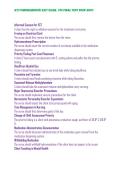
ATI Comprehensive Exit Exam. 180 Final Test 2026\2027.
Informed Consent for ECT
A client has the right to withdraw consent for the treatment at any time.
Fraying on Electrical Cord
The nurse should first remove the device from the room.
Hydromorphone Prescription
The nurse should count the current number of unit doses available in the medication
dispensing system.
Priority Finding Post Cast Placement
A client 2 hours post cast placement with 2+ pitting edema and pallor has the priority
finding.
Disulfiram Alcohol Use
A client should limit alcohol use to one drink daily while taking disulfiram.
Fluoxetine and Tyramine
A client should avoid foods containing tyramine while taking fluoxetine.
Sustained-Release Methylphenidate
A client should take the sustained-release methylphenidate every morning.
Major Depressive Disorder Precautions
The nurse should implement seizure precautions for the client.
Narcissistic Personality Disorder Expectation
The nurse should expect the client to be preoccupied with aging.
Time Management in Nursing
The nurse should first determine goals of the day.
Change-of-Shift Assessment Priority
The priority finding is a client with pneumonia, productive cough, and fever of 38.8° C (101.8°
F).
Medication Administration Documentation
The nurse should document administration of the medication upon removal from the
medication dispensing system.
Withholding Medication
The nurse should withhold hydromorphone if the client does not appear to be in pain.
Client Teaching in Mental Health
,ATI Comprehensive Exit Exam. 180 Final Test 2026\2027.
Understanding is indicated when a client states they will take their lithium on an empty
stomach.
Seizure Precautions
Implementing seizure precautions is a priority action for a client with major depressive
disorder.
Client Assessment in Mental Health
Encouraging the client to verbalize feelings is an important action but not the first priority.
Electrical Device Safety
Reporting the defect to the equipment maintenance staff is necessary but should follow
immediate removal of the device.
Medication Dispensing System
The nurse should ensure the device inspection sticker is current as part of routine safety
checks.
Postoperative Care
Monitoring for pain is crucial after administering hydromorphone.
Effective Client Teaching
Clients should be able to articulate the importance of medication adherence.
Managing Nursing Tasks
Developing an hourly time frame for tasks can help manage time effectively.
Client Assessment Findings
Identifying priority findings is essential during shift changes.
Understanding Medication Effects
Clients must understand the effects and side effects of their medications.
Determine goals of the day
Establish specific objectives for daily activities.
Magnesium sulfate via continuous IV infusion
A treatment for preeclampsia requiring careful monitoring.
Restrict the client's total fluid intake to 250 mL/hr
A guideline for fluid management in certain medical conditions.
Measure the client's urine output every hour
A critical action to monitor kidney function and fluid balance.
Give the client protamine if signs of magnesium sulfate toxicity occur
, ATI Comprehensive Exit Exam. 180 Final Test 2026\2027.
An emergency intervention for reversing magnesium toxicity.
Monitor the FHR via Doppler every 30 min
A procedure to assess fetal heart rate during labor.
Wounds healing by primary intention
Wounds that heal with minimal scarring, typically surgical incisions.
Approximated surgical incision
A type of wound expected to heal by primary intention.
Client taking clozapine to treat schizophrenia and reports sore throat
A priority client due to potential agranulocytosis risk.
Client has OCD and is upset about a change in daily routine
A client with stable condition, less urgent than others.
Client has narcissistic personality disorder and is mocking others during group
therapy
A client displaying disruptive behavior, but not immediately life-threatening.
Client who has depressive disorder and requires assistance with ADLs
A client needing support but not in immediate danger.
Implanted venous access port
A device for long-term venous access in patients.
A non-coring needle
A specialized needle used to access implanted ports.
Client who has pneumonia and feels chest pain
A patient requiring urgent assessment for potential cardiac issues.
12 lead ECG
A priority diagnostic test for evaluating cardiac function.
Assessing growth and development of a 3 y/o child
Evaluating developmental milestones in early childhood.
Can your child ride a tricycle?
A question to assess gross motor skills in a 3-year-old.
Fetal heart tones assessment at 12 weeks of gestation
A procedure to monitor fetal health early in pregnancy.
Position the ultrasound stethoscope above the symphysis pubis to assess the FHR
A technique for detecting fetal heart tones during early pregnancy.
Informed Consent for ECT
A client has the right to withdraw consent for the treatment at any time.
Fraying on Electrical Cord
The nurse should first remove the device from the room.
Hydromorphone Prescription
The nurse should count the current number of unit doses available in the medication
dispensing system.
Priority Finding Post Cast Placement
A client 2 hours post cast placement with 2+ pitting edema and pallor has the priority
finding.
Disulfiram Alcohol Use
A client should limit alcohol use to one drink daily while taking disulfiram.
Fluoxetine and Tyramine
A client should avoid foods containing tyramine while taking fluoxetine.
Sustained-Release Methylphenidate
A client should take the sustained-release methylphenidate every morning.
Major Depressive Disorder Precautions
The nurse should implement seizure precautions for the client.
Narcissistic Personality Disorder Expectation
The nurse should expect the client to be preoccupied with aging.
Time Management in Nursing
The nurse should first determine goals of the day.
Change-of-Shift Assessment Priority
The priority finding is a client with pneumonia, productive cough, and fever of 38.8° C (101.8°
F).
Medication Administration Documentation
The nurse should document administration of the medication upon removal from the
medication dispensing system.
Withholding Medication
The nurse should withhold hydromorphone if the client does not appear to be in pain.
Client Teaching in Mental Health
,ATI Comprehensive Exit Exam. 180 Final Test 2026\2027.
Understanding is indicated when a client states they will take their lithium on an empty
stomach.
Seizure Precautions
Implementing seizure precautions is a priority action for a client with major depressive
disorder.
Client Assessment in Mental Health
Encouraging the client to verbalize feelings is an important action but not the first priority.
Electrical Device Safety
Reporting the defect to the equipment maintenance staff is necessary but should follow
immediate removal of the device.
Medication Dispensing System
The nurse should ensure the device inspection sticker is current as part of routine safety
checks.
Postoperative Care
Monitoring for pain is crucial after administering hydromorphone.
Effective Client Teaching
Clients should be able to articulate the importance of medication adherence.
Managing Nursing Tasks
Developing an hourly time frame for tasks can help manage time effectively.
Client Assessment Findings
Identifying priority findings is essential during shift changes.
Understanding Medication Effects
Clients must understand the effects and side effects of their medications.
Determine goals of the day
Establish specific objectives for daily activities.
Magnesium sulfate via continuous IV infusion
A treatment for preeclampsia requiring careful monitoring.
Restrict the client's total fluid intake to 250 mL/hr
A guideline for fluid management in certain medical conditions.
Measure the client's urine output every hour
A critical action to monitor kidney function and fluid balance.
Give the client protamine if signs of magnesium sulfate toxicity occur
, ATI Comprehensive Exit Exam. 180 Final Test 2026\2027.
An emergency intervention for reversing magnesium toxicity.
Monitor the FHR via Doppler every 30 min
A procedure to assess fetal heart rate during labor.
Wounds healing by primary intention
Wounds that heal with minimal scarring, typically surgical incisions.
Approximated surgical incision
A type of wound expected to heal by primary intention.
Client taking clozapine to treat schizophrenia and reports sore throat
A priority client due to potential agranulocytosis risk.
Client has OCD and is upset about a change in daily routine
A client with stable condition, less urgent than others.
Client has narcissistic personality disorder and is mocking others during group
therapy
A client displaying disruptive behavior, but not immediately life-threatening.
Client who has depressive disorder and requires assistance with ADLs
A client needing support but not in immediate danger.
Implanted venous access port
A device for long-term venous access in patients.
A non-coring needle
A specialized needle used to access implanted ports.
Client who has pneumonia and feels chest pain
A patient requiring urgent assessment for potential cardiac issues.
12 lead ECG
A priority diagnostic test for evaluating cardiac function.
Assessing growth and development of a 3 y/o child
Evaluating developmental milestones in early childhood.
Can your child ride a tricycle?
A question to assess gross motor skills in a 3-year-old.
Fetal heart tones assessment at 12 weeks of gestation
A procedure to monitor fetal health early in pregnancy.
Position the ultrasound stethoscope above the symphysis pubis to assess the FHR
A technique for detecting fetal heart tones during early pregnancy.

