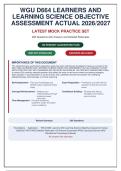
WGU D664 LEARNERS AND
LEARNING SCIENCE OBJECTIVE
ASSESSMENT ACTUAL 2026/2027
LATEST MOCK PRACTICE SET
200 Questions with Answers and Detailed Rationales
100 PERCENT GUARANTEED PASS
INSTANT DOWNLOAD ANSWERS INCLUDED
IMPORTANCE OF THIS DOCUMENT
This comprehensive examination preparation guide has been meticulously developed to help you succeed in the
WGU D664 LEARNERS AND LEARNING SCIENCE OBJECTIVE ASSESSMENT ACTUAL 2026/2027 LATEST
MOCK PRACTICE SET WITH ANSWERS AND DETAILED RATIONALES 100 PERCENT GUARANTEED PASS..
It contains 200 carefully selected questions that reflect the most current exam content and testing strategies.
Each question is accompanied by a correct answer and a detailed rationale that explains the underlying
pathophysiology, pharmacology, or clinical reasoning.
Self-Assessment – Test your knowledge and Exam Preparation – Familiarize yourself with the
identify areas requiring further question format and content
study areas
Concept Reinforcement – Deepen your Confidence Building – Develop test-taking
understanding through strategies and reduce
evidence-based exam anxiety
rationales
Time Management – Practice answering
questions under simulated
exam conditions
Review Summary 200 Questions
Foundations - Application - WGU D664 Learners AND Learning Science Objective Assessment Actual
2026/2027 WITH AND Detailed Rationales 100 Percent Guaranteed PASS Learning Sciences AND
Educational Psychology Graduate
All answers with rationales
,Table of Contents
Content Area Questions Key Topics
Learning 1-50 Students, Principles, Classroom, Teacher, Theory
Student 51-100 Learning, Teacher, Students, Theory, Cognitive
Teacher 101-150 Learning, Theory, Student, Likely, Cognitive
Theory 151-200 Learning, Teacher, Students, Likely, Cognitive
TOTAL 200 All questions include answers and detailed rationales
,Section A - Learning
Q1.
In a study, learners who generated their own examples of a concept outperformed peers
who studied provided examples. Which theoretical framework and cognitive mechanism
best explain this effect?
A. Dual coding theory; additive effects of B. Generative learning theory; integration of
verbal and imagery codes new information with prior knowledge
through effortful construction
C. Cognitive load theory; reduction of D. Spacing effect; distributed practice
extraneous load through worked examples enhances long-term retention
Correct: B - Generative learning theory; integration of new information with prior
knowledge through effortful construction
Rationale:Generative learning theory posits that meaningful learning requires active
construction of connections between new and existing knowledge; self-generation forces
deeper processing. Dual coding, cognitive load, and spacing do not directly explain the
generative advantage.
Q2.
A curriculum designer implements a retrieval practice schedule where initial tests are
frequent and then gradually spaced. This schedule is most directly supported by which
phenomenon?
A. Testing effect with expanding retrieval B. Overlearning leading to automaticity
intervals
C. Interleaving to enhance discrimination D. Desirable difficulties through varied
contexts
Correct: A - Testing effect with expanding retrieval intervals
Rationale:Expanding retrieval schedules (e.g., 1 day, 3 days, 7 days) capitalize on the testing
effect by spacing retrieval attempts to combat forgetting while maintaining accessibility.
Overlearning, interleaving, and varied contexts are distinct phenomena.
Q3.
Which instructional approach is most aligned with the principles of constructionism, as
distinguished from general constructivism?
A. Guided discovery where learners B. Collaborative problem-solving with
manipulate physical objects to build a minimal teacher intervention
working model
Page 3
, Section A - Learning
C. Direct instruction followed by D. Scaffolded questioning to elicit prior
independent practice misconceptions
Correct: A - Guided discovery where learners manipulate physical objects to build a
working model
Rationale:Constructionism (Papert) emphasizes learning through creating tangible, shareable
artifacts (e.g., models, robots). Guided discovery with physical construction is the hallmark.
General constructivism focuses on mental construction through social or cognitive processes.
Q4.
A large-scale analysis of classroom interventions finds that formative assessment
practices yield a high effect size, but variability is wide. Which moderator most
consistently explains this variability?
A. Frequency of testing B. Feedback that is task-focused and
provides actionable next steps
C. Use of technology for immediate scoring D. Alignment of assessments to learning
objectives
Correct: B - Feedback that is task-focused and provides actionable next steps
Rationale:Research (e.g., Black & Wiliam) shows feedback quality is the key moderator:
effective feedback addresses the task and offers strategies for improvement. Frequency,
technology, and alignment are less critical without feedback quality.
Q5.
In a flipped classroom, students watch video lectures at home and engage in
problem-solving in class. Which theoretical framework best justifies this structure?
A. Cognitive apprenticeship: modeling and B. Behaviorism: reinforcement of correct
coaching during active practice responses through immediate feedback
C. Connectivism: learning through D. Self-determination theory: autonomy in
networked digital resources pacing and choice of content
Correct: A - Cognitive apprenticeship: modeling and coaching during active practice
Rationale:Flipped classrooms allow class time for authentic problem-solving with instructor
coaching, aligning with cognitive apprenticeship's modeling, scaffolding, and fading.
Behaviorism, connectivism, and SDT do not centralize active practice with expert guidance.
Q6.
A student with a fixed mindset is more likely to exhibit which pattern after receiving a
challenging task?
Page 4
LEARNING SCIENCE OBJECTIVE
ASSESSMENT ACTUAL 2026/2027
LATEST MOCK PRACTICE SET
200 Questions with Answers and Detailed Rationales
100 PERCENT GUARANTEED PASS
INSTANT DOWNLOAD ANSWERS INCLUDED
IMPORTANCE OF THIS DOCUMENT
This comprehensive examination preparation guide has been meticulously developed to help you succeed in the
WGU D664 LEARNERS AND LEARNING SCIENCE OBJECTIVE ASSESSMENT ACTUAL 2026/2027 LATEST
MOCK PRACTICE SET WITH ANSWERS AND DETAILED RATIONALES 100 PERCENT GUARANTEED PASS..
It contains 200 carefully selected questions that reflect the most current exam content and testing strategies.
Each question is accompanied by a correct answer and a detailed rationale that explains the underlying
pathophysiology, pharmacology, or clinical reasoning.
Self-Assessment – Test your knowledge and Exam Preparation – Familiarize yourself with the
identify areas requiring further question format and content
study areas
Concept Reinforcement – Deepen your Confidence Building – Develop test-taking
understanding through strategies and reduce
evidence-based exam anxiety
rationales
Time Management – Practice answering
questions under simulated
exam conditions
Review Summary 200 Questions
Foundations - Application - WGU D664 Learners AND Learning Science Objective Assessment Actual
2026/2027 WITH AND Detailed Rationales 100 Percent Guaranteed PASS Learning Sciences AND
Educational Psychology Graduate
All answers with rationales
,Table of Contents
Content Area Questions Key Topics
Learning 1-50 Students, Principles, Classroom, Teacher, Theory
Student 51-100 Learning, Teacher, Students, Theory, Cognitive
Teacher 101-150 Learning, Theory, Student, Likely, Cognitive
Theory 151-200 Learning, Teacher, Students, Likely, Cognitive
TOTAL 200 All questions include answers and detailed rationales
,Section A - Learning
Q1.
In a study, learners who generated their own examples of a concept outperformed peers
who studied provided examples. Which theoretical framework and cognitive mechanism
best explain this effect?
A. Dual coding theory; additive effects of B. Generative learning theory; integration of
verbal and imagery codes new information with prior knowledge
through effortful construction
C. Cognitive load theory; reduction of D. Spacing effect; distributed practice
extraneous load through worked examples enhances long-term retention
Correct: B - Generative learning theory; integration of new information with prior
knowledge through effortful construction
Rationale:Generative learning theory posits that meaningful learning requires active
construction of connections between new and existing knowledge; self-generation forces
deeper processing. Dual coding, cognitive load, and spacing do not directly explain the
generative advantage.
Q2.
A curriculum designer implements a retrieval practice schedule where initial tests are
frequent and then gradually spaced. This schedule is most directly supported by which
phenomenon?
A. Testing effect with expanding retrieval B. Overlearning leading to automaticity
intervals
C. Interleaving to enhance discrimination D. Desirable difficulties through varied
contexts
Correct: A - Testing effect with expanding retrieval intervals
Rationale:Expanding retrieval schedules (e.g., 1 day, 3 days, 7 days) capitalize on the testing
effect by spacing retrieval attempts to combat forgetting while maintaining accessibility.
Overlearning, interleaving, and varied contexts are distinct phenomena.
Q3.
Which instructional approach is most aligned with the principles of constructionism, as
distinguished from general constructivism?
A. Guided discovery where learners B. Collaborative problem-solving with
manipulate physical objects to build a minimal teacher intervention
working model
Page 3
, Section A - Learning
C. Direct instruction followed by D. Scaffolded questioning to elicit prior
independent practice misconceptions
Correct: A - Guided discovery where learners manipulate physical objects to build a
working model
Rationale:Constructionism (Papert) emphasizes learning through creating tangible, shareable
artifacts (e.g., models, robots). Guided discovery with physical construction is the hallmark.
General constructivism focuses on mental construction through social or cognitive processes.
Q4.
A large-scale analysis of classroom interventions finds that formative assessment
practices yield a high effect size, but variability is wide. Which moderator most
consistently explains this variability?
A. Frequency of testing B. Feedback that is task-focused and
provides actionable next steps
C. Use of technology for immediate scoring D. Alignment of assessments to learning
objectives
Correct: B - Feedback that is task-focused and provides actionable next steps
Rationale:Research (e.g., Black & Wiliam) shows feedback quality is the key moderator:
effective feedback addresses the task and offers strategies for improvement. Frequency,
technology, and alignment are less critical without feedback quality.
Q5.
In a flipped classroom, students watch video lectures at home and engage in
problem-solving in class. Which theoretical framework best justifies this structure?
A. Cognitive apprenticeship: modeling and B. Behaviorism: reinforcement of correct
coaching during active practice responses through immediate feedback
C. Connectivism: learning through D. Self-determination theory: autonomy in
networked digital resources pacing and choice of content
Correct: A - Cognitive apprenticeship: modeling and coaching during active practice
Rationale:Flipped classrooms allow class time for authentic problem-solving with instructor
coaching, aligning with cognitive apprenticeship's modeling, scaffolding, and fading.
Behaviorism, connectivism, and SDT do not centralize active practice with expert guidance.
Q6.
A student with a fixed mindset is more likely to exhibit which pattern after receiving a
challenging task?
Page 4