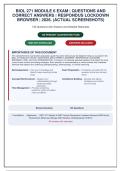
BIOL 271 MODULE 6 EXAM | QUESTIONS AND
CORRECT ANSWERS | RESPONDUS LOCKDOWN
BROWSER | 2026. (ACTUAL SCREENSHOTS)
140 Questions with Answers and Detailed Rationales
100 PERCENT GUARANTEED PASS
INSTANT DOWNLOAD ANSWERS INCLUDED
IMPORTANCE OF THIS DOCUMENT
This comprehensive examination preparation guide has been meticulously developed to help you succeed in the
BIOL 271 MODULE 6 EXAM | QUESTIONS AND CORRECT ANSWERS | RESPONDUS LOCKDOWN
BROWSER | 2026. (ACTUAL SCREENSHOTS). It contains 140 carefully selected questions that reflect the most
current exam content and testing strategies. Each question is accompanied by a correct answer and a detailed
rationale that explains the underlying pathophysiology, pharmacology, or clinical reasoning.
Self-Assessment – Test your knowledge and Exam Preparation – Familiarize yourself with the
identify areas requiring further question format and content
study areas
Concept Reinforcement – Deepen your Confidence Building – Develop test-taking
understanding through strategies and reduce
evidence-based exam anxiety
rationales
Time Management – Practice answering
questions under simulated
exam conditions
Review Summary 140 Questions
Foundations - Application - BIOL 271 Module 6 AND Correct Respondus Lockdown Browser 2026 Actual
Screenshots Molecular Biology AND Genetics Undergraduate YEAR 3
All answers with rationales
,Table of Contents
Content Area Questions Key Topics
CELL Biology AND 1-24 Likely, Mutation, Modification, Silencing, Factor
Membrane Transport
Metabolism AND Enzymes 25-48 Mutation, Enzyme, Likely, Consequence, Kinase
DNA Structure AND 49-72 Researcher, Likely, Protein, Studying, Bacterial
Replication
Transcription AND 73-96 Mutation, Likely, Researcher, GENE Encoding, Protein
Translation
CELL Cycle AND Mitosis 97-120 Researcher, Promoter, Transcription, Protein, Likely
Genetics AND Inheritance 121-140 Likely, Mitochondrial, Normal, Protein, Directly
TOTAL 140 All questions include answers and detailed rationales
,Section A - CELL Biology AND Membrane Transport
Q1.
In a genome-wide study, a chromatin remodeler is found to evict nucleosomes at promoter
regions. Which direct consequence is most consistent with this observation?
A. Increased DNA methylation at those B. Enhanced binding of general transcription
promoters factors to the promoters
C. Stabilization of nucleosome positioning D. Recruitment of histone deacetylases to
and reduced transcription the promoters
Correct: B - Enhanced binding of general transcription factors to the promoters
Rationale:Nucleosome eviction exposes promoter DNA, facilitating binding of transcription
factors and RNA polymerase. DNA methylation and HDAC recruitment typically repress
transcription, and nucleosome stabilization would impede factor access.
Q2.
A researcher maps DNA double-strand break repair events and finds that a significant
fraction are repaired using a homologous chromosome rather than the sister chromatid.
What is the most likely outcome of this repair?
A. Loss of heterozygosity (LOH) B. Gene conversion without crossover
C. Increased genomic stability D. Error-free repair with no sequence
changes
Correct: A - Loss of heterozygosity (LOH)
Rationale:Repair using a homologous chromosome can transfer genetic information, leading
to loss of heterozygosity if the homolog carries a different allele. Gene conversion can also
occur but LOH is the broader consequence. Sister chromatid repair is error-free and
preserves heterozygosity; homologous chromosome repair can introduce sequence changes.
Q3.
For a CRISPR-Cas9 experiment, you design a guide RNA that perfectly matches the target
site, but the desired gene knockout fails. Which modification to the experimental design is
most likely to improve knockout efficiency?
A. Using a Cas9 variant with increased B. Ensuring the target site is in a highly
nuclease activity but no PAM specificity methylated region of the genome
change
Page 3
, Section A - CELL Biology AND Membrane Transport
C. Selecting a guide RNA that targets a D. Introducing a double-strand break (DSB)
region with high nucleosome occupancy and providing a repair template with silent
mutations
Correct: D - Introducing a double-strand break (DSB) and providing a repair template with
silent mutations
Rationale:If the goal is knockout, inducing a DSB and providing a repair template with silent
mutations can disrupt the gene via homology-directed repair or indel formation. Methylated
regions, nucleosome occupancy, and nuclease activity alone do not guarantee knockout;
template addition increases the likelihood of a permanent mutation.
Q4.
In a study of a metabolic enzyme, you discover a long non-coding RNA (lncRNA) that is
transcribed antisense to the enzyme's gene. Which mechanism is most consistent with
the lncRNA's role in silencing the gene?
A. The lncRNA enhances RNA polymerase B. The lncRNA recruits a histone
II processivity on the gene methyltransferase that deposits H3K27me3
at the promoter
C. The lncRNA stabilizes the mature mRNA D. The lncRNA promotes nuclear export of
by binding to its 3' UTR the mRNA
Correct: B - The lncRNA recruits a histone methyltransferase that deposits H3K27me3 at
the promoter
Rationale:Antisense lncRNAs often recruit chromatin-modifying complexes to the locus,
leading to repressive marks like H3K27me3. Enhancing transcription, stabilizing mRNA, or
promoting export would increase expression, not silence.
Q5.
A transcription factor binds to an enhancer but only activates transcription when a
specific histone modification is present. Which modification is most likely required for its
activity?
A. H3K9me3 B. H3K27me3
C. H3K4me1 D. H3K9ac
Correct: C - H3K4me1
Rationale:H3K4me1 is a hallmark of active enhancers and often required for enhancer
function. H3K9me3 and H3K27me3 are repressive marks, and H3K9ac is more associated
with active promoters, not specifically enhancers.
Page 4
CORRECT ANSWERS | RESPONDUS LOCKDOWN
BROWSER | 2026. (ACTUAL SCREENSHOTS)
140 Questions with Answers and Detailed Rationales
100 PERCENT GUARANTEED PASS
INSTANT DOWNLOAD ANSWERS INCLUDED
IMPORTANCE OF THIS DOCUMENT
This comprehensive examination preparation guide has been meticulously developed to help you succeed in the
BIOL 271 MODULE 6 EXAM | QUESTIONS AND CORRECT ANSWERS | RESPONDUS LOCKDOWN
BROWSER | 2026. (ACTUAL SCREENSHOTS). It contains 140 carefully selected questions that reflect the most
current exam content and testing strategies. Each question is accompanied by a correct answer and a detailed
rationale that explains the underlying pathophysiology, pharmacology, or clinical reasoning.
Self-Assessment – Test your knowledge and Exam Preparation – Familiarize yourself with the
identify areas requiring further question format and content
study areas
Concept Reinforcement – Deepen your Confidence Building – Develop test-taking
understanding through strategies and reduce
evidence-based exam anxiety
rationales
Time Management – Practice answering
questions under simulated
exam conditions
Review Summary 140 Questions
Foundations - Application - BIOL 271 Module 6 AND Correct Respondus Lockdown Browser 2026 Actual
Screenshots Molecular Biology AND Genetics Undergraduate YEAR 3
All answers with rationales
,Table of Contents
Content Area Questions Key Topics
CELL Biology AND 1-24 Likely, Mutation, Modification, Silencing, Factor
Membrane Transport
Metabolism AND Enzymes 25-48 Mutation, Enzyme, Likely, Consequence, Kinase
DNA Structure AND 49-72 Researcher, Likely, Protein, Studying, Bacterial
Replication
Transcription AND 73-96 Mutation, Likely, Researcher, GENE Encoding, Protein
Translation
CELL Cycle AND Mitosis 97-120 Researcher, Promoter, Transcription, Protein, Likely
Genetics AND Inheritance 121-140 Likely, Mitochondrial, Normal, Protein, Directly
TOTAL 140 All questions include answers and detailed rationales
,Section A - CELL Biology AND Membrane Transport
Q1.
In a genome-wide study, a chromatin remodeler is found to evict nucleosomes at promoter
regions. Which direct consequence is most consistent with this observation?
A. Increased DNA methylation at those B. Enhanced binding of general transcription
promoters factors to the promoters
C. Stabilization of nucleosome positioning D. Recruitment of histone deacetylases to
and reduced transcription the promoters
Correct: B - Enhanced binding of general transcription factors to the promoters
Rationale:Nucleosome eviction exposes promoter DNA, facilitating binding of transcription
factors and RNA polymerase. DNA methylation and HDAC recruitment typically repress
transcription, and nucleosome stabilization would impede factor access.
Q2.
A researcher maps DNA double-strand break repair events and finds that a significant
fraction are repaired using a homologous chromosome rather than the sister chromatid.
What is the most likely outcome of this repair?
A. Loss of heterozygosity (LOH) B. Gene conversion without crossover
C. Increased genomic stability D. Error-free repair with no sequence
changes
Correct: A - Loss of heterozygosity (LOH)
Rationale:Repair using a homologous chromosome can transfer genetic information, leading
to loss of heterozygosity if the homolog carries a different allele. Gene conversion can also
occur but LOH is the broader consequence. Sister chromatid repair is error-free and
preserves heterozygosity; homologous chromosome repair can introduce sequence changes.
Q3.
For a CRISPR-Cas9 experiment, you design a guide RNA that perfectly matches the target
site, but the desired gene knockout fails. Which modification to the experimental design is
most likely to improve knockout efficiency?
A. Using a Cas9 variant with increased B. Ensuring the target site is in a highly
nuclease activity but no PAM specificity methylated region of the genome
change
Page 3
, Section A - CELL Biology AND Membrane Transport
C. Selecting a guide RNA that targets a D. Introducing a double-strand break (DSB)
region with high nucleosome occupancy and providing a repair template with silent
mutations
Correct: D - Introducing a double-strand break (DSB) and providing a repair template with
silent mutations
Rationale:If the goal is knockout, inducing a DSB and providing a repair template with silent
mutations can disrupt the gene via homology-directed repair or indel formation. Methylated
regions, nucleosome occupancy, and nuclease activity alone do not guarantee knockout;
template addition increases the likelihood of a permanent mutation.
Q4.
In a study of a metabolic enzyme, you discover a long non-coding RNA (lncRNA) that is
transcribed antisense to the enzyme's gene. Which mechanism is most consistent with
the lncRNA's role in silencing the gene?
A. The lncRNA enhances RNA polymerase B. The lncRNA recruits a histone
II processivity on the gene methyltransferase that deposits H3K27me3
at the promoter
C. The lncRNA stabilizes the mature mRNA D. The lncRNA promotes nuclear export of
by binding to its 3' UTR the mRNA
Correct: B - The lncRNA recruits a histone methyltransferase that deposits H3K27me3 at
the promoter
Rationale:Antisense lncRNAs often recruit chromatin-modifying complexes to the locus,
leading to repressive marks like H3K27me3. Enhancing transcription, stabilizing mRNA, or
promoting export would increase expression, not silence.
Q5.
A transcription factor binds to an enhancer but only activates transcription when a
specific histone modification is present. Which modification is most likely required for its
activity?
A. H3K9me3 B. H3K27me3
C. H3K4me1 D. H3K9ac
Correct: C - H3K4me1
Rationale:H3K4me1 is a hallmark of active enhancers and often required for enhancer
function. H3K9me3 and H3K27me3 are repressive marks, and H3K9ac is more associated
with active promoters, not specifically enhancers.
Page 4