HONDROS COLLEGE OF NURSING
Bachelor of Science in Nursing (BSN)
NUR 155 — Critical Thinking for the Practical Nurse
Academic Year: 2026/2027
Comprehensive Question Bank NCLEX-style
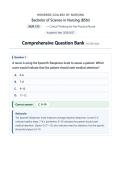
Question 1
A nurse is using the Epworth Sleepiness Scale to assess a patient. Which
score would indicate that the patient should seek medical attention?
A. 0–6
B. 7–8
C. 9–10
D. 11–12
Correct answer: C. 9–10
Rationale:
The Epworth Sleepiness Scale measures average daytime sleepiness. Scores 0–6
indicate healthy sleep; 7–8 is borderline; 9–10 indicates the patient should seek
medical attention. Option D (11–12) also indicates need for attention, but the specific
threshold stated is 9–10.
, Question 2
A nurse is using the SPICES tool to assess an older adult patient. The nurse
asks about the patient's sleep patterns. Which component of SPICES is
being addressed?
A. Problems with Eating or Feeding
B. Incontinence
C. Sleep Disorders
D. Confusion
Correct answer: C. Sleep Disorders
Rationale:
SPICES is a tool used to obtain information to prevent health alterations in older
adults. The acronym stands for: S = Sleep Disorders, P = Problems with Eating or
Feeding, I = Incontinence, C = Confusion, E = Evidence of Falls, S = Skin Breakdown.
Asking about sleep addresses the 'S' for Sleep Disorders.
, Question 3
A nurse is recognizing that all surgical patients are at risk for pneumonia
and atelectasis. This is an example of which component of Noticing?
A. Identifying signs and symptoms
B. Gathering complete and accurate data
C. Assessing systematically and comprehensively
D. Predicting and managing potential complications
Correct answer: D. Predicting and managing potential complications
Rationale:
Predicting and managing potential complications involves recognizing that all surgical
patients are at risk for certain complications like pneumonia and atelectasis. This is part
of Noticing where you predict possible problems. Option A is recognizing change; B is
data collection; C is organized assessment.
, Question 4
A nurse is preparing for an emergency. Which statement best reflects the
approach to emergencies?
A. Emergencies are unpredictable and cannot be prepared for
B. Emergencies cease to exist when you prepare for them
C. Only experienced nurses can handle emergencies
D. Emergencies should be handled by the charge nurse only
Correct answer:
B. Emergencies cease to exist when you prepare for them
Rationale:
The correct approach is that emergencies cease to exist when you prepare for them—
preparation and anticipation reduce the impact of emergencies. Option A is incorrect;
C and D are incorrect because all nurses should be prepared.