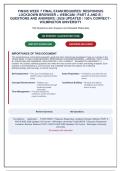
FIN305 WEEK 7 FINAL EXAM:REQUIRES: RESPONDUS
LOCKDOWN BROWSER + WEBCAM | PART A AND B |
QUESTIONS AND ANSWERS | 2026 UPDATED | 100% CORRECT -
WILMINGTON UNIVERSITY
160 Questions with Answers and Detailed Rationales
100 PERCENT GUARANTEED PASS
INSTANT DOWNLOAD ANSWERS INCLUDED
IMPORTANCE OF THIS DOCUMENT
This comprehensive examination preparation guide has been meticulously developed to help you succeed in the
FIN305 WEEK 7 FINAL EXAM:REQUIRES: RESPONDUS LOCKDOWN BROWSER + WEBCAM | PART A AND
B | QUESTIONS AND ANSWERS | 2026 UPDATED | 100% CORRECT - WILMINGTON UNIVERSITY. It
contains 160 carefully selected questions that reflect the most current exam content and testing strategies. Each
question is accompanied by a correct answer and a detailed rationale that explains the underlying
pathophysiology, pharmacology, or clinical reasoning.
Self-Assessment – Test your knowledge and Exam Preparation – Familiarize yourself with the
identify areas requiring further question format and content
study areas
Concept Reinforcement – Deepen your Confidence Building – Develop test-taking
understanding through strategies and reduce
evidence-based exam anxiety
rationales
Time Management – Practice answering
questions under simulated
exam conditions
Review Summary 160 Questions
Foundations - Application - Fin305 WEEK 7 Requires Respondus Lockdown Browser Webcam PART A
AND B AND 2026 Updated 100 Correct - Wilmington University Fin305 WEEK 7 Requires Respondus
Lockdown Browser Webcam PART A AND B AND 2026 Updated 100 Correct - Wilmington University
University
All answers with rationales
,Table of Contents
Content Area Questions Key Topics
Financial Statement Analysis 1-27 FIRM S, Project, Capital, Return, Equity
AND Ratios
TIME Value OF Money AND 28-54 Million, Company, Market, Expected, Value
Discounted CASH FLOW
Capital Budgeting 55-81 Project, FIRM S, Value, Ratio, Equity
Techniques NPV IRR
Payback
RISK AND Return CAPM AND 82-108 Capital, Equity, Project, Investment, Expected
WACC
BOND AND Stock Valuation 109-135 Company, Value, Lease, Lessee, Million
COST OF Capital AND 136-160 Equity, Capital, FIRM S, Project, Million
Capital Structure
TOTAL 160 All questions include answers and detailed rationales
,Section A - Financial Statement Analysis AND Ratios
Q1.
A firm's weighted average cost of capital (WACC) is 9.5%, and its marginal tax rate is 21%.
The firm is considering a project that has the same risk as its overall operations. If the
project is financed entirely with debt at an after-tax cost of 5.7%, what is the correct
approach to evaluate the project's cash flows?
A. Use the WACC of 9.5% to discount the B. Use the after-tax cost of debt (5.7%)
project's unlevered cash flows. because the project is debt-financed.
C. Adjust the WACC upward to reflect the D. Use the WACC of 9.5% to discount the
higher financial risk of debt financing. project's levered cash flows.
Correct: D - Use the WACC of 9.5% to discount the project's levered cash flows.
Rationale:For a project with the same risk as the firm, the WACC reflects the required return
on the firm's assets, regardless of the specific financing mix. Using the after-tax cost of debt
(B) would ignore the opportunity cost of equity. Adjusting WACC upward (C) is incorrect
because the project's risk is unchanged. The WACC should be applied to levered cash flows
that reflect the project's financing effects, hence D is correct.
Q2.
In a Modigliani-Miller world with corporate taxes but no bankruptcy costs, if a firm
increases its debt-to-equity ratio, which of the following statements is true?
A. The firm's weighted average cost of B. The value of the firm increases by the
capital increases due to higher financial risk. present value of the interest tax shield.
C. The cost of equity remains constant D. The firm's optimal capital structure is
because taxes do not affect equity holders. achieved at a debt ratio of 100%.
Correct: B - The value of the firm increases by the present value of the interest tax shield.
Rationale:With corporate taxes and no bankruptcy costs, MM Proposition I with taxes states
that firm value increases with leverage due to the tax shield on interest payments. The WACC
decreases as debt increases (A is false). The cost of equity increases with leverage (C is
false). While a 100% debt ratio would maximize the tax shield, other market imperfections
may exist, but within this framework, value increases with leverage, so B is the best answer.
Q3.
A firm has a beta of 1.2, a risk-free rate of 3%, and an expected market return of 10%.
Using the Capital Asset Pricing Model (CAPM), what is the firm's cost of equity? If the
firm's actual return is 12%, what is the alpha?
Page 3
, Section A - Financial Statement Analysis AND Ratios
A. Cost of equity = 11.4%; Alpha = 0.6% B. Cost of equity = 12.0%; Alpha = 0%
C. Cost of equity = 11.4%; Alpha = -0.6% D. Cost of equity = 10.0%; Alpha = 2.0%
Correct: A - Cost of equity = 11.4%; Alpha = 0.6%
Rationale:CAPM: Cost of equity = 3% + 1.2*(10% - 3%) = 3% + 8.4% = 11.4%. Alpha =
actual return - expected return = 12% - 11.4% = 0.6%. Thus, the stock outperformed its
required return. Option B misstates the cost of equity; C has the wrong alpha sign; D uses the
market return as the cost of equity.
Q4.
A firm with stable cash flows and high tangible assets is considering a leveraged buyout.
Which capital structure theory best explains why such a firm is a good candidate for high
leverage?
A. Pecking-order theory, because internal B. Trade-off theory, because the benefits of
funds are preferred over external debt. debt tax shields are weighed against
bankruptcy costs.
C. Agency cost theory, because debt D. Market timing theory, because equity is
reduces free cash flow problems. undervalued at the time of the buyout.
Correct: B - Trade-off theory, because the benefits of debt tax shields are weighed against
bankruptcy costs.
Rationale:Trade-off theory suggests that firms with stable cash flows and tangible assets can
support high debt because the expected costs of financial distress are low relative to tax
benefits. While agency cost theory (C) also supports debt, the question emphasizes asset
tangibility and stable cash flows, which are classic trade-off factors. Pecking-order (A)
predicts less reliance on external debt when internal funds are available. Market timing (D) is
about equity issuance, not LBOs.
Q5.
When a firm uses the adjusted present value (APV) method to evaluate a project, which of
the following components is explicitly added to the base-case value?
A. The present value of the interest tax B. The project's unlevered cost of equity
shield from debt financing. applied to cash flows.
C. The flotation costs of issuing new equity. D. The project's net present value at the
weighted average cost of capital.
Correct: A - The present value of the interest tax shield from debt financing.
Page 4
LOCKDOWN BROWSER + WEBCAM | PART A AND B |
QUESTIONS AND ANSWERS | 2026 UPDATED | 100% CORRECT -
WILMINGTON UNIVERSITY
160 Questions with Answers and Detailed Rationales
100 PERCENT GUARANTEED PASS
INSTANT DOWNLOAD ANSWERS INCLUDED
IMPORTANCE OF THIS DOCUMENT
This comprehensive examination preparation guide has been meticulously developed to help you succeed in the
FIN305 WEEK 7 FINAL EXAM:REQUIRES: RESPONDUS LOCKDOWN BROWSER + WEBCAM | PART A AND
B | QUESTIONS AND ANSWERS | 2026 UPDATED | 100% CORRECT - WILMINGTON UNIVERSITY. It
contains 160 carefully selected questions that reflect the most current exam content and testing strategies. Each
question is accompanied by a correct answer and a detailed rationale that explains the underlying
pathophysiology, pharmacology, or clinical reasoning.
Self-Assessment – Test your knowledge and Exam Preparation – Familiarize yourself with the
identify areas requiring further question format and content
study areas
Concept Reinforcement – Deepen your Confidence Building – Develop test-taking
understanding through strategies and reduce
evidence-based exam anxiety
rationales
Time Management – Practice answering
questions under simulated
exam conditions
Review Summary 160 Questions
Foundations - Application - Fin305 WEEK 7 Requires Respondus Lockdown Browser Webcam PART A
AND B AND 2026 Updated 100 Correct - Wilmington University Fin305 WEEK 7 Requires Respondus
Lockdown Browser Webcam PART A AND B AND 2026 Updated 100 Correct - Wilmington University
University
All answers with rationales
,Table of Contents
Content Area Questions Key Topics
Financial Statement Analysis 1-27 FIRM S, Project, Capital, Return, Equity
AND Ratios
TIME Value OF Money AND 28-54 Million, Company, Market, Expected, Value
Discounted CASH FLOW
Capital Budgeting 55-81 Project, FIRM S, Value, Ratio, Equity
Techniques NPV IRR
Payback
RISK AND Return CAPM AND 82-108 Capital, Equity, Project, Investment, Expected
WACC
BOND AND Stock Valuation 109-135 Company, Value, Lease, Lessee, Million
COST OF Capital AND 136-160 Equity, Capital, FIRM S, Project, Million
Capital Structure
TOTAL 160 All questions include answers and detailed rationales
,Section A - Financial Statement Analysis AND Ratios
Q1.
A firm's weighted average cost of capital (WACC) is 9.5%, and its marginal tax rate is 21%.
The firm is considering a project that has the same risk as its overall operations. If the
project is financed entirely with debt at an after-tax cost of 5.7%, what is the correct
approach to evaluate the project's cash flows?
A. Use the WACC of 9.5% to discount the B. Use the after-tax cost of debt (5.7%)
project's unlevered cash flows. because the project is debt-financed.
C. Adjust the WACC upward to reflect the D. Use the WACC of 9.5% to discount the
higher financial risk of debt financing. project's levered cash flows.
Correct: D - Use the WACC of 9.5% to discount the project's levered cash flows.
Rationale:For a project with the same risk as the firm, the WACC reflects the required return
on the firm's assets, regardless of the specific financing mix. Using the after-tax cost of debt
(B) would ignore the opportunity cost of equity. Adjusting WACC upward (C) is incorrect
because the project's risk is unchanged. The WACC should be applied to levered cash flows
that reflect the project's financing effects, hence D is correct.
Q2.
In a Modigliani-Miller world with corporate taxes but no bankruptcy costs, if a firm
increases its debt-to-equity ratio, which of the following statements is true?
A. The firm's weighted average cost of B. The value of the firm increases by the
capital increases due to higher financial risk. present value of the interest tax shield.
C. The cost of equity remains constant D. The firm's optimal capital structure is
because taxes do not affect equity holders. achieved at a debt ratio of 100%.
Correct: B - The value of the firm increases by the present value of the interest tax shield.
Rationale:With corporate taxes and no bankruptcy costs, MM Proposition I with taxes states
that firm value increases with leverage due to the tax shield on interest payments. The WACC
decreases as debt increases (A is false). The cost of equity increases with leverage (C is
false). While a 100% debt ratio would maximize the tax shield, other market imperfections
may exist, but within this framework, value increases with leverage, so B is the best answer.
Q3.
A firm has a beta of 1.2, a risk-free rate of 3%, and an expected market return of 10%.
Using the Capital Asset Pricing Model (CAPM), what is the firm's cost of equity? If the
firm's actual return is 12%, what is the alpha?
Page 3
, Section A - Financial Statement Analysis AND Ratios
A. Cost of equity = 11.4%; Alpha = 0.6% B. Cost of equity = 12.0%; Alpha = 0%
C. Cost of equity = 11.4%; Alpha = -0.6% D. Cost of equity = 10.0%; Alpha = 2.0%
Correct: A - Cost of equity = 11.4%; Alpha = 0.6%
Rationale:CAPM: Cost of equity = 3% + 1.2*(10% - 3%) = 3% + 8.4% = 11.4%. Alpha =
actual return - expected return = 12% - 11.4% = 0.6%. Thus, the stock outperformed its
required return. Option B misstates the cost of equity; C has the wrong alpha sign; D uses the
market return as the cost of equity.
Q4.
A firm with stable cash flows and high tangible assets is considering a leveraged buyout.
Which capital structure theory best explains why such a firm is a good candidate for high
leverage?
A. Pecking-order theory, because internal B. Trade-off theory, because the benefits of
funds are preferred over external debt. debt tax shields are weighed against
bankruptcy costs.
C. Agency cost theory, because debt D. Market timing theory, because equity is
reduces free cash flow problems. undervalued at the time of the buyout.
Correct: B - Trade-off theory, because the benefits of debt tax shields are weighed against
bankruptcy costs.
Rationale:Trade-off theory suggests that firms with stable cash flows and tangible assets can
support high debt because the expected costs of financial distress are low relative to tax
benefits. While agency cost theory (C) also supports debt, the question emphasizes asset
tangibility and stable cash flows, which are classic trade-off factors. Pecking-order (A)
predicts less reliance on external debt when internal funds are available. Market timing (D) is
about equity issuance, not LBOs.
Q5.
When a firm uses the adjusted present value (APV) method to evaluate a project, which of
the following components is explicitly added to the base-case value?
A. The present value of the interest tax B. The project's unlevered cost of equity
shield from debt financing. applied to cash flows.
C. The flotation costs of issuing new equity. D. The project's net present value at the
weighted average cost of capital.
Correct: A - The present value of the interest tax shield from debt financing.
Page 4