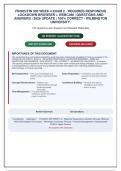
FIN305/FIN 305 WEEK 4 EXAM 2 - REQUIRES RESPONDUS
LOCKDOWN BROWSER + WEBCAM | QUESTIONS AND
ANSWERS | 2026 UPDATE | 100% CORRECT - WILMINGTON
UNIVERSITY.
130 Questions with Answers and Detailed Rationales
100 PERCENT GUARANTEED PASS
INSTANT DOWNLOAD ANSWERS INCLUDED
IMPORTANCE OF THIS DOCUMENT
This comprehensive examination preparation guide has been meticulously developed to help you succeed in the
FIN305/FIN 305 WEEK 4 EXAM 2 - REQUIRES RESPONDUS LOCKDOWN BROWSER + WEBCAM |
QUESTIONS AND ANSWERS | 2026 UPDATE | 100% CORRECT - WILMINGTON UNIVERSITY.. It contains
130 carefully selected questions that reflect the most current exam content and testing strategies. Each question
is accompanied by a correct answer and a detailed rationale that explains the underlying pathophysiology,
pharmacology, or clinical reasoning.
Self-Assessment – Test your knowledge and Exam Preparation – Familiarize yourself with the
identify areas requiring further question format and content
study areas
Concept Reinforcement – Deepen your Confidence Building – Develop test-taking
understanding through strategies and reduce
evidence-based exam anxiety
rationales
Time Management – Practice answering
questions under simulated
exam conditions
Review Summary 130 Questions
Foundations - Application - Fin305/fin 305 WEEK 4 2 - Requires Respondus Lockdown Browser Webcam
AND 2026 Update 100 Correct - Wilmington University Finance / Financial Management Undergraduate
YEAR 3 Upper Division
All answers with rationales
,Table of Contents
Content Area Questions Key Topics
TIME Value OF Money 1-22 FIRM S, Capital, Equity, Project, Ratio
BOND Valuation 23-44 Project, FIRM S, Capital, Expected, Equity
Stock Valuation 45-66 FIRM S, Project, Capital, Ratio, Expected
RISK AND Return 67-88 Million, FIRM S, Ratio, Project, Value
COST OF Capital 89-110 Project, FIRM S, Million, CASH Flows, Capital
Capital Budgeting 111-130 Capital, Years, Project, Payback, Expected
TOTAL 130 All questions include answers and detailed rationales
,Section A - TIME Value OF Money
Q1.
A firm with high operating leverage and high business risk is considering a major
debt-financed expansion. According to the trade-off theory, which of the following
adjustments is most appropriate?
A. Increase target debt ratio to exploit the B. Maintain a lower target debt ratio to
tax shield, as the expansion will increase balance the higher bankruptcy costs against
taxable income. the tax benefits.
C. Issue only equity to avoid any increase in D. Set the target debt ratio to 100% to
financial risk. maximize the interest tax shield.
Correct: B - Maintain a lower target debt ratio to balance the higher bankruptcy costs
against the tax benefits.
Rationale:The trade-off theory posits that optimal capital structure balances the tax benefits
of debt against the costs of financial distress. High operating leverage already elevates
business risk, so additional debt increases the probability of bankruptcy, making a lower
target debt ratio appropriate. Option A ignores distress costs; C is too extreme and ignores
tax shields; D ignores both distress costs and the existence of an optimal point.
Q2.
Under the residual dividend policy, if a firm has a target capital structure of 60% equity
and 40% debt, and it has net income of $10 million, what is the maximum capital budget
that allows it to maintain its target structure while paying no dividends?
A. $6.0 million B. $10.0 million
C. $16.7 million D. $25.0 million
Correct: C - $16.7 million
Rationale:Residual dividend policy implies dividends are paid only after funding all
positive-NPV projects with retained earnings that maintain the target capital structure. With
60% equity, the maximum capital budget equals net income / equity proportion = $10M / 0.60
= $16.67M. Option A uses the debt proportion; B ignores leverage; D incorrectly uses 40%.
Q3.
A multinational corporation expects to receive 10 million in 6 months. The current spot
rate is $1.10/, the 6-month forward rate is $1.12/, and the firm's weighted average cost of
capital is 12%. If the firm uses a forward contract to hedge, what is the dollar amount it
will lock in?
Page 3
, Section A - TIME Value OF Money
A. $10.8 million B. $11.0 million
C. $11.2 million D. $11.36 million
Correct: C - $11.2 million
Rationale:A forward contract fixes the exchange rate at the forward rate. The guaranteed
dollar amount is 10,000,000 × $1.12/ = $11,200,000. The spot rate and WACC are irrelevant
for the forward contract's payout, making A, B, and D incorrect.
Q4.
Which of the following is the most appropriate method for estimating the cost of equity for
a private firm that has no market data, when the firm operates in a single industry?
A. CAPM using the firm's own beta B. Dividend discount model (DDM) using
estimated from historical stock returns. current dividend and growth rate.
C. Build-up method: risk-free rate + equity D. Yield to maturity on the firm's debt plus a
risk premium + industry risk premium + size fixed risk premium.
premium.
Correct: C - Build-up method: risk-free rate + equity risk premium + industry risk premium
+ size premium.
Rationale:For private firms lacking market data, the build-up method is commonly used
because it does not require a beta or market price. CAPM requires a beta (A), DDM requires
a stable dividend and growth (B), and debt yield plus premium (D) is less standard and
ignores equity-specific risks. The build-up method explicitly incorporates multiple risk
components.
Q5.
A company is considering a project with an initial investment of $500,000 and expected
cash flows of $150,000 per year for 5 years. If the discount rate is 10%, what is the
profitability index (PI)? (Round to two decimal places.)
A. 1.14 B. 1.50
C. 0.88 D. 1.00
Correct: A - 1.14
Rationale:PI = PV of future cash flows / initial investment. PV of annuity = $150,000 × [1 -
(1.10)^-5] / 0.10 = $150,000 × 3.7908 = $568,620. PI = $568,620 / $500,000 = 1.14. Option B
ignores discounting; C uses NPV incorrectly; D would imply NPV = 0.
Page 4
LOCKDOWN BROWSER + WEBCAM | QUESTIONS AND
ANSWERS | 2026 UPDATE | 100% CORRECT - WILMINGTON
UNIVERSITY.
130 Questions with Answers and Detailed Rationales
100 PERCENT GUARANTEED PASS
INSTANT DOWNLOAD ANSWERS INCLUDED
IMPORTANCE OF THIS DOCUMENT
This comprehensive examination preparation guide has been meticulously developed to help you succeed in the
FIN305/FIN 305 WEEK 4 EXAM 2 - REQUIRES RESPONDUS LOCKDOWN BROWSER + WEBCAM |
QUESTIONS AND ANSWERS | 2026 UPDATE | 100% CORRECT - WILMINGTON UNIVERSITY.. It contains
130 carefully selected questions that reflect the most current exam content and testing strategies. Each question
is accompanied by a correct answer and a detailed rationale that explains the underlying pathophysiology,
pharmacology, or clinical reasoning.
Self-Assessment – Test your knowledge and Exam Preparation – Familiarize yourself with the
identify areas requiring further question format and content
study areas
Concept Reinforcement – Deepen your Confidence Building – Develop test-taking
understanding through strategies and reduce
evidence-based exam anxiety
rationales
Time Management – Practice answering
questions under simulated
exam conditions
Review Summary 130 Questions
Foundations - Application - Fin305/fin 305 WEEK 4 2 - Requires Respondus Lockdown Browser Webcam
AND 2026 Update 100 Correct - Wilmington University Finance / Financial Management Undergraduate
YEAR 3 Upper Division
All answers with rationales
,Table of Contents
Content Area Questions Key Topics
TIME Value OF Money 1-22 FIRM S, Capital, Equity, Project, Ratio
BOND Valuation 23-44 Project, FIRM S, Capital, Expected, Equity
Stock Valuation 45-66 FIRM S, Project, Capital, Ratio, Expected
RISK AND Return 67-88 Million, FIRM S, Ratio, Project, Value
COST OF Capital 89-110 Project, FIRM S, Million, CASH Flows, Capital
Capital Budgeting 111-130 Capital, Years, Project, Payback, Expected
TOTAL 130 All questions include answers and detailed rationales
,Section A - TIME Value OF Money
Q1.
A firm with high operating leverage and high business risk is considering a major
debt-financed expansion. According to the trade-off theory, which of the following
adjustments is most appropriate?
A. Increase target debt ratio to exploit the B. Maintain a lower target debt ratio to
tax shield, as the expansion will increase balance the higher bankruptcy costs against
taxable income. the tax benefits.
C. Issue only equity to avoid any increase in D. Set the target debt ratio to 100% to
financial risk. maximize the interest tax shield.
Correct: B - Maintain a lower target debt ratio to balance the higher bankruptcy costs
against the tax benefits.
Rationale:The trade-off theory posits that optimal capital structure balances the tax benefits
of debt against the costs of financial distress. High operating leverage already elevates
business risk, so additional debt increases the probability of bankruptcy, making a lower
target debt ratio appropriate. Option A ignores distress costs; C is too extreme and ignores
tax shields; D ignores both distress costs and the existence of an optimal point.
Q2.
Under the residual dividend policy, if a firm has a target capital structure of 60% equity
and 40% debt, and it has net income of $10 million, what is the maximum capital budget
that allows it to maintain its target structure while paying no dividends?
A. $6.0 million B. $10.0 million
C. $16.7 million D. $25.0 million
Correct: C - $16.7 million
Rationale:Residual dividend policy implies dividends are paid only after funding all
positive-NPV projects with retained earnings that maintain the target capital structure. With
60% equity, the maximum capital budget equals net income / equity proportion = $10M / 0.60
= $16.67M. Option A uses the debt proportion; B ignores leverage; D incorrectly uses 40%.
Q3.
A multinational corporation expects to receive 10 million in 6 months. The current spot
rate is $1.10/, the 6-month forward rate is $1.12/, and the firm's weighted average cost of
capital is 12%. If the firm uses a forward contract to hedge, what is the dollar amount it
will lock in?
Page 3
, Section A - TIME Value OF Money
A. $10.8 million B. $11.0 million
C. $11.2 million D. $11.36 million
Correct: C - $11.2 million
Rationale:A forward contract fixes the exchange rate at the forward rate. The guaranteed
dollar amount is 10,000,000 × $1.12/ = $11,200,000. The spot rate and WACC are irrelevant
for the forward contract's payout, making A, B, and D incorrect.
Q4.
Which of the following is the most appropriate method for estimating the cost of equity for
a private firm that has no market data, when the firm operates in a single industry?
A. CAPM using the firm's own beta B. Dividend discount model (DDM) using
estimated from historical stock returns. current dividend and growth rate.
C. Build-up method: risk-free rate + equity D. Yield to maturity on the firm's debt plus a
risk premium + industry risk premium + size fixed risk premium.
premium.
Correct: C - Build-up method: risk-free rate + equity risk premium + industry risk premium
+ size premium.
Rationale:For private firms lacking market data, the build-up method is commonly used
because it does not require a beta or market price. CAPM requires a beta (A), DDM requires
a stable dividend and growth (B), and debt yield plus premium (D) is less standard and
ignores equity-specific risks. The build-up method explicitly incorporates multiple risk
components.
Q5.
A company is considering a project with an initial investment of $500,000 and expected
cash flows of $150,000 per year for 5 years. If the discount rate is 10%, what is the
profitability index (PI)? (Round to two decimal places.)
A. 1.14 B. 1.50
C. 0.88 D. 1.00
Correct: A - 1.14
Rationale:PI = PV of future cash flows / initial investment. PV of annuity = $150,000 × [1 -
(1.10)^-5] / 0.10 = $150,000 × 3.7908 = $568,620. PI = $568,620 / $500,000 = 1.14. Option B
ignores discounting; C uses NPV incorrectly; D would imply NPV = 0.
Page 4