

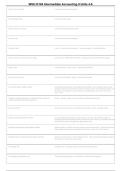
WGU D104 Intermediate Accounting II Units 4-6
Asset Turnover Ratio net sales/average total assets
Profit Margin Ratio net income/total sales
Rate of return on assets net income/average total assets
Current ratio current assets/current liabilities
acid-test ratio (cash + short-term investments + net receivables) / current liabilities
rate of return on common stock equity (net income - preferred dividends) / average common stockholders' equity
payout ratio cash dividends / (net income - preferred dividends)
book value per share common stockholders' equity / outstanding shares
sum-of-the-years'-digits method Accelerated depreciation with higher depreciation cost in beginning and lower
charges in the end. Numerator is the # of years of est. life remaining at the 1st of
the year, denominator is sum of the years individually. (e.g. 5/15, 4/15, 3/15,
2/15, 1/15)
Variable charge depreciation method (activity method or ((cost - salvage value) X current units) / total estimated units
units-of-activity/ production approach)
activity method (actual activity in period / total estimate activity) X (cost - salvage value)
double declining balance method An accelerated depreciation method that computes annual depreciation by
multiplying the depreciable asset's decreasing book value by a constant percent
that is two times the straight-line depreciation rate.
Multiple assets group depreciation method Assets similar in nature and have approx. same useful lives. Total of the annual
depreciation expense for all assets in the group / total cost of the assets.
Multiple assets composite depreciation method Assets are dissimilar and have different lives. Total annual depreciation expense
of all assets / total cost of all assets.
Composite life (Original cost - salvage value) / total annual depreciation
Composite depreciation rate Total annual depreciation of all assets / total cost of all assets.
, WGU D104 Intermediate Accounting II Units 4-6
Journal entry for gain on sale of composite depreciation Debit cash & accumulated depreciation (subtract gain), credit equipment.
equipment
Impairment If the carrying amount exceeds the undiscounted future cash flows. Loss =
carrying amount > fair value.
Journal entry for impairment Debit impairment loss, credit accumulated depreciation
When is the restoration of an impairment loss permitted? When an assets is held for disposal. Impairment loss is reported at the lower of
cost or net realizable value (fair value - cost to sell/dispose) not to exceed
amount of initial impairment loss.
Depletion base for natural resources (cost to acquire + cost to explore + cost to develop i.e. intangible costs + cost to
restore). Tangible costs to extract resources depreciated separately.
Natural resources depletion rate (depletion base - salvage value) / total units to be recovered.
Natural resources depletion expense (depletion rate X units of usage) / extracted
Journal entry to record ore extracted Debit inventory (ore), credit mineral mine
Journal entry to record the ore sold Debit cost of goods sold, credit inventory (ore)
Journal entry to record depletion expense for mine Debit depletion expense, credit accumulated depletion
Types of current liabilities Accounts payable, notes payable, dividends payable, customer
advances/deposits, unearned (deferred) revenues, sales tax payable, current
maturities of long-term debt
Journal entry to record issuance of a note Debit cash, credit notes payable
Journal entry to record payment of the note at maturity Debit notes payable, debit interest expense, credit cash
Journal entry to record issuance of a zero interest Debit cash, debit discount on notes payable, credit notes payable
bearing note
Journal entry to record payment of a zero interest Debit notes payable, credit cash
bearing note at maturity
Journal entry to record sale of gift certificate booklet Debit cash, credit unearned gift card revenue
Asset Turnover Ratio net sales/average total assets
Profit Margin Ratio net income/total sales
Rate of return on assets net income/average total assets
Current ratio current assets/current liabilities
acid-test ratio (cash + short-term investments + net receivables) / current liabilities
rate of return on common stock equity (net income - preferred dividends) / average common stockholders' equity
payout ratio cash dividends / (net income - preferred dividends)
book value per share common stockholders' equity / outstanding shares
sum-of-the-years'-digits method Accelerated depreciation with higher depreciation cost in beginning and lower
charges in the end. Numerator is the # of years of est. life remaining at the 1st of
the year, denominator is sum of the years individually. (e.g. 5/15, 4/15, 3/15,
2/15, 1/15)
Variable charge depreciation method (activity method or ((cost - salvage value) X current units) / total estimated units
units-of-activity/ production approach)
activity method (actual activity in period / total estimate activity) X (cost - salvage value)
double declining balance method An accelerated depreciation method that computes annual depreciation by
multiplying the depreciable asset's decreasing book value by a constant percent
that is two times the straight-line depreciation rate.
Multiple assets group depreciation method Assets similar in nature and have approx. same useful lives. Total of the annual
depreciation expense for all assets in the group / total cost of the assets.
Multiple assets composite depreciation method Assets are dissimilar and have different lives. Total annual depreciation expense
of all assets / total cost of all assets.
Composite life (Original cost - salvage value) / total annual depreciation
Composite depreciation rate Total annual depreciation of all assets / total cost of all assets.
, WGU D104 Intermediate Accounting II Units 4-6
Journal entry for gain on sale of composite depreciation Debit cash & accumulated depreciation (subtract gain), credit equipment.
equipment
Impairment If the carrying amount exceeds the undiscounted future cash flows. Loss =
carrying amount > fair value.
Journal entry for impairment Debit impairment loss, credit accumulated depreciation
When is the restoration of an impairment loss permitted? When an assets is held for disposal. Impairment loss is reported at the lower of
cost or net realizable value (fair value - cost to sell/dispose) not to exceed
amount of initial impairment loss.
Depletion base for natural resources (cost to acquire + cost to explore + cost to develop i.e. intangible costs + cost to
restore). Tangible costs to extract resources depreciated separately.
Natural resources depletion rate (depletion base - salvage value) / total units to be recovered.
Natural resources depletion expense (depletion rate X units of usage) / extracted
Journal entry to record ore extracted Debit inventory (ore), credit mineral mine
Journal entry to record the ore sold Debit cost of goods sold, credit inventory (ore)
Journal entry to record depletion expense for mine Debit depletion expense, credit accumulated depletion
Types of current liabilities Accounts payable, notes payable, dividends payable, customer
advances/deposits, unearned (deferred) revenues, sales tax payable, current
maturities of long-term debt
Journal entry to record issuance of a note Debit cash, credit notes payable
Journal entry to record payment of the note at maturity Debit notes payable, debit interest expense, credit cash
Journal entry to record issuance of a zero interest Debit cash, debit discount on notes payable, credit notes payable
bearing note
Journal entry to record payment of a zero interest Debit notes payable, credit cash
bearing note at maturity
Journal entry to record sale of gift certificate booklet Debit cash, credit unearned gift card revenue

