

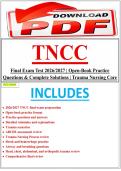
TNCC
Final Exam Test 2026/2027 | Open-Book Practice
Questions & Complete Solutions | Trauma Nursing Core
TESTS CORNER Course
INCLUDES
• 2026/2027 TNCC final-exam preparation
• Open-book practice format
• Practice questions and answers
• Detailed rationales and explanations
• Trauma scenarios
• ABCDE assessment review
• Trauma Nursing Process review
• Shock and hemorrhage practice
• Airway and breathing questions
• Head, chest, abdominal, and orthopedic trauma review
• Comprehensive final review
,Question 1
Why is a measure of serum lactate obtained in the initial assessment
of the trauma patient?
A) to measure oxygenation and ventilation
B) to quantify the base deficit for the adequacy of cellular perfusion
C) to gauge end-organ perfusion and tissue hypoxia
D) to determine the underlying cause of shock
Answer: C
Rationale: Serum lactate is a marker of anaerobic metabolism that occurs
when tissues are hypoperfused and oxygen delivery is inadequate. Elevated
lactate levels indicate tissue hypoxia and poor end-organ perfusion,
making it a valuable indicator of shock severity. While base deficit (B) also
reflects metabolic acidosis from poor perfusion, lactate specifically
measures the byproduct of anaerobic glycolysis. Option A is incorrect
because oxygenation and ventilation are assessed through arterial blood
gases and pulse oximetry. Option D is incorrect because lactate elevation
suggests shock but does not identify the specific underlying cause.
Question 2
A trauma patient is restless and repeatedly asking "where am I?" Vital
signs upon arrival were BP 100/60 mm Hg, HR 96 beats/min, and RR
24 breaths/min. Her skin is cool and dry. Current vital signs are BP
,104/84 mm Hg, HR 108, RR 28 breaths/min. The patient is
demonstrating signs and symptoms of which stage of shock?
A) compensated
B) progressive
C) irreversible
D) decompensated
Answer: A
Rationale: This patient is in compensated shock, characterized by the
body's compensatory mechanisms attempting to maintain perfusion to
vital organs. Signs include tachycardia, tachypnea, narrowed pulse pressure
(from 40 to 20 mmHg), restlessness, and anxiety—all present in this patient.
The skin is cool and dry rather than cold and clammy. In compensated
shock, blood pressure may remain relatively normal as vasoconstriction
maintains perfusion. Progressive shock (B) would show worsening organ
dysfunction, hypotension, and metabolic acidosis. Irreversible shock (C) is
characterized by cellular death and organ failure unresponsive to
treatment. Decompensated shock (D) would demonstrate significant
hypotension, altered mental status, and impending cardiac arrest.
Question 3
An elderly patient with a history of anticoagulant use presents after a
fall at home that day. She denies any loss of consciousness. She has a
, hematoma to her forehead and complains of headache, dizziness, and
nausea. Which is a most likely cause of her symptoms?
A) epidural hematoma
B) diffuse axonal injury
C) post-concussive syndrome
D) subdural hematoma
Answer: D
Rationale: Subdural hematoma is most likely in this elderly patient on
anticoagulants. The bridging veins that drain from the cerebral cortex to
the dural sinuses are stretched and torn during acceleration-deceleration
injuries, causing bleeding into the subdural space. Elderly patients are at
increased risk due to age-related brain atrophy, which stretches these veins.
Anticoagulant use significantly increases bleeding risk. Symptoms may
develop slowly (hours to days) and include headache, confusion, nausea,
and dizziness. Epidural hematoma (A) is typically associated with arterial
bleeding (middle meningeal artery) and a lucid interval followed by rapid
deterioration; it is less common in elderly patients. Diffuse axonal injury (B)
results from rotational forces and would cause more significant
neurological deficits. Post-concussive syndrome (C) is a diagnosis of
exclusion and wouldn't typically present with a hematoma.
Question 5
Final Exam Test 2026/2027 | Open-Book Practice
Questions & Complete Solutions | Trauma Nursing Core
TESTS CORNER Course
INCLUDES
• 2026/2027 TNCC final-exam preparation
• Open-book practice format
• Practice questions and answers
• Detailed rationales and explanations
• Trauma scenarios
• ABCDE assessment review
• Trauma Nursing Process review
• Shock and hemorrhage practice
• Airway and breathing questions
• Head, chest, abdominal, and orthopedic trauma review
• Comprehensive final review
,Question 1
Why is a measure of serum lactate obtained in the initial assessment
of the trauma patient?
A) to measure oxygenation and ventilation
B) to quantify the base deficit for the adequacy of cellular perfusion
C) to gauge end-organ perfusion and tissue hypoxia
D) to determine the underlying cause of shock
Answer: C
Rationale: Serum lactate is a marker of anaerobic metabolism that occurs
when tissues are hypoperfused and oxygen delivery is inadequate. Elevated
lactate levels indicate tissue hypoxia and poor end-organ perfusion,
making it a valuable indicator of shock severity. While base deficit (B) also
reflects metabolic acidosis from poor perfusion, lactate specifically
measures the byproduct of anaerobic glycolysis. Option A is incorrect
because oxygenation and ventilation are assessed through arterial blood
gases and pulse oximetry. Option D is incorrect because lactate elevation
suggests shock but does not identify the specific underlying cause.
Question 2
A trauma patient is restless and repeatedly asking "where am I?" Vital
signs upon arrival were BP 100/60 mm Hg, HR 96 beats/min, and RR
24 breaths/min. Her skin is cool and dry. Current vital signs are BP
,104/84 mm Hg, HR 108, RR 28 breaths/min. The patient is
demonstrating signs and symptoms of which stage of shock?
A) compensated
B) progressive
C) irreversible
D) decompensated
Answer: A
Rationale: This patient is in compensated shock, characterized by the
body's compensatory mechanisms attempting to maintain perfusion to
vital organs. Signs include tachycardia, tachypnea, narrowed pulse pressure
(from 40 to 20 mmHg), restlessness, and anxiety—all present in this patient.
The skin is cool and dry rather than cold and clammy. In compensated
shock, blood pressure may remain relatively normal as vasoconstriction
maintains perfusion. Progressive shock (B) would show worsening organ
dysfunction, hypotension, and metabolic acidosis. Irreversible shock (C) is
characterized by cellular death and organ failure unresponsive to
treatment. Decompensated shock (D) would demonstrate significant
hypotension, altered mental status, and impending cardiac arrest.
Question 3
An elderly patient with a history of anticoagulant use presents after a
fall at home that day. She denies any loss of consciousness. She has a
, hematoma to her forehead and complains of headache, dizziness, and
nausea. Which is a most likely cause of her symptoms?
A) epidural hematoma
B) diffuse axonal injury
C) post-concussive syndrome
D) subdural hematoma
Answer: D
Rationale: Subdural hematoma is most likely in this elderly patient on
anticoagulants. The bridging veins that drain from the cerebral cortex to
the dural sinuses are stretched and torn during acceleration-deceleration
injuries, causing bleeding into the subdural space. Elderly patients are at
increased risk due to age-related brain atrophy, which stretches these veins.
Anticoagulant use significantly increases bleeding risk. Symptoms may
develop slowly (hours to days) and include headache, confusion, nausea,
and dizziness. Epidural hematoma (A) is typically associated with arterial
bleeding (middle meningeal artery) and a lucid interval followed by rapid
deterioration; it is less common in elderly patients. Diffuse axonal injury (B)
results from rotational forces and would cause more significant
neurological deficits. Post-concussive syndrome (C) is a diagnosis of
exclusion and wouldn't typically present with a hematoma.
Question 5

