

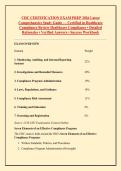
CHC CERTIFICATION EXAM PREP 2026 Latest
Comprehensive Study Guide — Certified in Healthcare
Compliance Review Healthcare Compliance • Detailed
Rationales • Verified Answers • Success Workbook
EXAM OVERVIEW
Domain Weight
1. Monitoring, Auditing, and Internal Reporting
22%
Systems
2. Investigations and Remedial Measures 20%
3. Compliance Program Administration 19%
4. Laws, Regulations, and Guidance 14%
5. Compliance Risk Assessment 11%
6. Training and Education 8%
7. Screening and Registration 6%
Source: CCB CHC Examination Content Outline
Seven Elements of an Effective Compliance Program
The CHC exam is built around the OIG's Seven Elements of an Effective
Compliance Program:
1. Written Standards, Policies, and Procedures
2. Compliance Program Administration (Oversight)
, 3. Communication, Education, and Training
4. Monitoring and Auditing
5. Enforcement and Discipline
6. Investigations and Remedial Measures
7. Risk Assessment
DOMAIN 1: MONITORING, AUDITING, AND INTERNAL REPORTING
SYSTEMS (Questions 1–22)
Question 1
A healthcare compliance officer is designing an internal reporting system for the
organization. Which of the following is a required element for an effective system
under the OIG's Seven Elements?
A) Anonymous reporting must be prohibited to ensure accountability
B) The system must include a mechanism for anonymous reporting and
protect against retaliation
C) All reports must be investigated within 24 hours or less
D) Reports must be forwarded directly to the Board without review
Rationale: An effective compliance program must include a mechanism for
employees and others to report compliance concerns anonymously or
confidentially, without fear of retaliation.The OIG explicitly requires that reporting
systems protect against retaliation and provide multiple reporting channels (e.g.,
hotline, email, web portal). Reports must be properly triaged and investigated, but
there is no universal 24-hour requirement.
Question 2
What is the primary difference between monitoring and auditing in a compliance
program?
A) Monitoring is performed by external auditors; auditing is performed internally
B) Monitoring is ongoing and continuous; auditing is periodic and point-in-
time
,C) Monitoring focuses on financial issues; auditing focuses on clinical issues
D) There is no meaningful difference between monitoring and auditing
Rationale: Monitoring is an ongoing, continuous process that identifies
compliance risks in real-time as part of daily operations. Auditing is a periodic,
point-in-time review that evaluates compliance with specific standards, policies, or
regulations.Both are essential elements of an effective compliance program but
serve different functions.
Question 3
A compliance officer discovers that a physician has been routinely submitting
claims for services not actually rendered. What is the most appropriate immediate
action?
A) Confront the physician privately and ask them to stop
B) Initiate the internal reporting protocol and conduct a preliminary
investigation
C) Terminate the physician immediately without investigation
D) Ignore the issue to avoid conflict with a high-revenue provider
Rationale: When potential fraud or compliance violations are identified, the
compliance officer must initiate the internal reporting protocol and conduct a
preliminary investigation.Termination without investigation may violate due
process rights, and ignoring the issue is not acceptable. The investigation should be
conducted with appropriate discretion and legal guidance.
Question 4
Which of the following is a key characteristic of an effective internal reporting
system?
A) Reporting must be limited to clinical staff only
B) Reports must be documented, tracked, and resolved in a timely manner
C) All reports must be investigated by the same individual
D) Reports should be discarded if they cannot be substantiated immediately
Rationale: An effective internal reporting system requires that reports be
documented, tracked, and resolved in a timely manner with appropriate follow-up
and closure.Reports should be properly triaged, investigated, and tracked to
, resolution. Documentation ensures accountability and provides evidence of the
organization's response.
Question 5
A compliance officer is developing an audit work plan. Which of the following
should be the primary consideration in prioritizing audits?
A) The personal preferences of the CEO
B) The organization's risk assessment findings and identified high-risk areas
C) The recommendations of external consultants only
D) The ease of conducting the audit
Rationale: Audit work plans should be based on the organization's risk assessment
findings, focusing on areas of highest risk.The OIG Work Plan, enforcement
trends, and organizational vulnerabilities should guide prioritization. Personal
preferences and convenience are not appropriate bases for audit prioritization.
Question 6
Under the OIG's Seven Elements, what is the purpose of monitoring and auditing?
A) To generate revenue through fines
B) To identify and correct compliance deficiencies before they result in legal
violations
C) To evaluate employee performance for disciplinary purposes
D) To reduce the cost of healthcare delivery
Rationale: The purpose of monitoring and auditing is to proactively identify and
correct compliance deficiencies before they result in legal violations, false claims,
or other regulatory issues.While audits may inform performance evaluations, their
primary purpose is risk mitigation and program effectiveness.
Question 7
A compliance officer receives a hotline report alleging that a department manager
is routinely falsifying time records. What is the most appropriate first step?
A) Immediately terminate the manager
B) Document the report, conduct a preliminary assessment, and determine the
Comprehensive Study Guide — Certified in Healthcare
Compliance Review Healthcare Compliance • Detailed
Rationales • Verified Answers • Success Workbook
EXAM OVERVIEW
Domain Weight
1. Monitoring, Auditing, and Internal Reporting
22%
Systems
2. Investigations and Remedial Measures 20%
3. Compliance Program Administration 19%
4. Laws, Regulations, and Guidance 14%
5. Compliance Risk Assessment 11%
6. Training and Education 8%
7. Screening and Registration 6%
Source: CCB CHC Examination Content Outline
Seven Elements of an Effective Compliance Program
The CHC exam is built around the OIG's Seven Elements of an Effective
Compliance Program:
1. Written Standards, Policies, and Procedures
2. Compliance Program Administration (Oversight)
, 3. Communication, Education, and Training
4. Monitoring and Auditing
5. Enforcement and Discipline
6. Investigations and Remedial Measures
7. Risk Assessment
DOMAIN 1: MONITORING, AUDITING, AND INTERNAL REPORTING
SYSTEMS (Questions 1–22)
Question 1
A healthcare compliance officer is designing an internal reporting system for the
organization. Which of the following is a required element for an effective system
under the OIG's Seven Elements?
A) Anonymous reporting must be prohibited to ensure accountability
B) The system must include a mechanism for anonymous reporting and
protect against retaliation
C) All reports must be investigated within 24 hours or less
D) Reports must be forwarded directly to the Board without review
Rationale: An effective compliance program must include a mechanism for
employees and others to report compliance concerns anonymously or
confidentially, without fear of retaliation.The OIG explicitly requires that reporting
systems protect against retaliation and provide multiple reporting channels (e.g.,
hotline, email, web portal). Reports must be properly triaged and investigated, but
there is no universal 24-hour requirement.
Question 2
What is the primary difference between monitoring and auditing in a compliance
program?
A) Monitoring is performed by external auditors; auditing is performed internally
B) Monitoring is ongoing and continuous; auditing is periodic and point-in-
time
,C) Monitoring focuses on financial issues; auditing focuses on clinical issues
D) There is no meaningful difference between monitoring and auditing
Rationale: Monitoring is an ongoing, continuous process that identifies
compliance risks in real-time as part of daily operations. Auditing is a periodic,
point-in-time review that evaluates compliance with specific standards, policies, or
regulations.Both are essential elements of an effective compliance program but
serve different functions.
Question 3
A compliance officer discovers that a physician has been routinely submitting
claims for services not actually rendered. What is the most appropriate immediate
action?
A) Confront the physician privately and ask them to stop
B) Initiate the internal reporting protocol and conduct a preliminary
investigation
C) Terminate the physician immediately without investigation
D) Ignore the issue to avoid conflict with a high-revenue provider
Rationale: When potential fraud or compliance violations are identified, the
compliance officer must initiate the internal reporting protocol and conduct a
preliminary investigation.Termination without investigation may violate due
process rights, and ignoring the issue is not acceptable. The investigation should be
conducted with appropriate discretion and legal guidance.
Question 4
Which of the following is a key characteristic of an effective internal reporting
system?
A) Reporting must be limited to clinical staff only
B) Reports must be documented, tracked, and resolved in a timely manner
C) All reports must be investigated by the same individual
D) Reports should be discarded if they cannot be substantiated immediately
Rationale: An effective internal reporting system requires that reports be
documented, tracked, and resolved in a timely manner with appropriate follow-up
and closure.Reports should be properly triaged, investigated, and tracked to
, resolution. Documentation ensures accountability and provides evidence of the
organization's response.
Question 5
A compliance officer is developing an audit work plan. Which of the following
should be the primary consideration in prioritizing audits?
A) The personal preferences of the CEO
B) The organization's risk assessment findings and identified high-risk areas
C) The recommendations of external consultants only
D) The ease of conducting the audit
Rationale: Audit work plans should be based on the organization's risk assessment
findings, focusing on areas of highest risk.The OIG Work Plan, enforcement
trends, and organizational vulnerabilities should guide prioritization. Personal
preferences and convenience are not appropriate bases for audit prioritization.
Question 6
Under the OIG's Seven Elements, what is the purpose of monitoring and auditing?
A) To generate revenue through fines
B) To identify and correct compliance deficiencies before they result in legal
violations
C) To evaluate employee performance for disciplinary purposes
D) To reduce the cost of healthcare delivery
Rationale: The purpose of monitoring and auditing is to proactively identify and
correct compliance deficiencies before they result in legal violations, false claims,
or other regulatory issues.While audits may inform performance evaluations, their
primary purpose is risk mitigation and program effectiveness.
Question 7
A compliance officer receives a hotline report alleging that a department manager
is routinely falsifying time records. What is the most appropriate first step?
A) Immediately terminate the manager
B) Document the report, conduct a preliminary assessment, and determine the

