

AQA GCSE Chemistry - 2026 Paper 1
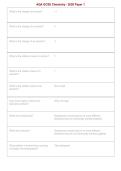
What is the charge of a proton? +1
What is the charge of a neutron? 0
What is the charge of an electron? -1
What is the relative mass of a proton? 1
What is the relative mass of a 1
neutron?
What is the relative mass of an Very small
electron?
How many types of atoms do Only one type
elements contain?
What are compounds? Substances containing two or more different
elements that are chemically bonded together
What are mixtures? Substances containing two or more different
elements that are not chemically bonded together
What pattern is formed from carrying Chromatogram
out paper chromatography?
, AQA GCSE Chemistry - 2026 Paper 1
Which method of separation is useful Filtration
to separate an insoluble solid from a
liquid?
Which method of separation is useful Evaporation or Crystillisation
to separate a soluble solid from a
liquid?
Which method of distillation separates Fractional distillation
liquids with similar boiling points?
Who discovered that the plum Ernest Rutherford
pudding model was wrong?
Who devised an experiment that Niels Bohr
proved the existence of the neutron?
Why did Mendeleev leave gaps in his To ensure that elements with similar properties
Table of Elements? stayed in the same groups. The gaps indicated the
existence of undiscovered elements and allowed
Mendeleev to predict what their properties might be
How are the group number and the The group number tells you how many electrons are
number of electrons in the outer shell in the outer shell of an element. E.g. sodium is in
of an element related? Group 1 therefore it has 1 electron on its outer shell
What kind of ions do metals form? Positive
Where are the non-metals on the On the right hand side
periodic table?
, AQA GCSE Chemistry - 2026 Paper 1
Give three properties which are 1) They can form more than one ion e.g cobalt form
specific to transition metals Co2+
2) They are often coloured, therefore compounds
which contain them are colourful e.g. potassium
chromate is yellow
3) They often make good catalysts e.g. nickel based
catalysts are used in the hydrogenation of alkenes
State three trends as you go down 1) Increased reactivity - the outer electron is more
Group 1 easily lost as the attraction between the nucleus and
the electron decreases because the electron is
further away from the nucleus
2) Lower melting and boiling points
3) Higher relative atomic mass
What are the products of the reaction Hydrogen gas and a metal hydroxide
of a Group 1 metal and water E.g. sodium + water --> sodium hydroxide +
hydrogen
What's the difference between the Transition metals are harder, denser and stronger
hardness of Group 1 and transition than Group 1 metals
metals?
What's the difference between the Group 1 metals are much more reactive than
reactivity of Group 1 and transition transition metals
metals?
What's the difference between the Transition metals have higher melting points than
melting points of Group 1 and Group 1 metals
transition metals?
What trends occur as you go down 1) They become less reactive - it's harder to gain an
Group 7? extra electron because the outer shell's further from
the nucleus
2) They have higher melting and boiling points
3) They have higher relative atomic masses
What is the charge of the ions that They form negative ions
halogens form when they react with
metals?
What is the trend in boiling point as The boiling points increase
you go down Group 0?
What is the charge of a proton? +1
What is the charge of a neutron? 0
What is the charge of an electron? -1
What is the relative mass of a proton? 1
What is the relative mass of a 1
neutron?
What is the relative mass of an Very small
electron?
How many types of atoms do Only one type
elements contain?
What are compounds? Substances containing two or more different
elements that are chemically bonded together
What are mixtures? Substances containing two or more different
elements that are not chemically bonded together
What pattern is formed from carrying Chromatogram
out paper chromatography?
, AQA GCSE Chemistry - 2026 Paper 1
Which method of separation is useful Filtration
to separate an insoluble solid from a
liquid?
Which method of separation is useful Evaporation or Crystillisation
to separate a soluble solid from a
liquid?
Which method of distillation separates Fractional distillation
liquids with similar boiling points?
Who discovered that the plum Ernest Rutherford
pudding model was wrong?
Who devised an experiment that Niels Bohr
proved the existence of the neutron?
Why did Mendeleev leave gaps in his To ensure that elements with similar properties
Table of Elements? stayed in the same groups. The gaps indicated the
existence of undiscovered elements and allowed
Mendeleev to predict what their properties might be
How are the group number and the The group number tells you how many electrons are
number of electrons in the outer shell in the outer shell of an element. E.g. sodium is in
of an element related? Group 1 therefore it has 1 electron on its outer shell
What kind of ions do metals form? Positive
Where are the non-metals on the On the right hand side
periodic table?
, AQA GCSE Chemistry - 2026 Paper 1
Give three properties which are 1) They can form more than one ion e.g cobalt form
specific to transition metals Co2+
2) They are often coloured, therefore compounds
which contain them are colourful e.g. potassium
chromate is yellow
3) They often make good catalysts e.g. nickel based
catalysts are used in the hydrogenation of alkenes
State three trends as you go down 1) Increased reactivity - the outer electron is more
Group 1 easily lost as the attraction between the nucleus and
the electron decreases because the electron is
further away from the nucleus
2) Lower melting and boiling points
3) Higher relative atomic mass
What are the products of the reaction Hydrogen gas and a metal hydroxide
of a Group 1 metal and water E.g. sodium + water --> sodium hydroxide +
hydrogen
What's the difference between the Transition metals are harder, denser and stronger
hardness of Group 1 and transition than Group 1 metals
metals?
What's the difference between the Group 1 metals are much more reactive than
reactivity of Group 1 and transition transition metals
metals?
What's the difference between the Transition metals have higher melting points than
melting points of Group 1 and Group 1 metals
transition metals?
What trends occur as you go down 1) They become less reactive - it's harder to gain an
Group 7? extra electron because the outer shell's further from
the nucleus
2) They have higher melting and boiling points
3) They have higher relative atomic masses
What is the charge of the ions that They form negative ions
halogens form when they react with
metals?
What is the trend in boiling point as The boiling points increase
you go down Group 0?

