

CHEM 112 EXAM 3 WVU
two classes of compounds containing carbonyl group Class I & II
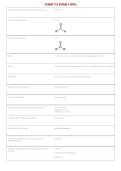
aldehyde functional group O=C-H
ketone functional group O=C
Class I compound w/ only C or H atoms bonded to carbonyl group (Ald/ket)
Class II compound w/ an electronegative atom (N or O), heteroatom, bonded to carbonyl grp
heteroatom atom in ring of cyclic compound other than carbon
geometry of carbonyl carbon trigonal planar 120*
location of aldehydes terminal (always)
polarity of carbonyl group in ketones & aldehydes Overall POLAR
carbonyl O e- rich (-)
carbonyl C e- poor (+)
strongest IMFs of aldehydes & ketones dipole-dipole
abbreviations for aldehydes see actual notecard
aldehydes and ketones have ? boiling point than HIGHER
comparable ethers
aldehydes and ketones have ? boiling point than similar LOWER
alcohols
CANNOT HAVE H BONDING
WEAKER
, CHEM 112 EXAM 3 WVU
aldehydes & ketones have ? bp than similar alkanes HIGHER
aldehydes & ketones are ? in organic solvents SOLUBLE
aldehydes and ketones ? in water SOLUBLE if less than 6Cs
INSOLUBLE if 7 or more Cs
IUPAC nomenclature of aldehydes 1. longest chain containing CHO group -e to -al
2. # chain/ring w/ CHO gap as 1 BUT omit # from name
3. apply all other usual rules
common naming of aldehydes -1st 4 use the prefix followed by aldehydes
-C adjacent to carbonyl carbon alpha then beta & gamma
prefixes for common naming 1C: form-
2C: acet-
3C: prop ion
4C: butyr
IUPAC naming of ketones 1. find longest chain w/ carbonyl grp -e to -one
2. # carbon chain to give carbonyl carbon lower #
3. apply all usual rules of nomenclature
common names for ketones name alkyl grp on carbonyl carbon & arrange alphabetically - add ketone
ex. ethyl methyl ketone
acetone
acetophenone
benzophenone
ketone
oxidation of alcohol -aldehydes w/ mild oxidation
-aldehydes oxidize to carboxylic acids
-carboxilic acid w/ strong oxidation
two classes of compounds containing carbonyl group Class I & II
aldehyde functional group O=C-H
ketone functional group O=C
Class I compound w/ only C or H atoms bonded to carbonyl group (Ald/ket)
Class II compound w/ an electronegative atom (N or O), heteroatom, bonded to carbonyl grp
heteroatom atom in ring of cyclic compound other than carbon
geometry of carbonyl carbon trigonal planar 120*
location of aldehydes terminal (always)
polarity of carbonyl group in ketones & aldehydes Overall POLAR
carbonyl O e- rich (-)
carbonyl C e- poor (+)
strongest IMFs of aldehydes & ketones dipole-dipole
abbreviations for aldehydes see actual notecard
aldehydes and ketones have ? boiling point than HIGHER
comparable ethers
aldehydes and ketones have ? boiling point than similar LOWER
alcohols
CANNOT HAVE H BONDING
WEAKER
, CHEM 112 EXAM 3 WVU
aldehydes & ketones have ? bp than similar alkanes HIGHER
aldehydes & ketones are ? in organic solvents SOLUBLE
aldehydes and ketones ? in water SOLUBLE if less than 6Cs
INSOLUBLE if 7 or more Cs
IUPAC nomenclature of aldehydes 1. longest chain containing CHO group -e to -al
2. # chain/ring w/ CHO gap as 1 BUT omit # from name
3. apply all other usual rules
common naming of aldehydes -1st 4 use the prefix followed by aldehydes
-C adjacent to carbonyl carbon alpha then beta & gamma
prefixes for common naming 1C: form-
2C: acet-
3C: prop ion
4C: butyr
IUPAC naming of ketones 1. find longest chain w/ carbonyl grp -e to -one
2. # carbon chain to give carbonyl carbon lower #
3. apply all usual rules of nomenclature
common names for ketones name alkyl grp on carbonyl carbon & arrange alphabetically - add ketone
ex. ethyl methyl ketone
acetone
acetophenone
benzophenone
ketone
oxidation of alcohol -aldehydes w/ mild oxidation
-aldehydes oxidize to carboxylic acids
-carboxilic acid w/ strong oxidation

