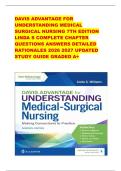
DAVIS ADVANTAGE FOR
UNDERSTANDING MEDICAL
SURGICAL NURSING 7TH EDITION
LINDA S COMPLETE CHAPTER
QUESTIONS ANSWERS DETAILED
RATIONALES 2026 2027 UPDATED
STUDY GUIDE GRADED A+
,Table of Contents
UNIT 1 – Understanding Health Care Issues
1. Critical Thinking, Clinical Judgment, and the Nursing Process
2. Evidence-Based Practice
3. Issues in Nursing Practice
4. Cultural and Spiritual Influences on Nursing Care
5. Complementary and Alternative Modalities
UNIT 2 – Understanding Health and Illness
6. Nursing Care of Patients with Fluid, Electrolyte, and Acid-Base
Imbalances
7. Nursing Care of Patients Receiving Intravenous Therapy
8. Nursing Care of Patients with Infections
9. Nursing Care of Patients in Shock
,UNIT 3 – Systems and Disease Management
10. Nursing Care of Patients with Cardiovascular Disorders
11. Nursing Care of Patients with Respiratory Disorders
12. Nursing Care of Patients with Gastrointestinal Disorders
13. Nursing Care of Patients with Renal and Urinary Disorders
14. Nursing Care of Patients with Endocrine Disorders
15. Nursing Care of Patients with Hematologic and Immune
Disorders
16. Nursing Care of Patients Undergoing Perioperative Care
17. Pain Management and Sensory Alterations
18. Nursing Care of Patients with Neurologic Disorders
19. Nursing Care of Patients with Musculoskeletal Disorders
20. Nursing Care of Patients with Integumentary Disorders
21. Oncology and Palliative Care
22. Rehabilitation and Restorative Care
23. Ethical, Legal, and Professional Practice Issues
24. Leadership, Management, and Delegation in Medical-Surgical
Nursing
, CHAPTER 1: CRITICAL THINKING, CLINICAL JUDGMENT, AND THE
NURSING PROCESS
This chapter introduces the foundational concepts of critical thinking,
clinical judgment, and the nursing process as essential frameworks
for providing safe, patient-centered care in medical-surgical nursing.
Key concepts include the steps of the nursing process (Assessment,
Diagnosis, Planning, Implementation, Evaluation), the development
of clinical judgment through critical thinking, and the application of
these skills to the unique needs of medical-surgical patients.
Understanding these principles is essential for nurses to deliver
competent, evidence-based care.
1. A nurse is caring for a patient postoperatively. Which action
reflects the assessment phase of the nursing process?
A. Administering prescribed pain medication
B. Evaluating the patient's response to treatment
C. Collecting data about the patient's vital signs and pain level
D. Developing a plan to prevent complications
UNDERSTANDING MEDICAL
SURGICAL NURSING 7TH EDITION
LINDA S COMPLETE CHAPTER
QUESTIONS ANSWERS DETAILED
RATIONALES 2026 2027 UPDATED
STUDY GUIDE GRADED A+
,Table of Contents
UNIT 1 – Understanding Health Care Issues
1. Critical Thinking, Clinical Judgment, and the Nursing Process
2. Evidence-Based Practice
3. Issues in Nursing Practice
4. Cultural and Spiritual Influences on Nursing Care
5. Complementary and Alternative Modalities
UNIT 2 – Understanding Health and Illness
6. Nursing Care of Patients with Fluid, Electrolyte, and Acid-Base
Imbalances
7. Nursing Care of Patients Receiving Intravenous Therapy
8. Nursing Care of Patients with Infections
9. Nursing Care of Patients in Shock
,UNIT 3 – Systems and Disease Management
10. Nursing Care of Patients with Cardiovascular Disorders
11. Nursing Care of Patients with Respiratory Disorders
12. Nursing Care of Patients with Gastrointestinal Disorders
13. Nursing Care of Patients with Renal and Urinary Disorders
14. Nursing Care of Patients with Endocrine Disorders
15. Nursing Care of Patients with Hematologic and Immune
Disorders
16. Nursing Care of Patients Undergoing Perioperative Care
17. Pain Management and Sensory Alterations
18. Nursing Care of Patients with Neurologic Disorders
19. Nursing Care of Patients with Musculoskeletal Disorders
20. Nursing Care of Patients with Integumentary Disorders
21. Oncology and Palliative Care
22. Rehabilitation and Restorative Care
23. Ethical, Legal, and Professional Practice Issues
24. Leadership, Management, and Delegation in Medical-Surgical
Nursing
, CHAPTER 1: CRITICAL THINKING, CLINICAL JUDGMENT, AND THE
NURSING PROCESS
This chapter introduces the foundational concepts of critical thinking,
clinical judgment, and the nursing process as essential frameworks
for providing safe, patient-centered care in medical-surgical nursing.
Key concepts include the steps of the nursing process (Assessment,
Diagnosis, Planning, Implementation, Evaluation), the development
of clinical judgment through critical thinking, and the application of
these skills to the unique needs of medical-surgical patients.
Understanding these principles is essential for nurses to deliver
competent, evidence-based care.
1. A nurse is caring for a patient postoperatively. Which action
reflects the assessment phase of the nursing process?
A. Administering prescribed pain medication
B. Evaluating the patient's response to treatment
C. Collecting data about the patient's vital signs and pain level
D. Developing a plan to prevent complications