

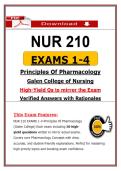
, NUR 210 Exam 1-4 | Principles of Pharmacology |
Actual Questions and Answers (PDF) | Galen Nursing
Table of Contents
• NUR 210 EXAM 1
• NUR 210 EXAM 2
• NUR 210 EXAM 3
• NUR 210 EXAM 4
NUR 210 EXAM 1
1. Which term describes what the body does to a drug, including absorption,
distribution, metabolism, and excretion?
• A. Pharmacodynamics
• B. Pharmacokinetics
• C. Pharmacotherapeutics
• D. Pharmacogenetics
Answer B: Pharmacokinetics
Rationale: Pharmacokinetics (ADME) describes drug movement through the body .
Pharmacodynamics studies what the drug does to the body.
2. What are the four phases of pharmacokinetics?
• A. Absorption, distribution, metabolism, excretion
• B. Absorption, distribution, metabolism, elimination
• C. Administration, distribution, metabolism, excretion
• D. Absorption, dispersion, metabolism, excretion
Answer A: Absorption, distribution, metabolism, excretion
,Rationale: The four phases of pharmacokinetics are absorption, distribution, metabolism,
and excretion (ADME) .
3. A drug is administered orally. In which part of the gastrointestinal tract does the
majority of absorption occur?
• A. Stomach
• B. Small intestine
• C. Large intestine
• D. Esophagus
Answer B: Small intestine
Rationale: The small intestine is the primary site of drug absorption due to its large
surface area and extensive blood supply .
4. The nurse is preparing to administer an oral medication and wants to ensure
rapid drug action. Which form of medication will the nurse administer?
• A. Capsule
• B. Enteric-coated tablet
• C. Liquid suspension
• D. Tablet
Answer C: Liquid suspension
Rationale: Liquid drugs are already in solution, which is the form necessary for
absorption. Capsules, enteric-coated pills, and tablets must disintegrate and dissolve
first .
5. Which process involves the breakdown of an oral drug into small particles?
• A. Dissolution
, • B. Disintegration
• C. Absorption
• D. Ionization
Answer B: Disintegration
Rationale: Disintegration is the breakdown of an oral drug to small particles. Dissolution
is the process of combining small drug particles with liquid to form a solution .
6. Which term refers to the percentage of an administered drug that reaches
systemic circulation unchanged?
• A. Half-life
• B. Bioavailability
• C. Therapeutic index
• D. Loading dose
Answer B: Bioavailability
Rationale: Bioavailability is affected by absorption and first-pass metabolism. IV drugs
have 100% bioavailability; oral drugs often have less.
7. A patient is receiving an intravenous drug. What is the bioavailability of this
drug?
• A. Less than 50%
• B. 50%
• C. 100%
• D. Variable depending on the drug
Answer C: 100%
Rationale: IV drugs bypass absorption and enter systemic circulation directly, giving
them 100% bioavailability.
Actual Questions and Answers (PDF) | Galen Nursing
Table of Contents
• NUR 210 EXAM 1
• NUR 210 EXAM 2
• NUR 210 EXAM 3
• NUR 210 EXAM 4
NUR 210 EXAM 1
1. Which term describes what the body does to a drug, including absorption,
distribution, metabolism, and excretion?
• A. Pharmacodynamics
• B. Pharmacokinetics
• C. Pharmacotherapeutics
• D. Pharmacogenetics
Answer B: Pharmacokinetics
Rationale: Pharmacokinetics (ADME) describes drug movement through the body .
Pharmacodynamics studies what the drug does to the body.
2. What are the four phases of pharmacokinetics?
• A. Absorption, distribution, metabolism, excretion
• B. Absorption, distribution, metabolism, elimination
• C. Administration, distribution, metabolism, excretion
• D. Absorption, dispersion, metabolism, excretion
Answer A: Absorption, distribution, metabolism, excretion
,Rationale: The four phases of pharmacokinetics are absorption, distribution, metabolism,
and excretion (ADME) .
3. A drug is administered orally. In which part of the gastrointestinal tract does the
majority of absorption occur?
• A. Stomach
• B. Small intestine
• C. Large intestine
• D. Esophagus
Answer B: Small intestine
Rationale: The small intestine is the primary site of drug absorption due to its large
surface area and extensive blood supply .
4. The nurse is preparing to administer an oral medication and wants to ensure
rapid drug action. Which form of medication will the nurse administer?
• A. Capsule
• B. Enteric-coated tablet
• C. Liquid suspension
• D. Tablet
Answer C: Liquid suspension
Rationale: Liquid drugs are already in solution, which is the form necessary for
absorption. Capsules, enteric-coated pills, and tablets must disintegrate and dissolve
first .
5. Which process involves the breakdown of an oral drug into small particles?
• A. Dissolution
, • B. Disintegration
• C. Absorption
• D. Ionization
Answer B: Disintegration
Rationale: Disintegration is the breakdown of an oral drug to small particles. Dissolution
is the process of combining small drug particles with liquid to form a solution .
6. Which term refers to the percentage of an administered drug that reaches
systemic circulation unchanged?
• A. Half-life
• B. Bioavailability
• C. Therapeutic index
• D. Loading dose
Answer B: Bioavailability
Rationale: Bioavailability is affected by absorption and first-pass metabolism. IV drugs
have 100% bioavailability; oral drugs often have less.
7. A patient is receiving an intravenous drug. What is the bioavailability of this
drug?
• A. Less than 50%
• B. 50%
• C. 100%
• D. Variable depending on the drug
Answer C: 100%
Rationale: IV drugs bypass absorption and enter systemic circulation directly, giving
them 100% bioavailability.

