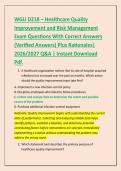
WGU D218 – Healthcare Quality
Improvement and Risk Management
Exam Questions With Correct Answers
(Verified Answers) Plus Rationales|
2026/2027 Q&A | Instant Download
Pdf.
1. A healthcare organization notices that its rate of hospital-acquired
infections has increased over the past six months. Which action
should the quality improvement team take first?
A. Implement a new infection-control policy
B. Discipline employees who failed to follow procedures
C. Collect and analyze data to determine the extent and possible
causes of the problem
D. Purchase additional infection-control equipment
Rationale: Quality improvement begins with understanding the current
state of performance. Collecting and analyzing reliable data helps
identify patterns, establish a baseline, and determine potential
contributing factors before interventions are selected. Immediately
implementing a solution without understanding the problem may
address the wrong cause.
2. Which statement best describes the primary purpose of
healthcare quality improvement?
,A. To identify employees who make mistakes
B. To reduce healthcare employee salaries
C. To systematically improve processes and outcomes of patient care
D. To eliminate all healthcare risks
Rationale: Quality improvement focuses on continuously improving
healthcare processes and outcomes. It is not primarily a disciplinary
activity, nor is it realistic to eliminate every risk. Instead, organizations
use systematic approaches to make care safer, more effective, efficient,
timely, equitable, and patient-centered.
3. Which quality dimension is most directly concerned with
preventing patient injuries caused by healthcare delivery?
A. Efficiency
B. Timeliness
C. Equity
D. Safety
Rationale: Safety is the quality dimension concerned with preventing
harm to patients from the care intended to help them. Examples include
preventing medication errors, falls, infections, wrong-site procedures,
and other avoidable adverse events.
4. A nurse reports that medication errors frequently occur during
shift changes because important information is sometimes
omitted during handoff. Which intervention would most directly
address the problem?
A. Increase the number of medications stocked on the unit
B. Standardize the handoff communication process
,C. Reduce the number of patients assigned to the hospital
D. Replace the electronic health record
Rationale: The identified problem involves inconsistent communication
during handoffs. A standardized handoff process, such as a structured
communication tool, can ensure that critical information is consistently
transferred. This addresses the process contributing to the errors rather
than treating individual mistakes as isolated events.
5. Which tool is commonly used to identify potential failures in a
healthcare process before they occur?
A. Pareto chart
B. Control chart
C. Failure Mode and Effects Analysis (FMEA)
D. Patient satisfaction survey
Rationale: FMEA is a proactive risk-management technique that
examines a process step by step to identify possible failure modes, their
effects, and their causes. Organizations can then prioritize risks and
implement preventive measures before an adverse event occurs.
6. A hospital wants to determine whether a small number of causes
are responsible for most of its patient complaints. Which tool
would be most appropriate?
A. Scatter diagram
B. Pareto chart
C. Run chart
D. Flowchart
Rationale: A Pareto chart helps organizations identify the most
significant contributing factors by displaying causes in descending order
, of frequency or impact. It is based on the principle that a relatively small
number of causes may account for a large proportion of problems.
7. What is the primary purpose of a root cause analysis (RCA)?
A. To determine which employee should be terminated
B. To calculate the hospital's operating budget
C. To identify underlying system and process factors that contributed
to an adverse event
D. To determine patient satisfaction scores
Rationale: RCA is a retrospective approach used after an adverse event
or significant problem occurs. The objective is to identify underlying
causes and system weaknesses so corrective actions can reduce the
likelihood of recurrence. RCA should not simply focus on blaming an
individual.
8. A patient receives the wrong medication but experiences no harm.
How should this event generally be classified?
A. Sentinel event
B. Near miss or no-harm medication error
C. Never event
D. Malpractice judgment
Rationale: A medication error that reaches the patient but causes no
harm is generally considered a no-harm event. A near miss more
specifically refers to an error that is caught before reaching the patient.
Both provide valuable opportunities for learning and system
improvement.
9. Which approach best reflects a just culture in healthcare?
Improvement and Risk Management
Exam Questions With Correct Answers
(Verified Answers) Plus Rationales|
2026/2027 Q&A | Instant Download
Pdf.
1. A healthcare organization notices that its rate of hospital-acquired
infections has increased over the past six months. Which action
should the quality improvement team take first?
A. Implement a new infection-control policy
B. Discipline employees who failed to follow procedures
C. Collect and analyze data to determine the extent and possible
causes of the problem
D. Purchase additional infection-control equipment
Rationale: Quality improvement begins with understanding the current
state of performance. Collecting and analyzing reliable data helps
identify patterns, establish a baseline, and determine potential
contributing factors before interventions are selected. Immediately
implementing a solution without understanding the problem may
address the wrong cause.
2. Which statement best describes the primary purpose of
healthcare quality improvement?
,A. To identify employees who make mistakes
B. To reduce healthcare employee salaries
C. To systematically improve processes and outcomes of patient care
D. To eliminate all healthcare risks
Rationale: Quality improvement focuses on continuously improving
healthcare processes and outcomes. It is not primarily a disciplinary
activity, nor is it realistic to eliminate every risk. Instead, organizations
use systematic approaches to make care safer, more effective, efficient,
timely, equitable, and patient-centered.
3. Which quality dimension is most directly concerned with
preventing patient injuries caused by healthcare delivery?
A. Efficiency
B. Timeliness
C. Equity
D. Safety
Rationale: Safety is the quality dimension concerned with preventing
harm to patients from the care intended to help them. Examples include
preventing medication errors, falls, infections, wrong-site procedures,
and other avoidable adverse events.
4. A nurse reports that medication errors frequently occur during
shift changes because important information is sometimes
omitted during handoff. Which intervention would most directly
address the problem?
A. Increase the number of medications stocked on the unit
B. Standardize the handoff communication process
,C. Reduce the number of patients assigned to the hospital
D. Replace the electronic health record
Rationale: The identified problem involves inconsistent communication
during handoffs. A standardized handoff process, such as a structured
communication tool, can ensure that critical information is consistently
transferred. This addresses the process contributing to the errors rather
than treating individual mistakes as isolated events.
5. Which tool is commonly used to identify potential failures in a
healthcare process before they occur?
A. Pareto chart
B. Control chart
C. Failure Mode and Effects Analysis (FMEA)
D. Patient satisfaction survey
Rationale: FMEA is a proactive risk-management technique that
examines a process step by step to identify possible failure modes, their
effects, and their causes. Organizations can then prioritize risks and
implement preventive measures before an adverse event occurs.
6. A hospital wants to determine whether a small number of causes
are responsible for most of its patient complaints. Which tool
would be most appropriate?
A. Scatter diagram
B. Pareto chart
C. Run chart
D. Flowchart
Rationale: A Pareto chart helps organizations identify the most
significant contributing factors by displaying causes in descending order
, of frequency or impact. It is based on the principle that a relatively small
number of causes may account for a large proportion of problems.
7. What is the primary purpose of a root cause analysis (RCA)?
A. To determine which employee should be terminated
B. To calculate the hospital's operating budget
C. To identify underlying system and process factors that contributed
to an adverse event
D. To determine patient satisfaction scores
Rationale: RCA is a retrospective approach used after an adverse event
or significant problem occurs. The objective is to identify underlying
causes and system weaknesses so corrective actions can reduce the
likelihood of recurrence. RCA should not simply focus on blaming an
individual.
8. A patient receives the wrong medication but experiences no harm.
How should this event generally be classified?
A. Sentinel event
B. Near miss or no-harm medication error
C. Never event
D. Malpractice judgment
Rationale: A medication error that reaches the patient but causes no
harm is generally considered a no-harm event. A near miss more
specifically refers to an error that is caught before reaching the patient.
Both provide valuable opportunities for learning and system
improvement.
9. Which approach best reflects a just culture in healthcare?