
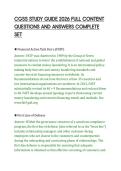
CGSS STUDY GUIDE 2026 FULL CONTENT
QUESTIONS AND ANSWERS COMPLETE
SET
◉ Financial Action Task Force (FATF)
Answer: FATF was chartered in 1989 by the Group of Seven
industrial nations to foster the establishment of national and global
measures to combat money laundering. It is an international policy-
making body that sets anti-money laundering standards and
counter-terrorist financing measures worldwide. Its
Recommendations do not have the force of law. 35 countries and
two international organizations are members. In 2012, FATF
substantially revised its 40 + 9 Recommendations and reduced them
to 40. FATF develops annual typology reports showcasing current
money laundering and terrorist financing trends and methods. See
www.fatf-gafi.org
◉ First Line of Defense
Answer: Within the governance structure of a sanctions compliance
program, the first line of defense (also referred to as the "front line")
includes relationship managers and other customer-facing
employees who are closest to the customers and counterparties
during the onboarding and contracting phase of relationships. The
first-line defense is responsible for ensuring that adequate
information is obtained so that effective screening of customers and
,their owners and controllers can be performed. In general, the first-
line defense owns and manages the collection of SDD information.
◉ Foreign Sanctions Evaders (FSE)
Answer: A foreign individual or entity determined to have violated,
attempted to violate, conspired to violate, or caused a violation of US
sanctions. OFAC publishes a list of FSEs, and transactions by US
persons or within the United States involving FSEs are prohibited.
◉ Free Trade Zone (FTZ)
Answer: Also known as special economic zones, FTZs are delimited
geographic areas within a country with zone management that
provides infrastructure and services to tenant companies. In FTZs,
the rules for doing business are different and promoted by a set of
policy instruments that are not generally applicable to the rest of the
country. FTZs constitute a key risk area specific to trade-related
activities because they commonly have inadequate sanctions
safeguards; minimal oversight by local authorities; weak procedures
to inspect goods and legal entities, including appropriate record-
keeping and information technology systems; and lack of
cooperation between FTZs and local customs authorities.
◉ Front Company
Answer: Any business set up and controlled by another organization.
While not necessarily illicit, criminals use front companies to
launder money by giving the funds the appearance of legitimate
, origin. Front companies may subsidize products and services at
levels well below market rates or even below manufacturing costs.
◉ Fuzzy Logic
Answer: A matching technique used by financial institutions to
increase the effectiveness of the screening processes by overcoming
problems such as flawed records and databases. Fuzzy logic is
accomplished through algorithms that use "degrees of similarity" to
determine the probability that two names are the same.
◉ Globalization
Answer: The integrating of national economic, trade, and
communication operations by businesses engaging in international
trade. It is believed that globalization may limit the effectiveness of
sanctions because a globalized market makes it easier to replace and
reroute trade channels.
◉ Governance
Answer: The allocation of power and decision making authority
among the board of directors and management to establish internal
controls for the purpose of managing risk and compliance with the
laws, regulations, and internal policies.
◉ Greylist
QUESTIONS AND ANSWERS COMPLETE
SET
◉ Financial Action Task Force (FATF)
Answer: FATF was chartered in 1989 by the Group of Seven
industrial nations to foster the establishment of national and global
measures to combat money laundering. It is an international policy-
making body that sets anti-money laundering standards and
counter-terrorist financing measures worldwide. Its
Recommendations do not have the force of law. 35 countries and
two international organizations are members. In 2012, FATF
substantially revised its 40 + 9 Recommendations and reduced them
to 40. FATF develops annual typology reports showcasing current
money laundering and terrorist financing trends and methods. See
www.fatf-gafi.org
◉ First Line of Defense
Answer: Within the governance structure of a sanctions compliance
program, the first line of defense (also referred to as the "front line")
includes relationship managers and other customer-facing
employees who are closest to the customers and counterparties
during the onboarding and contracting phase of relationships. The
first-line defense is responsible for ensuring that adequate
information is obtained so that effective screening of customers and
,their owners and controllers can be performed. In general, the first-
line defense owns and manages the collection of SDD information.
◉ Foreign Sanctions Evaders (FSE)
Answer: A foreign individual or entity determined to have violated,
attempted to violate, conspired to violate, or caused a violation of US
sanctions. OFAC publishes a list of FSEs, and transactions by US
persons or within the United States involving FSEs are prohibited.
◉ Free Trade Zone (FTZ)
Answer: Also known as special economic zones, FTZs are delimited
geographic areas within a country with zone management that
provides infrastructure and services to tenant companies. In FTZs,
the rules for doing business are different and promoted by a set of
policy instruments that are not generally applicable to the rest of the
country. FTZs constitute a key risk area specific to trade-related
activities because they commonly have inadequate sanctions
safeguards; minimal oversight by local authorities; weak procedures
to inspect goods and legal entities, including appropriate record-
keeping and information technology systems; and lack of
cooperation between FTZs and local customs authorities.
◉ Front Company
Answer: Any business set up and controlled by another organization.
While not necessarily illicit, criminals use front companies to
launder money by giving the funds the appearance of legitimate
, origin. Front companies may subsidize products and services at
levels well below market rates or even below manufacturing costs.
◉ Fuzzy Logic
Answer: A matching technique used by financial institutions to
increase the effectiveness of the screening processes by overcoming
problems such as flawed records and databases. Fuzzy logic is
accomplished through algorithms that use "degrees of similarity" to
determine the probability that two names are the same.
◉ Globalization
Answer: The integrating of national economic, trade, and
communication operations by businesses engaging in international
trade. It is believed that globalization may limit the effectiveness of
sanctions because a globalized market makes it easier to replace and
reroute trade channels.
◉ Governance
Answer: The allocation of power and decision making authority
among the board of directors and management to establish internal
controls for the purpose of managing risk and compliance with the
laws, regulations, and internal policies.
◉ Greylist

