Theory of Evolution
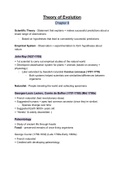
Chapter 8
Scientific Theory - Statement that explains + makes successful predictions about a
broad range of observations
- Based on hypotheses that lead to consistently successful predictions
Empirical System - Observation + experimentation to form hypotheses about
nature
John Ray (1627-1705)
= 1st scientist to carry out empirical studies of the natural world
= Developed classification system for plants + animals (based on anatomy +
physiology)
- Later extended by Swedish naturalist Carolus Linnaeus (1707-1778)
- Both systems helped scientists see similarities/differences between
organisms
Naturalist - People traveling the world and collecting specimens
Georges-Louis Leclerc, Comte de Buffon (1707-1788) (Mid 1700s)
= French naturalist (had revolutionary ideas)
= Suggested humans + apes had common ancestor (since they’re similar)
- Species change over time
= Suggested Earth 6000+ years old
= “Heretic” & widely discredited :(
Paleontology
= Study of ancient life through fossils
Fossil - preserved remains of once-living organisms
George Cuvier (1769-1832) (Late 1700s-Early 1800s)
= French naturalist
= Credited with developing paleontology
, = Found that each stratum (layer of rock) has its own unique group of fossil species
= The deeper (older) the stratum, the more different types of species
= Found new species appeared/disappeared
- Evidence that species could be extinct
Catastrophism
= Earth experienced many destructive natural events (“revolutions”) that would kill
many species in a region
- Unaffected species nearby would repopulate the area again
= Suggested that these revolutions led to the boundaries of strata
Charles Lyell and James Hutton’s help (1797-1875) (Mid 1800s)
= Scottish geologist that rejected catastrophism
= Based on Hutton’s work, he proposed Uniformitarianism
- Geological processes operated at the same rates in the past as they do today
- Ex: Forces that build/erode mountains happen at the same rate in the
past and present (one doesn’t have greater power than the other)
- Suggested Earth is 6000+ years old
- Earth undergoes constant and slow change
Jean-Baptiste Lamarck (1744-1828) (Late 1700s)
= French naturalist
= Compared current species with fossil forms
- Created “line of descent”
- Series of fossils (from old to recent) led to modern species
- As the complexity increases, the organisms are changing to be
“perfect”
Inheritance of acquired characteristics
= Organisms can pass on characteristics acquired during their lifetime that helped
them survive
= Organisms become better adapted to their environment
= People thought body parts often used to cope with environmental conditions
become larger + stronger
- Ex: Giraffes stretched their necks over time to eat tops of trees
= Unused body parts would slowly disappear (“Use and disuse”)
Chapter 8
Scientific Theory - Statement that explains + makes successful predictions about a
broad range of observations
- Based on hypotheses that lead to consistently successful predictions
Empirical System - Observation + experimentation to form hypotheses about
nature
John Ray (1627-1705)
= 1st scientist to carry out empirical studies of the natural world
= Developed classification system for plants + animals (based on anatomy +
physiology)
- Later extended by Swedish naturalist Carolus Linnaeus (1707-1778)
- Both systems helped scientists see similarities/differences between
organisms
Naturalist - People traveling the world and collecting specimens
Georges-Louis Leclerc, Comte de Buffon (1707-1788) (Mid 1700s)
= French naturalist (had revolutionary ideas)
= Suggested humans + apes had common ancestor (since they’re similar)
- Species change over time
= Suggested Earth 6000+ years old
= “Heretic” & widely discredited :(
Paleontology
= Study of ancient life through fossils
Fossil - preserved remains of once-living organisms
George Cuvier (1769-1832) (Late 1700s-Early 1800s)
= French naturalist
= Credited with developing paleontology
, = Found that each stratum (layer of rock) has its own unique group of fossil species
= The deeper (older) the stratum, the more different types of species
= Found new species appeared/disappeared
- Evidence that species could be extinct
Catastrophism
= Earth experienced many destructive natural events (“revolutions”) that would kill
many species in a region
- Unaffected species nearby would repopulate the area again
= Suggested that these revolutions led to the boundaries of strata
Charles Lyell and James Hutton’s help (1797-1875) (Mid 1800s)
= Scottish geologist that rejected catastrophism
= Based on Hutton’s work, he proposed Uniformitarianism
- Geological processes operated at the same rates in the past as they do today
- Ex: Forces that build/erode mountains happen at the same rate in the
past and present (one doesn’t have greater power than the other)
- Suggested Earth is 6000+ years old
- Earth undergoes constant and slow change
Jean-Baptiste Lamarck (1744-1828) (Late 1700s)
= French naturalist
= Compared current species with fossil forms
- Created “line of descent”
- Series of fossils (from old to recent) led to modern species
- As the complexity increases, the organisms are changing to be
“perfect”
Inheritance of acquired characteristics
= Organisms can pass on characteristics acquired during their lifetime that helped
them survive
= Organisms become better adapted to their environment
= People thought body parts often used to cope with environmental conditions
become larger + stronger
- Ex: Giraffes stretched their necks over time to eat tops of trees
= Unused body parts would slowly disappear (“Use and disuse”)