
Unit 4 Psychological Skills
Types of data
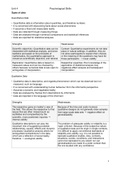
Quantitative Data
• Quantitative data is information about quantities, and therefore numbers
• It is concerned with discovering facts about social phenomena
• It assumes a xed and measurable reality
• Data are collected through measuring things
• Data are analysed through numerical comparisons and statistical inferences
• Data are reported for statistical analyses
Strengths Weaknesses
Scienti c objectivity: Quantitative data can be Context: Quantitative experiments do not take
interpreted with statistical analysis, and since place in natural settings. In addition, they do
statistics are based on the principles of not allow participants to explain their choices
mathematics, the quantitative approach is or the meaning of the questions may have for
viewed as scienti cally objective, and rational those participants → lower validity
Replication: Quantitative data is based on Researcher expertise: Poor knowledge of the
measured values and can be checked by application of statistical analysis may
others because numerical data is less open to negatively a ect analysis and subsequent
ambiguities of interpretation. interpretation
Qualitative Data
• Qualitative data is descriptive, and regards phenomenon which can be observed but not
measured, such as language
• It is concerned with understanding human behaviour from the informants perspective
• Assumes a dynamic and negotiated reality
• Data are analysed by themes from descriptions by informants
• Data are reported in the language of the informant
Strengths Weaknesses
The researcher gains an insider's view of Because of the time and costs involved,
the eld. This allows the researcher to nd qualitative designs do not generally draw samples
issues that are often missed (such as from large-scale data sets → negative e ect on
subtleties and complexities) by the generalisability
scienti c, more positivistic inquiries →
internal validity
Qualitative descriptions can play the The problem of adequate validity or reliability is a
important role of suggesting possible major criticism. Because of the subjective nature
relationships, causes, e ects and dynamic of qualitative data and its origin in single contexts,
processes; Qualitative analysis allows for it is di cult to apply conventional standards of
ambiguities/contradictions in the data, reliability and validity, e.g. it is not possible to
which are a re ection of social reality, replicate qualitative studies. Also, contexts,
therefore → ecological validity situations, events, conditions, and interactions
cannot be replicated to any extent nor can
generalisations be made to a wider context than
the one studied with any con dence
1
fi ffififi ff fifl fi ff fi fi ff
, Unit 4 Psychological Skills
Primary Data
Primary data - data which is gathered rst hand by the researcher or their representative. It is
produced for a purpose in order to test a hypothesis in an experiment.
Strengths Weaknesses
Generated rst-hand so carries authenticity May be subject to researcher bias as the
and credibility (uses original documents and intention is to collect data that ts with the
sources as evidence) speci cally for the original idea / hypothesis in order to produce
purposes of the research → valid favourable results
Usually involves standardised procedures Can be time-consuming and expensive and
which allows to check for reliability therefore not practical, limiting generalisability
Secondary Data
Secondary data - the analysis of existing primary data after it has been collected. It is not usually
done by the researcher, but by someone else taking their results and using them in a di erent
way, e.g investigating cross cultural di erences in obedience.
Strengths Weaknesses
Can use large amounts of data that may be It may have been subject to bias when
di cult / impossible to gather individually, e.g. collected originally and the researcher cannot
cross cultural research → useful identify any aws → lower validity
No ethical considerations need to be The data may not directly answer the research
considered question of the researcher as it may have been
collected for di erent purposes, so lacking
detail → lower validity
Sampling methods
• Sampling is the process of selecting a representative group from the population under study.
• The target population is the total group of individuals from which the sample might be drawn.
• A sample is the group of people who take part in the investigation. The people who take part are
referred to as “participants”.
Random Sampling
Random sampling is a type of probability sampling where everyone in the entire target population
has an equal chance of being selected. The researcher has to identify target population rst, and
then put all the names / numbers into the system (could be either a computer system that based
on algorithms randomly selects participants or could be done manually by putting the name in a
hat and blindly drawing them out).
Strengths Weaknesses
Researcher is not involved → reduces Di cult to include everyone from the target
researcher bias population → used when tp = small
Representative → generalisable Unbiased is not always representative
2
ffi
ffi fifl ff fi fi fffi fffi
, Unit 4 Psychological Skills
Strati ed Sampling
Strati ed sampling involves classifying the population into categories and then choosing a sample
which consists of participants from each category in the same proportions as they are in the
population. Strata are sub-groups within the target population (like boys and girls or di erent age
groups). This technique involves working out the strata you need in your sample and how many
people there should be in each, then lling the strata through random sampling.
Strengths Weaknesses
Highly representative of target population → Extremely time-consuming and di cult; it is
results can be de nitely generalised barely used in psychology → not practical
Allows to eliminate potential extraneous Not always obvious which strata is important
variables that might interfere with the research for the purposes of the research (race,
→ increases validity ethnicity, sex) → may not produce valid results
in the end
Opportunity Sampling
The sample is those members of the target population who happen to be available at the time. It
involves getting hold of the nearest and most convenient people: your friends, neighbours and
passers-by. It is based on convenience. It is obtained by asking members of the population of
interest if they would take part in your research. An example would be selecting a sample of
students from those coming out of the library.
Strengths Weaknesses
Very easy and convenient, thus does not take a Researcher bias, → only people near to you or
lot of time → practical known to you have any chance of being in the
study.
May not be representative of target population
→ limits generalisability
Volunteer Sampling
The sample is those members of the target population who select themselves. Volunteer sampling
involves asking for volunteers – for example, advertising your study on a notice board or on
Facebook and using anyone who signs up.
Strengths Weaknesses
Much more varied sample than opportunity Certain sorts of people volunteering (the ones
sampling because there's no experimenter interested in Psychology, people with a lot of
bias → validity free time), participant bias→ demand
characteristics → validity
Much easier to create a suitable advertisement More time-consuming as you have to wait for
and place it appropriately rather than select the volunteers to take part in your study → less
sample yourself practical
3
fi fi ffi fi ff
, Unit 4 Psychological Skills
Experimental Designs
Independent Measures Design
• Independent measures design - an experimental design where di erent participants are used in
each condition of the independent variable. This means that each condition of the experiment
includes a di erent group of participants.
• This should be done by random allocation, which ensures that each participant has an equal
chance of being assigned to one group or the other.
• Independent measures involve using two separate groups of participants; one in each condition.
Strengths Weaknesses
Avoids order e ects (such as practice or More people are needed than with the
fatigue) as people participate in one condition repeated measures design as there are several
only. If a person is involved in several conditions → more time consuming and thus
conditions, they may become bored, tired and less practical
fed up by the time they come to the second
condition, or becoming wise to the
requirements of the experiment → validity
Random allocation is used in order to get rid of Random allocation does not always solve the
participant variables - everybody has equal issue with participant variables, it is almost
chance of being in a condition thus → impossible to get rid of them → could
increased validity jeopardise validity
Repeated Measures Design
• Repeated Measures design is an experimental design where the same participants take part in
each condition of the independent variable. This means that each condition of the experiment
includes the same group of participants.
• Repeated Measures design is also known as within groups, or within-subjects design.
Strengths Weaknesses
As the same participants are used in each There may be order e ects (the order of the
condition, participant variables (i.e., individual conditions having an e ect on the participants’
di erences) are reduced to zero → increases behaviour). This limitation can be controlled
validity using counterbalancing → could jeopardise
validity
Fewer people are needed as they take part in
all conditions → less time-consuming thus
more practical
*Counterbalancing: The sample would split into two groups experimental (A) and control (B). For
example, group 1 does ‘A’ then ‘B,’ group 2 does ‘B’ then ‘A’ this is to eliminate order e ects.
Although order e ects occur for each participant, because they occur equally in both groups, they
balance each other out in the results.
4
ff
ff ff ff ffff ff ff
Types of data
Quantitative Data
• Quantitative data is information about quantities, and therefore numbers
• It is concerned with discovering facts about social phenomena
• It assumes a xed and measurable reality
• Data are collected through measuring things
• Data are analysed through numerical comparisons and statistical inferences
• Data are reported for statistical analyses
Strengths Weaknesses
Scienti c objectivity: Quantitative data can be Context: Quantitative experiments do not take
interpreted with statistical analysis, and since place in natural settings. In addition, they do
statistics are based on the principles of not allow participants to explain their choices
mathematics, the quantitative approach is or the meaning of the questions may have for
viewed as scienti cally objective, and rational those participants → lower validity
Replication: Quantitative data is based on Researcher expertise: Poor knowledge of the
measured values and can be checked by application of statistical analysis may
others because numerical data is less open to negatively a ect analysis and subsequent
ambiguities of interpretation. interpretation
Qualitative Data
• Qualitative data is descriptive, and regards phenomenon which can be observed but not
measured, such as language
• It is concerned with understanding human behaviour from the informants perspective
• Assumes a dynamic and negotiated reality
• Data are analysed by themes from descriptions by informants
• Data are reported in the language of the informant
Strengths Weaknesses
The researcher gains an insider's view of Because of the time and costs involved,
the eld. This allows the researcher to nd qualitative designs do not generally draw samples
issues that are often missed (such as from large-scale data sets → negative e ect on
subtleties and complexities) by the generalisability
scienti c, more positivistic inquiries →
internal validity
Qualitative descriptions can play the The problem of adequate validity or reliability is a
important role of suggesting possible major criticism. Because of the subjective nature
relationships, causes, e ects and dynamic of qualitative data and its origin in single contexts,
processes; Qualitative analysis allows for it is di cult to apply conventional standards of
ambiguities/contradictions in the data, reliability and validity, e.g. it is not possible to
which are a re ection of social reality, replicate qualitative studies. Also, contexts,
therefore → ecological validity situations, events, conditions, and interactions
cannot be replicated to any extent nor can
generalisations be made to a wider context than
the one studied with any con dence
1
fi ffififi ff fifl fi ff fi fi ff
, Unit 4 Psychological Skills
Primary Data
Primary data - data which is gathered rst hand by the researcher or their representative. It is
produced for a purpose in order to test a hypothesis in an experiment.
Strengths Weaknesses
Generated rst-hand so carries authenticity May be subject to researcher bias as the
and credibility (uses original documents and intention is to collect data that ts with the
sources as evidence) speci cally for the original idea / hypothesis in order to produce
purposes of the research → valid favourable results
Usually involves standardised procedures Can be time-consuming and expensive and
which allows to check for reliability therefore not practical, limiting generalisability
Secondary Data
Secondary data - the analysis of existing primary data after it has been collected. It is not usually
done by the researcher, but by someone else taking their results and using them in a di erent
way, e.g investigating cross cultural di erences in obedience.
Strengths Weaknesses
Can use large amounts of data that may be It may have been subject to bias when
di cult / impossible to gather individually, e.g. collected originally and the researcher cannot
cross cultural research → useful identify any aws → lower validity
No ethical considerations need to be The data may not directly answer the research
considered question of the researcher as it may have been
collected for di erent purposes, so lacking
detail → lower validity
Sampling methods
• Sampling is the process of selecting a representative group from the population under study.
• The target population is the total group of individuals from which the sample might be drawn.
• A sample is the group of people who take part in the investigation. The people who take part are
referred to as “participants”.
Random Sampling
Random sampling is a type of probability sampling where everyone in the entire target population
has an equal chance of being selected. The researcher has to identify target population rst, and
then put all the names / numbers into the system (could be either a computer system that based
on algorithms randomly selects participants or could be done manually by putting the name in a
hat and blindly drawing them out).
Strengths Weaknesses
Researcher is not involved → reduces Di cult to include everyone from the target
researcher bias population → used when tp = small
Representative → generalisable Unbiased is not always representative
2
ffi
ffi fifl ff fi fi fffi fffi
, Unit 4 Psychological Skills
Strati ed Sampling
Strati ed sampling involves classifying the population into categories and then choosing a sample
which consists of participants from each category in the same proportions as they are in the
population. Strata are sub-groups within the target population (like boys and girls or di erent age
groups). This technique involves working out the strata you need in your sample and how many
people there should be in each, then lling the strata through random sampling.
Strengths Weaknesses
Highly representative of target population → Extremely time-consuming and di cult; it is
results can be de nitely generalised barely used in psychology → not practical
Allows to eliminate potential extraneous Not always obvious which strata is important
variables that might interfere with the research for the purposes of the research (race,
→ increases validity ethnicity, sex) → may not produce valid results
in the end
Opportunity Sampling
The sample is those members of the target population who happen to be available at the time. It
involves getting hold of the nearest and most convenient people: your friends, neighbours and
passers-by. It is based on convenience. It is obtained by asking members of the population of
interest if they would take part in your research. An example would be selecting a sample of
students from those coming out of the library.
Strengths Weaknesses
Very easy and convenient, thus does not take a Researcher bias, → only people near to you or
lot of time → practical known to you have any chance of being in the
study.
May not be representative of target population
→ limits generalisability
Volunteer Sampling
The sample is those members of the target population who select themselves. Volunteer sampling
involves asking for volunteers – for example, advertising your study on a notice board or on
Facebook and using anyone who signs up.
Strengths Weaknesses
Much more varied sample than opportunity Certain sorts of people volunteering (the ones
sampling because there's no experimenter interested in Psychology, people with a lot of
bias → validity free time), participant bias→ demand
characteristics → validity
Much easier to create a suitable advertisement More time-consuming as you have to wait for
and place it appropriately rather than select the volunteers to take part in your study → less
sample yourself practical
3
fi fi ffi fi ff
, Unit 4 Psychological Skills
Experimental Designs
Independent Measures Design
• Independent measures design - an experimental design where di erent participants are used in
each condition of the independent variable. This means that each condition of the experiment
includes a di erent group of participants.
• This should be done by random allocation, which ensures that each participant has an equal
chance of being assigned to one group or the other.
• Independent measures involve using two separate groups of participants; one in each condition.
Strengths Weaknesses
Avoids order e ects (such as practice or More people are needed than with the
fatigue) as people participate in one condition repeated measures design as there are several
only. If a person is involved in several conditions → more time consuming and thus
conditions, they may become bored, tired and less practical
fed up by the time they come to the second
condition, or becoming wise to the
requirements of the experiment → validity
Random allocation is used in order to get rid of Random allocation does not always solve the
participant variables - everybody has equal issue with participant variables, it is almost
chance of being in a condition thus → impossible to get rid of them → could
increased validity jeopardise validity
Repeated Measures Design
• Repeated Measures design is an experimental design where the same participants take part in
each condition of the independent variable. This means that each condition of the experiment
includes the same group of participants.
• Repeated Measures design is also known as within groups, or within-subjects design.
Strengths Weaknesses
As the same participants are used in each There may be order e ects (the order of the
condition, participant variables (i.e., individual conditions having an e ect on the participants’
di erences) are reduced to zero → increases behaviour). This limitation can be controlled
validity using counterbalancing → could jeopardise
validity
Fewer people are needed as they take part in
all conditions → less time-consuming thus
more practical
*Counterbalancing: The sample would split into two groups experimental (A) and control (B). For
example, group 1 does ‘A’ then ‘B,’ group 2 does ‘B’ then ‘A’ this is to eliminate order e ects.
Although order e ects occur for each participant, because they occur equally in both groups, they
balance each other out in the results.
4
ff
ff ff ff ffff ff ff


