

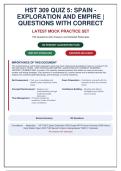
HST 309 QUIZ 5: SPAIN -
EXPLORATION AND EMPIRE |
QUESTIONS WITH CORRECT
LATEST MOCK PRACTICE SET
150 Questions with Answers and Detailed Rationales
100 PERCENT GUARANTEED PASS
INSTANT DOWNLOAD ANSWERS INCLUDED
IMPORTANCE OF THIS DOCUMENT
This comprehensive examination preparation guide has been meticulously developed to help you succeed in the
HST 309 QUIZ 5: SPAIN - EXPLORATION AND EMPIRE | QUESTIONS WITH CORRECT ANSWERS |
VERIFIED | SUMMER 2026. It contains 150 carefully selected questions that reflect the most current exam
content and testing strategies. Each question is accompanied by a correct answer and a detailed rationale that
explains the underlying pathophysiology, pharmacology, or clinical reasoning.
Self-Assessment – Test your knowledge and Exam Preparation – Familiarize yourself with the
identify areas requiring further question format and content
study areas
Concept Reinforcement – Deepen your Confidence Building – Develop test-taking
understanding through strategies and reduce
evidence-based exam anxiety
rationales
Time Management – Practice answering
questions under simulated
exam conditions
Review Summary 150 Questions
Foundations - Application - HST 309 5 Spain Exploration AND Empire WITH Correct Summer 2026 History
Early Modern Spain AND THE Spanish Empire Undergraduate YEAR 3 / Graduate
All answers with rationales
,Table of Contents
Content Area Questions Key Topics
Spanish Exploration AND 1-25 Spanish, System, Treaty, Factor, Directly
Conquest
THE Spanish Empire IN THE 26-50 Spanish, Empire S, Context, Describes, Colonial
Americas
Colonial Administration AND 51-75 Spanish, System, Century, Colonial, Encomienda
Governance
Economic Systems AND 76-100 Spanish, Colonial, System, Economic, Context
Trade
Impact ON Indigenous 101-125 Spanish, System, Century, Crown S, Colonial
Peoples
Religion AND THE Catholic 126-150 Spanish, Colonial, Century, Factor, Context
Church
TOTAL 150 All questions include answers and detailed rationales
,Section A - Spanish Exploration AND Conquest
Q1.
Which of the following best explains why the Spanish Crown favored the system of
encomienda over direct royal administration in the early decades after 1492?
A. It allowed the Crown to avoid the costs of B. It was a direct import of feudal institutions
a colonial bureaucracy while rewarding from medieval Castile.
conquistadors.
C. It was designed to protect indigenous D. It facilitated the rapid conversion of
populations from exploitation. indigenous peoples to Christianity.
Correct: A - It allowed the Crown to avoid the costs of a colonial bureaucracy while
rewarding conquistadors.
Rationale:The encomienda system delegated labor and tribute collection to conquistadors,
reducing Crown expenditure while providing incentives. It was not a feudal import but a new
institution, nor was it protective or primarily missionary.
Q2.
The Treaty of Tordesillas (1494) and the subsequent Treaty of Zaragoza (1529) together
established what principle in international law?
A. Freedom of the seas for all nations B. Papal authority to divide non-Christian
lands between Iberian powers
C. The primacy of discovery over occupation D. The right of indigenous peoples to resist
in territorial claims colonization
Correct: B - Papal authority to divide non-Christian lands between Iberian powers
Rationale:These treaties, mediated by the Pope, divided the non-European world along
meridians between Spain and Portugal. They did not establish freedom of the seas or
indigenous rights; they were based on papal grants.
Q3.
Which factor most directly contributed to the demographic collapse of indigenous
populations in the Caribbean after 1492?
A. Enslavement and forced labor in gold B. Introduction of Old World pathogens
mines
C. Mass migration to the mainland D. Intertribal warfare instigated by the
Spanish
Correct: B - Introduction of Old World pathogens
Page 3
, Section A - Spanish Exploration AND Conquest
Rationale: Disease, especially smallpox, was the primary killer. While forced labor and
warfare contributed, the lack of immunity to Old World pathogens caused catastrophic
mortality.
Q4.
Which of the following best describes the role of the Casa de Contratación in Seville?
A. It was the highest court for colonial legal B. It regulated all trade and navigation
disputes. between Spain and the Americas.
C. It managed the conversion of indigenous D. It administered the encomienda system.
peoples.
Correct: B - It regulated all trade and navigation between Spain and the Americas.
Rationale:The Casa de Contratación oversaw commerce, immigration, and navigation, acting
as a central regulatory body. Judicial matters were handled by the Council of the Indies;
religious and labor systems were separate.
Q5.
The New Laws of 1542 were significant because they:
A. Abolished the encomienda system B. Prohibited the enslavement of indigenous
outright. people and limited encomienda inheritance.
C. Granted full citizenship rights to D. Established the viceroyalties of New
indigenous peoples. Spain and Peru.
Correct: B - Prohibited the enslavement of indigenous people and limited encomienda
inheritance.
Rationale:The New Laws aimed to protect indigenous people by banning their enslavement
and restricting the encomienda's hereditary nature. They did not abolish encomienda entirely
nor grant citizenship, and the viceroyalties were established earlier.
Q6.
Which of the following was a primary function of the mita in the Viceroyalty of Peru?
A. To provide labor for the silver mines at B. To collect tribute from indigenous
Potosí communities
C. To organize the shipment of silver to D. To enforce religious orthodoxy
Spain
Correct: A - To provide labor for the silver mines at Potosí
Page 4
EXPLORATION AND EMPIRE |
QUESTIONS WITH CORRECT
LATEST MOCK PRACTICE SET
150 Questions with Answers and Detailed Rationales
100 PERCENT GUARANTEED PASS
INSTANT DOWNLOAD ANSWERS INCLUDED
IMPORTANCE OF THIS DOCUMENT
This comprehensive examination preparation guide has been meticulously developed to help you succeed in the
HST 309 QUIZ 5: SPAIN - EXPLORATION AND EMPIRE | QUESTIONS WITH CORRECT ANSWERS |
VERIFIED | SUMMER 2026. It contains 150 carefully selected questions that reflect the most current exam
content and testing strategies. Each question is accompanied by a correct answer and a detailed rationale that
explains the underlying pathophysiology, pharmacology, or clinical reasoning.
Self-Assessment – Test your knowledge and Exam Preparation – Familiarize yourself with the
identify areas requiring further question format and content
study areas
Concept Reinforcement – Deepen your Confidence Building – Develop test-taking
understanding through strategies and reduce
evidence-based exam anxiety
rationales
Time Management – Practice answering
questions under simulated
exam conditions
Review Summary 150 Questions
Foundations - Application - HST 309 5 Spain Exploration AND Empire WITH Correct Summer 2026 History
Early Modern Spain AND THE Spanish Empire Undergraduate YEAR 3 / Graduate
All answers with rationales
,Table of Contents
Content Area Questions Key Topics
Spanish Exploration AND 1-25 Spanish, System, Treaty, Factor, Directly
Conquest
THE Spanish Empire IN THE 26-50 Spanish, Empire S, Context, Describes, Colonial
Americas
Colonial Administration AND 51-75 Spanish, System, Century, Colonial, Encomienda
Governance
Economic Systems AND 76-100 Spanish, Colonial, System, Economic, Context
Trade
Impact ON Indigenous 101-125 Spanish, System, Century, Crown S, Colonial
Peoples
Religion AND THE Catholic 126-150 Spanish, Colonial, Century, Factor, Context
Church
TOTAL 150 All questions include answers and detailed rationales
,Section A - Spanish Exploration AND Conquest
Q1.
Which of the following best explains why the Spanish Crown favored the system of
encomienda over direct royal administration in the early decades after 1492?
A. It allowed the Crown to avoid the costs of B. It was a direct import of feudal institutions
a colonial bureaucracy while rewarding from medieval Castile.
conquistadors.
C. It was designed to protect indigenous D. It facilitated the rapid conversion of
populations from exploitation. indigenous peoples to Christianity.
Correct: A - It allowed the Crown to avoid the costs of a colonial bureaucracy while
rewarding conquistadors.
Rationale:The encomienda system delegated labor and tribute collection to conquistadors,
reducing Crown expenditure while providing incentives. It was not a feudal import but a new
institution, nor was it protective or primarily missionary.
Q2.
The Treaty of Tordesillas (1494) and the subsequent Treaty of Zaragoza (1529) together
established what principle in international law?
A. Freedom of the seas for all nations B. Papal authority to divide non-Christian
lands between Iberian powers
C. The primacy of discovery over occupation D. The right of indigenous peoples to resist
in territorial claims colonization
Correct: B - Papal authority to divide non-Christian lands between Iberian powers
Rationale:These treaties, mediated by the Pope, divided the non-European world along
meridians between Spain and Portugal. They did not establish freedom of the seas or
indigenous rights; they were based on papal grants.
Q3.
Which factor most directly contributed to the demographic collapse of indigenous
populations in the Caribbean after 1492?
A. Enslavement and forced labor in gold B. Introduction of Old World pathogens
mines
C. Mass migration to the mainland D. Intertribal warfare instigated by the
Spanish
Correct: B - Introduction of Old World pathogens
Page 3
, Section A - Spanish Exploration AND Conquest
Rationale: Disease, especially smallpox, was the primary killer. While forced labor and
warfare contributed, the lack of immunity to Old World pathogens caused catastrophic
mortality.
Q4.
Which of the following best describes the role of the Casa de Contratación in Seville?
A. It was the highest court for colonial legal B. It regulated all trade and navigation
disputes. between Spain and the Americas.
C. It managed the conversion of indigenous D. It administered the encomienda system.
peoples.
Correct: B - It regulated all trade and navigation between Spain and the Americas.
Rationale:The Casa de Contratación oversaw commerce, immigration, and navigation, acting
as a central regulatory body. Judicial matters were handled by the Council of the Indies;
religious and labor systems were separate.
Q5.
The New Laws of 1542 were significant because they:
A. Abolished the encomienda system B. Prohibited the enslavement of indigenous
outright. people and limited encomienda inheritance.
C. Granted full citizenship rights to D. Established the viceroyalties of New
indigenous peoples. Spain and Peru.
Correct: B - Prohibited the enslavement of indigenous people and limited encomienda
inheritance.
Rationale:The New Laws aimed to protect indigenous people by banning their enslavement
and restricting the encomienda's hereditary nature. They did not abolish encomienda entirely
nor grant citizenship, and the viceroyalties were established earlier.
Q6.
Which of the following was a primary function of the mita in the Viceroyalty of Peru?
A. To provide labor for the silver mines at B. To collect tribute from indigenous
Potosí communities
C. To organize the shipment of silver to D. To enforce religious orthodoxy
Spain
Correct: A - To provide labor for the silver mines at Potosí
Page 4

