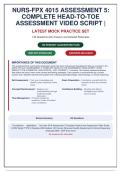
NURS-FPX 4015 ASSESSMENT 5:
COMPLETE HEAD-TO-TOE
ASSESSMENT VIDEO SCRIPT |
LATEST MOCK PRACTICE SET
140 Questions with Answers and Detailed Rationales
100 PERCENT GUARANTEED PASS
INSTANT DOWNLOAD ANSWERS INCLUDED
IMPORTANCE OF THIS DOCUMENT
This comprehensive examination preparation guide has been meticulously developed to help you succeed in the
NURS-FPX 4015 ASSESSMENT 5: COMPLETE HEAD-TO-TOE ASSESSMENT VIDEO SCRIPT | EVAN
WRIGHT TYPE 2 DIABETES | 2026 UPDATE | 100% CORRECT.. It contains 140 carefully selected questions
that reflect the most current exam content and testing strategies. Each question is accompanied by a correct
answer and a detailed rationale that explains the underlying pathophysiology, pharmacology, or clinical reasoning.
Self-Assessment – Test your knowledge and Exam Preparation – Familiarize yourself with the
identify areas requiring further question format and content
study areas
Concept Reinforcement – Deepen your Confidence Building – Develop test-taking
understanding through strategies and reduce
evidence-based exam anxiety
rationales
Time Management – Practice answering
questions under simulated
exam conditions
Review Summary 140 Questions
Foundations - Application - Nurs-fpx 4015 Assessment 5 Complete Head-to-toe Assessment Video Script
EVAN Wright TYPE 2 Diabetes 2026 Update 100 Correct Advanced Health Assessment & Clinical Reasoning
Graduate MSN / DNP Entry-level
All answers with rationales
,Table of Contents
Content Area Questions Key Topics
Health History AND Review 1-24 Diabetes, Head-to-toe, Finding, Appropriate, EVAN Wright S
OF Systems
Vital Signs AND General 25-48 Diabetes, Finding, Neuropathy, Head-to-toe, Examiner
Survey
HEAD EYES EARS NOSE 49-72 Diabetes, Diabetic, Finding, Rather, Video Script
AND Throat Heent
Assessment
Cardiovascular AND 73-96 Script, Video, Finding, Diabetes, Technique
Peripheral Vascular
Assessment
Respiratory Assessment 97-120 Diabetes, Head-to-toe, Finding, Video, Diabetic
Abdominal AND 121-140 Diabetes, Finding, Head-to-toe, Cardiovascular, Diabetic
Gastrointestinal Assessment
TOTAL 140 All questions include answers and detailed rationales
,Section A - Health History AND Review OF Systems
Q1.
During the head-to-toe assessment, which sequence best minimizes patient repositioning
and optimizes accuracy of cardiovascular and pulmonary findings?
A. Inspect anterior chest, auscultate lung B. Auscultate heart sounds in supine, left
bases posteriorly, then palpate apical lateral, and sitting positions before
impulse with patient supine. examining the lungs.
C. Perform respiratory assessment in sitting D. Palpate the abdomen before auscultating
position, then cardiac assessment in supine heart and lung sounds to avoid referred
and left lateral positions. tenderness.
Correct: C - Perform respiratory assessment in sitting position, then cardiac assessment
in supine and left lateral positions.
Rationale:The correct sequence is to assess respiratory status in a sitting position
(optimizing lung expansion) and then cardiac status in supine and left lateral positions
(enhancing heart sound detection). Option A incorrectly places auscultation of lung bases
posteriorly after anterior inspection but before cardiac, which is less efficient. Option B omits
pulmonary assessment priority. Option D is incorrect as abdominal palpation can alter bowel
sounds and should occur after cardiopulmonary assessment.
Q2.
In a patient with Type 2 Diabetes, which combination of physical findings most strongly
suggests the presence of autonomic neuropathy?
A. Resting tachycardia, orthostatic B. Peripheral edema, jugular venous
hypotension, and gastroparesis distention, and hepatomegaly
C. Acanthosis nigricans, central obesity, and D. Diminished pedal pulses, cool
hirsutism extremities, and delayed capillary refill
Correct: A - Resting tachycardia, orthostatic hypotension, and gastroparesis
Rationale:Autonomic neuropathy in diabetes commonly manifests as resting tachycardia
(vagal denervation), orthostatic hypotension (sympathetic dysfunction), and gastroparesis
(vagal nerve involvement). Option B indicates heart failure or volume overload. Option C
suggests insulin resistance and metabolic syndrome. Option D points to peripheral arterial
disease, not autonomic dysfunction.
Q3.
When documenting the head-to-toe assessment, which technique ensures accurate
representation of the patient's respiratory effort and oxygenation status?
Page 3
, Section A - Health History AND Review OF Systems
A. Record pulse oximetry reading without B. Describe chest wall expansion, use of
noting the fraction of inspired oxygen (FiO2). accessory muscles, and auscultatory
findings, and correlate with SpO2.
C. Document the patient's respiratory rate D. Rely solely on arterial blood gas results
as 'normal' if within 12-20 breaths per to document respiratory status.
minute.
Correct: B - Describe chest wall expansion, use of accessory muscles, and auscultatory
findings, and correlate with SpO2.
Rationale:Accurate documentation requires integrating inspection (chest expansion,
accessory muscle use), auscultation, and oxygenation data (SpO2) to provide a complete
picture. Option A is incomplete without FiO2 context. Option C is vague and ignores work of
breathing. Option D is invasive and not always indicated; physical assessment remains
essential.
Q4.
A patient with Type 2 Diabetes reports new-onset dizziness when standing. Which
assessment technique is most appropriate to differentiate orthostatic hypotension from
other causes?
A. Measure blood pressure in supine, sitting, B. Perform a single blood pressure reading
and standing positions after 1-3 minutes in in the seated position.
each position.
C. Assess for nystagmus and perform the D. Check blood glucose level to rule out
Dix-Hallpike maneuver. hypoglycemia.
Correct: A - Measure blood pressure in supine, sitting, and standing positions after 1-3
minutes in each position.
Rationale:Orthostatic hypotension is diagnosed by measuring BP in supine, sitting, and
standing positions, with a drop of 20 mmHg systolic or 10 mmHg diastolic upon standing.
Option B is insufficient. Option C evaluates benign paroxysmal positional vertigo. Option D is
important but does not confirm orthostatic hypotension.
Q5.
In the context of a head-to-toe assessment for a patient with Type 2 Diabetes, which
finding warrants immediate referral for ophthalmologic evaluation?
A. Presbyopia that corrects with reading B. Microaneurysms and dot-blot
glasses hemorrhages on fundoscopic exam
C. Mild dry eyes that respond to artificial D. Blepharitis without visual changes
tears
Correct: B - Microaneurysms and dot-blot hemorrhages on fundoscopic exam
Page 4
COMPLETE HEAD-TO-TOE
ASSESSMENT VIDEO SCRIPT |
LATEST MOCK PRACTICE SET
140 Questions with Answers and Detailed Rationales
100 PERCENT GUARANTEED PASS
INSTANT DOWNLOAD ANSWERS INCLUDED
IMPORTANCE OF THIS DOCUMENT
This comprehensive examination preparation guide has been meticulously developed to help you succeed in the
NURS-FPX 4015 ASSESSMENT 5: COMPLETE HEAD-TO-TOE ASSESSMENT VIDEO SCRIPT | EVAN
WRIGHT TYPE 2 DIABETES | 2026 UPDATE | 100% CORRECT.. It contains 140 carefully selected questions
that reflect the most current exam content and testing strategies. Each question is accompanied by a correct
answer and a detailed rationale that explains the underlying pathophysiology, pharmacology, or clinical reasoning.
Self-Assessment – Test your knowledge and Exam Preparation – Familiarize yourself with the
identify areas requiring further question format and content
study areas
Concept Reinforcement – Deepen your Confidence Building – Develop test-taking
understanding through strategies and reduce
evidence-based exam anxiety
rationales
Time Management – Practice answering
questions under simulated
exam conditions
Review Summary 140 Questions
Foundations - Application - Nurs-fpx 4015 Assessment 5 Complete Head-to-toe Assessment Video Script
EVAN Wright TYPE 2 Diabetes 2026 Update 100 Correct Advanced Health Assessment & Clinical Reasoning
Graduate MSN / DNP Entry-level
All answers with rationales
,Table of Contents
Content Area Questions Key Topics
Health History AND Review 1-24 Diabetes, Head-to-toe, Finding, Appropriate, EVAN Wright S
OF Systems
Vital Signs AND General 25-48 Diabetes, Finding, Neuropathy, Head-to-toe, Examiner
Survey
HEAD EYES EARS NOSE 49-72 Diabetes, Diabetic, Finding, Rather, Video Script
AND Throat Heent
Assessment
Cardiovascular AND 73-96 Script, Video, Finding, Diabetes, Technique
Peripheral Vascular
Assessment
Respiratory Assessment 97-120 Diabetes, Head-to-toe, Finding, Video, Diabetic
Abdominal AND 121-140 Diabetes, Finding, Head-to-toe, Cardiovascular, Diabetic
Gastrointestinal Assessment
TOTAL 140 All questions include answers and detailed rationales
,Section A - Health History AND Review OF Systems
Q1.
During the head-to-toe assessment, which sequence best minimizes patient repositioning
and optimizes accuracy of cardiovascular and pulmonary findings?
A. Inspect anterior chest, auscultate lung B. Auscultate heart sounds in supine, left
bases posteriorly, then palpate apical lateral, and sitting positions before
impulse with patient supine. examining the lungs.
C. Perform respiratory assessment in sitting D. Palpate the abdomen before auscultating
position, then cardiac assessment in supine heart and lung sounds to avoid referred
and left lateral positions. tenderness.
Correct: C - Perform respiratory assessment in sitting position, then cardiac assessment
in supine and left lateral positions.
Rationale:The correct sequence is to assess respiratory status in a sitting position
(optimizing lung expansion) and then cardiac status in supine and left lateral positions
(enhancing heart sound detection). Option A incorrectly places auscultation of lung bases
posteriorly after anterior inspection but before cardiac, which is less efficient. Option B omits
pulmonary assessment priority. Option D is incorrect as abdominal palpation can alter bowel
sounds and should occur after cardiopulmonary assessment.
Q2.
In a patient with Type 2 Diabetes, which combination of physical findings most strongly
suggests the presence of autonomic neuropathy?
A. Resting tachycardia, orthostatic B. Peripheral edema, jugular venous
hypotension, and gastroparesis distention, and hepatomegaly
C. Acanthosis nigricans, central obesity, and D. Diminished pedal pulses, cool
hirsutism extremities, and delayed capillary refill
Correct: A - Resting tachycardia, orthostatic hypotension, and gastroparesis
Rationale:Autonomic neuropathy in diabetes commonly manifests as resting tachycardia
(vagal denervation), orthostatic hypotension (sympathetic dysfunction), and gastroparesis
(vagal nerve involvement). Option B indicates heart failure or volume overload. Option C
suggests insulin resistance and metabolic syndrome. Option D points to peripheral arterial
disease, not autonomic dysfunction.
Q3.
When documenting the head-to-toe assessment, which technique ensures accurate
representation of the patient's respiratory effort and oxygenation status?
Page 3
, Section A - Health History AND Review OF Systems
A. Record pulse oximetry reading without B. Describe chest wall expansion, use of
noting the fraction of inspired oxygen (FiO2). accessory muscles, and auscultatory
findings, and correlate with SpO2.
C. Document the patient's respiratory rate D. Rely solely on arterial blood gas results
as 'normal' if within 12-20 breaths per to document respiratory status.
minute.
Correct: B - Describe chest wall expansion, use of accessory muscles, and auscultatory
findings, and correlate with SpO2.
Rationale:Accurate documentation requires integrating inspection (chest expansion,
accessory muscle use), auscultation, and oxygenation data (SpO2) to provide a complete
picture. Option A is incomplete without FiO2 context. Option C is vague and ignores work of
breathing. Option D is invasive and not always indicated; physical assessment remains
essential.
Q4.
A patient with Type 2 Diabetes reports new-onset dizziness when standing. Which
assessment technique is most appropriate to differentiate orthostatic hypotension from
other causes?
A. Measure blood pressure in supine, sitting, B. Perform a single blood pressure reading
and standing positions after 1-3 minutes in in the seated position.
each position.
C. Assess for nystagmus and perform the D. Check blood glucose level to rule out
Dix-Hallpike maneuver. hypoglycemia.
Correct: A - Measure blood pressure in supine, sitting, and standing positions after 1-3
minutes in each position.
Rationale:Orthostatic hypotension is diagnosed by measuring BP in supine, sitting, and
standing positions, with a drop of 20 mmHg systolic or 10 mmHg diastolic upon standing.
Option B is insufficient. Option C evaluates benign paroxysmal positional vertigo. Option D is
important but does not confirm orthostatic hypotension.
Q5.
In the context of a head-to-toe assessment for a patient with Type 2 Diabetes, which
finding warrants immediate referral for ophthalmologic evaluation?
A. Presbyopia that corrects with reading B. Microaneurysms and dot-blot
glasses hemorrhages on fundoscopic exam
C. Mild dry eyes that respond to artificial D. Blepharitis without visual changes
tears
Correct: B - Microaneurysms and dot-blot hemorrhages on fundoscopic exam
Page 4