

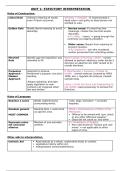
UNIT 1: STATUTORY INTERPRETATION
Rules of Construction
Literal Rule Ordinary meaning of words, Whiteley v Chappell – D impersonated a
even if harsh outcomes. dead voter→ not guilty as dead person not
entitled to vote.
Golden Rule Modify literal meaning to avoid Narrow sense: If a word has two
absurdity. meanings, choose the one that avoids
absurdity.
→ R v Allen – ‘marry’ = going through the
ceremony (so bigamy possible).
Wider sense: Depart from meaning to
prevent injustice.
→ Re Sigsworth – son who murdered
mother prevented from inheriting estate.
Mischief Identify gap the legislation was Royal College of Nursing v DHSS – nurses
Rule intended to fill. allowed to perform abortions under doctor’s
direction as Abortion Act 1967 aimed to fix
unsafe abortions.
Purposive Interpret to achieve R (Quintavalle) v Secretary of State for
Approach – Parliament’s purpose, not strict Health – cloned embryos covered by HFEA
Modern wording. 1990; aim = regulate all embryos created
Approach outside body.
‘Always speaking’ principle:
apply legislation to new Litster v Forth Dry Dock and Engineering Co
contexts not imagined when Ltd [1990]: read purposively to achieve EU
law was written. Directive.
Rules of Language
Noscitur a sociis Words understood by ‘Cats, dogs, hamsters’ → excludes
surrounding words. leopards.
Eiusdem generis General term = same kind Wood v Commissioner of Police of the
as specific ones. Metropolis:
MOST COMMON Offense to be armed with ‘gun, pistol,
or any other offensive weapon.’
Glass did not count as ‘any other’
Expressio unius Mention of one excludes R v Inhabitants of Sedgley:
est exclusion another. Poor rate levied on ‘houses and coal
alterius mines’ = not applicable to other
types of mine.
Other aids to interpretation
Intrinsic Aid Read statute as a whole, understand words in context.
Legislative history within Act.
Interpretation sections/definitions.
,Extrinsic Aid Interpretation Act 1978.
Dictionaries.
Other statutes.
Hansard: can refer to if:
→ statute is ambiguous, or literal meaning leads to absurdity; and
→ material consists of clear statements by Minister or other
promoter of Bill – Pepper v Hart.
Presumptions
1. Against altering common law
2. Against retrospective effect (exception: War Crimes Act 1991)
3. Against criminal liability without guilty intention
4. Against depriving liberty
5. Against depriving property or interfering with private rights
6. Against binding the Crown
7. Against removing courts’ power to review matters
EU Law Influence
European Communities Act 1972 → purposive approach to EU legislation.
Retained EU law post-Brexit still purposively interpreted; pre-31 Dec 2020 CJEU rulings
bind lower courts (higher courts may depart).
HRA 1998 Influence
S3 HRA: statutes must be read compatibly
with ECHR ‘so far as possible.’
R v A (No 2)- allowed sexual history
evidence to ensure fair trial (Art. 6
ECHR).
, UNIT 2: DOCTRINE OF PRECEDENT
Elements necessary for application of doctrine of precedent:
1. A proposition of law
2. Part of the ratio decidendi of a case
3. Decided in a court whose decisions are not binding on the present court
4. There are no relevant distinctions between the two cases.
Ensures consistency, certainty and proportionality.
Stare decisis = duty to follow established legal precedent.
1. Proposition of law
Facts = proven from evidence (not binding)
Law example: DPP v Johnson [1995]
Alcohol came from injection, not drinking. Court held that ‘consumption’ = introducing
alcohol into body by any means → law, not fact.
2. Ratio decidendi
Binding legal principle of a case. To find it:
a. Identify the material facts.
b. Identify the legal issue decided by the court.
c. Identify the reasoning used to reach the decision.
d. Extract the principle of law that logically connects the facts and decision.
Can have a wide ratio (general facts which apply to more cases) or a narrow ratio (applies
to fewer cases)
Donoghue v Stevenson: broad ratio – established neighbour principle.
Corkery v Carpenter: narrow ratio – bicycle is a carriage under the Licensing Act.
Obiter dictum
Statements made by judge which are not essential to decision. Not binding but may be
persuasive. To find it:
a. Wider than necessary to decide case.
b. Hypothetical examples (if the facts were different, I would have…)
c. What decision would have been if not bound by precedent.
d. Remarks in dissenting judgements.
, 3. Court Hierarchy
Rule: lower courts bound by higher courts– Cassell v Broome.
Supreme Binds courts below, not itself.
Court HoL previously bound by own decisions – Practice Statement (Judicial
Precedent) [1966] changed this.
Austin v Southwark confirmed PS had same effect in SC.
Court of Civil Division
Appeal Young v Bristol Aeroplane Co Ltd: bound by own decisions, except:
1. Where own previous decisions conflict.
2. Previous decision implicitly overruled by SC.
3. Previous decision made per incurium (carelessly ignoring law)
Morelle v Wakeling: only applied to decisions given in
ignorance.
Duke v Reliance Systems Ltd: only if court must have
reached a different conclusion, not might.
Further exceptions added:
4. Interim decision by two judges – Boys v Chaplin
5. Previous decision conflicts with later ECtHR decision – free (but not
obliged) to depart from its earlier decision.
Criminal Division: same applies + extra discretion if individual liberty at
stake - R v Gould.
High Court Divisional Court (appellate jurisdiction)
Bound by own decisions (same exceptions as CoA) – R v Greater
Manchester Coroner.
First instance cases:
Binding on lower courts, not themselves.
Crown Court Not bound by previous decisions; however, strongly persuaded by them
Inferior Not bound by previous decisions; do not bind other courts.
Courts –
County,
Family,
Magistrates
European Not bound by previous decisions; but do not generally depart from them.
Court of
Justice
HRA 1998: UK courts must take into account ECtHR decisions.
4. Only binding if no relevant distinctions between cases
Rules of Construction
Literal Rule Ordinary meaning of words, Whiteley v Chappell – D impersonated a
even if harsh outcomes. dead voter→ not guilty as dead person not
entitled to vote.
Golden Rule Modify literal meaning to avoid Narrow sense: If a word has two
absurdity. meanings, choose the one that avoids
absurdity.
→ R v Allen – ‘marry’ = going through the
ceremony (so bigamy possible).
Wider sense: Depart from meaning to
prevent injustice.
→ Re Sigsworth – son who murdered
mother prevented from inheriting estate.
Mischief Identify gap the legislation was Royal College of Nursing v DHSS – nurses
Rule intended to fill. allowed to perform abortions under doctor’s
direction as Abortion Act 1967 aimed to fix
unsafe abortions.
Purposive Interpret to achieve R (Quintavalle) v Secretary of State for
Approach – Parliament’s purpose, not strict Health – cloned embryos covered by HFEA
Modern wording. 1990; aim = regulate all embryos created
Approach outside body.
‘Always speaking’ principle:
apply legislation to new Litster v Forth Dry Dock and Engineering Co
contexts not imagined when Ltd [1990]: read purposively to achieve EU
law was written. Directive.
Rules of Language
Noscitur a sociis Words understood by ‘Cats, dogs, hamsters’ → excludes
surrounding words. leopards.
Eiusdem generis General term = same kind Wood v Commissioner of Police of the
as specific ones. Metropolis:
MOST COMMON Offense to be armed with ‘gun, pistol,
or any other offensive weapon.’
Glass did not count as ‘any other’
Expressio unius Mention of one excludes R v Inhabitants of Sedgley:
est exclusion another. Poor rate levied on ‘houses and coal
alterius mines’ = not applicable to other
types of mine.
Other aids to interpretation
Intrinsic Aid Read statute as a whole, understand words in context.
Legislative history within Act.
Interpretation sections/definitions.
,Extrinsic Aid Interpretation Act 1978.
Dictionaries.
Other statutes.
Hansard: can refer to if:
→ statute is ambiguous, or literal meaning leads to absurdity; and
→ material consists of clear statements by Minister or other
promoter of Bill – Pepper v Hart.
Presumptions
1. Against altering common law
2. Against retrospective effect (exception: War Crimes Act 1991)
3. Against criminal liability without guilty intention
4. Against depriving liberty
5. Against depriving property or interfering with private rights
6. Against binding the Crown
7. Against removing courts’ power to review matters
EU Law Influence
European Communities Act 1972 → purposive approach to EU legislation.
Retained EU law post-Brexit still purposively interpreted; pre-31 Dec 2020 CJEU rulings
bind lower courts (higher courts may depart).
HRA 1998 Influence
S3 HRA: statutes must be read compatibly
with ECHR ‘so far as possible.’
R v A (No 2)- allowed sexual history
evidence to ensure fair trial (Art. 6
ECHR).
, UNIT 2: DOCTRINE OF PRECEDENT
Elements necessary for application of doctrine of precedent:
1. A proposition of law
2. Part of the ratio decidendi of a case
3. Decided in a court whose decisions are not binding on the present court
4. There are no relevant distinctions between the two cases.
Ensures consistency, certainty and proportionality.
Stare decisis = duty to follow established legal precedent.
1. Proposition of law
Facts = proven from evidence (not binding)
Law example: DPP v Johnson [1995]
Alcohol came from injection, not drinking. Court held that ‘consumption’ = introducing
alcohol into body by any means → law, not fact.
2. Ratio decidendi
Binding legal principle of a case. To find it:
a. Identify the material facts.
b. Identify the legal issue decided by the court.
c. Identify the reasoning used to reach the decision.
d. Extract the principle of law that logically connects the facts and decision.
Can have a wide ratio (general facts which apply to more cases) or a narrow ratio (applies
to fewer cases)
Donoghue v Stevenson: broad ratio – established neighbour principle.
Corkery v Carpenter: narrow ratio – bicycle is a carriage under the Licensing Act.
Obiter dictum
Statements made by judge which are not essential to decision. Not binding but may be
persuasive. To find it:
a. Wider than necessary to decide case.
b. Hypothetical examples (if the facts were different, I would have…)
c. What decision would have been if not bound by precedent.
d. Remarks in dissenting judgements.
, 3. Court Hierarchy
Rule: lower courts bound by higher courts– Cassell v Broome.
Supreme Binds courts below, not itself.
Court HoL previously bound by own decisions – Practice Statement (Judicial
Precedent) [1966] changed this.
Austin v Southwark confirmed PS had same effect in SC.
Court of Civil Division
Appeal Young v Bristol Aeroplane Co Ltd: bound by own decisions, except:
1. Where own previous decisions conflict.
2. Previous decision implicitly overruled by SC.
3. Previous decision made per incurium (carelessly ignoring law)
Morelle v Wakeling: only applied to decisions given in
ignorance.
Duke v Reliance Systems Ltd: only if court must have
reached a different conclusion, not might.
Further exceptions added:
4. Interim decision by two judges – Boys v Chaplin
5. Previous decision conflicts with later ECtHR decision – free (but not
obliged) to depart from its earlier decision.
Criminal Division: same applies + extra discretion if individual liberty at
stake - R v Gould.
High Court Divisional Court (appellate jurisdiction)
Bound by own decisions (same exceptions as CoA) – R v Greater
Manchester Coroner.
First instance cases:
Binding on lower courts, not themselves.
Crown Court Not bound by previous decisions; however, strongly persuaded by them
Inferior Not bound by previous decisions; do not bind other courts.
Courts –
County,
Family,
Magistrates
European Not bound by previous decisions; but do not generally depart from them.
Court of
Justice
HRA 1998: UK courts must take into account ECtHR decisions.
4. Only binding if no relevant distinctions between cases

