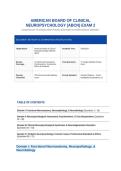
AMERICAN BOARD OF CLINICAL
NEUROPSYCHOLOGY (ABCN) EXAM 2
Comprehensive 72-Question Board Practice Examination & Verified Solutions 2026/2027
DOCUMENT METADATA & EXAMINATION SPECIFICATIONS
Target Board: American Board of Clinical Academic Year: 2026/2027
Neuropsychology (ABCN) /
ABPP
Domain Functional Neuroanatomy, Total Questions: 72 Unique Multiple-Choice
Coverage: Psychometrics, Syndromes, Items
Ethics & Pediatrics
Passing 75% Recommended Mastery Format Standard: Itemized Options + Green
Threshold: Score Highlighted Explanations V2
TABLE OF CONTENTS
Domain I: Functional Neuroanatomy, Neuropathology, & Neurobiology (Questions 1 – 18)
Domain II: Neuropsychological Assessment, Psychometrics, & Test Interpretation (Questions
19 – 36)
Domain III: Clinical Neuropsychological Syndromes & Neurodegenerative Disorders
(Questions 37 – 54)
Domain IV: Pediatric Neuropsychology, Forensic Issues, Professional Standards & Ethics
(Questions 55 – 72)
Domain I: Functional Neuroanatomy, Neuropathology, &
Neurobiology
,Question 1
A 65-year-old right-handed patient experiences an acute stroke resulting in dense transcortical
motor aphasia. Which arterial territory is most typically affected?
A. Left Anterior Cerebral Artery (ACA) / MCA watershed region
B. Main stem of the Left Posterior Cerebral Artery (PCA)
C. Inferior division of the Left Middle Cerebral Artery (MCA)
D. Basilar artery trunk
Correct Answer: A
Verified Solution & Rationale:
Transcortical motor aphasia occurs due to lesions in the left anterior watershed/borderzone region
between the ACA and MCA territories, sparing Broca's area itself and preserving repetition skills
while disrupting non-fluent spontaneous speech initiation.
Question 2
Which thalamic nucleus serves as the primary relay station for visual sensory information
projecting directly to the primary visual cortex (V1)?
A. Medial Geniculate Nucleus (MGN)
B. Lateral Geniculate Nucleus (LGN)
C. Ventral Posterior Lateral Nucleus (VPL)
D. Pulvinar Nucleus
Correct Answer: B
Verified Solution & Rationale:
The Lateral Geniculate Nucleus (LGN) of the thalamus receives visual inputs from optic tract fibers
and projects directly to Brodmann area 17 (primary visual cortex) via optic radiations.
Question 3
Damage restricted to the bilateral ventromedial prefrontal cortex (vmPFC) produces which
primary cognitive/behavioral impairment?
A. Severe deficit in real-world moral/risk decision-making despite intact formal intelligence
, B. Dense anterograde amnesia with preserved working memory
C. Aphasic speech output with severe comprehension impairment
D. Severe contralateral resting tremor
Correct Answer: A
Verified Solution & Rationale:
The ventromedial prefrontal cortex integrates emotion and somatic markers into value-based
decision-making. Lesions leave formal IQ intact but severely compromise risk assessment and
social judgment (e.g., Iowa Gambling Task performance).
Question 4
Which white matter pathway connects Wernicke's area to Broca's area, and when damaged,
leads to conduction aphasia?
A. Uncinate Fasciculus
B. Arcuate Fasciculus
C. Cingulum Bundle
D. Inferior Longitudinal Fasciculus
Correct Answer: B
Verified Solution & Rationale:
The Arcuate Fasciculus bridges temporal and frontal language regions. Disruption impairs speech
repetition while leaving comprehension and spontaneous fluency relatively preserved (conduction
aphasia).
Question 5
The primary neurotransmitter deficit in Alzheimer's disease associated with early memory
degradation originates in which subcortical cholinergic nucleus?
A. Substantia Nigra
B. Nucleus Basalis of Meynert
C. Locus Coeruleus
D. Edinger-Westphal Nucleus
Correct Answer: B
Verified Solution & Rationale:
, Degeneration of cholinergic neurons in the Nucleus Basalis of Meynert leads to widespread cortical
acetylcholine depletion, driving memory and attentional decline in Alzheimer's disease.
Question 6
Which brain region plays a central role in emotional memory processing, specifically fear
conditioning and threat appraisal?
A. Amygdala
B. Caudate Nucleus
C. Cerebellar Vermis
D. Putamen
Correct Answer: A
Verified Solution & Rationale:
The amygdala coordinates physiological and psychological responses to fear and threat appraisal
within the limbic system.
Question 7
Occlusion of the Posterior Inferior Cerebellar Artery (PICA) causes lateral medullary syndrome
(Wallenberg syndrome). Which cognitive or motor sign is commonly associated?
A. Ipsilateral cerebellar ataxia and loss of pain/temperature on contralateral body
B. Dense fluent Wernicke's aphasia
C. Bilateral bitemporal hemianopia
D. Pure motor hemiplegia sparing sensory pathways
Correct Answer: A
Verified Solution & Rationale:
PICA occlusion leads to brainstem damage causing ipsilateral ataxia, facial numbness, Horner's
syndrome, and contralateral loss of body pain/temperature perception.
Question 8
NEUROPSYCHOLOGY (ABCN) EXAM 2
Comprehensive 72-Question Board Practice Examination & Verified Solutions 2026/2027
DOCUMENT METADATA & EXAMINATION SPECIFICATIONS
Target Board: American Board of Clinical Academic Year: 2026/2027
Neuropsychology (ABCN) /
ABPP
Domain Functional Neuroanatomy, Total Questions: 72 Unique Multiple-Choice
Coverage: Psychometrics, Syndromes, Items
Ethics & Pediatrics
Passing 75% Recommended Mastery Format Standard: Itemized Options + Green
Threshold: Score Highlighted Explanations V2
TABLE OF CONTENTS
Domain I: Functional Neuroanatomy, Neuropathology, & Neurobiology (Questions 1 – 18)
Domain II: Neuropsychological Assessment, Psychometrics, & Test Interpretation (Questions
19 – 36)
Domain III: Clinical Neuropsychological Syndromes & Neurodegenerative Disorders
(Questions 37 – 54)
Domain IV: Pediatric Neuropsychology, Forensic Issues, Professional Standards & Ethics
(Questions 55 – 72)
Domain I: Functional Neuroanatomy, Neuropathology, &
Neurobiology
,Question 1
A 65-year-old right-handed patient experiences an acute stroke resulting in dense transcortical
motor aphasia. Which arterial territory is most typically affected?
A. Left Anterior Cerebral Artery (ACA) / MCA watershed region
B. Main stem of the Left Posterior Cerebral Artery (PCA)
C. Inferior division of the Left Middle Cerebral Artery (MCA)
D. Basilar artery trunk
Correct Answer: A
Verified Solution & Rationale:
Transcortical motor aphasia occurs due to lesions in the left anterior watershed/borderzone region
between the ACA and MCA territories, sparing Broca's area itself and preserving repetition skills
while disrupting non-fluent spontaneous speech initiation.
Question 2
Which thalamic nucleus serves as the primary relay station for visual sensory information
projecting directly to the primary visual cortex (V1)?
A. Medial Geniculate Nucleus (MGN)
B. Lateral Geniculate Nucleus (LGN)
C. Ventral Posterior Lateral Nucleus (VPL)
D. Pulvinar Nucleus
Correct Answer: B
Verified Solution & Rationale:
The Lateral Geniculate Nucleus (LGN) of the thalamus receives visual inputs from optic tract fibers
and projects directly to Brodmann area 17 (primary visual cortex) via optic radiations.
Question 3
Damage restricted to the bilateral ventromedial prefrontal cortex (vmPFC) produces which
primary cognitive/behavioral impairment?
A. Severe deficit in real-world moral/risk decision-making despite intact formal intelligence
, B. Dense anterograde amnesia with preserved working memory
C. Aphasic speech output with severe comprehension impairment
D. Severe contralateral resting tremor
Correct Answer: A
Verified Solution & Rationale:
The ventromedial prefrontal cortex integrates emotion and somatic markers into value-based
decision-making. Lesions leave formal IQ intact but severely compromise risk assessment and
social judgment (e.g., Iowa Gambling Task performance).
Question 4
Which white matter pathway connects Wernicke's area to Broca's area, and when damaged,
leads to conduction aphasia?
A. Uncinate Fasciculus
B. Arcuate Fasciculus
C. Cingulum Bundle
D. Inferior Longitudinal Fasciculus
Correct Answer: B
Verified Solution & Rationale:
The Arcuate Fasciculus bridges temporal and frontal language regions. Disruption impairs speech
repetition while leaving comprehension and spontaneous fluency relatively preserved (conduction
aphasia).
Question 5
The primary neurotransmitter deficit in Alzheimer's disease associated with early memory
degradation originates in which subcortical cholinergic nucleus?
A. Substantia Nigra
B. Nucleus Basalis of Meynert
C. Locus Coeruleus
D. Edinger-Westphal Nucleus
Correct Answer: B
Verified Solution & Rationale:
, Degeneration of cholinergic neurons in the Nucleus Basalis of Meynert leads to widespread cortical
acetylcholine depletion, driving memory and attentional decline in Alzheimer's disease.
Question 6
Which brain region plays a central role in emotional memory processing, specifically fear
conditioning and threat appraisal?
A. Amygdala
B. Caudate Nucleus
C. Cerebellar Vermis
D. Putamen
Correct Answer: A
Verified Solution & Rationale:
The amygdala coordinates physiological and psychological responses to fear and threat appraisal
within the limbic system.
Question 7
Occlusion of the Posterior Inferior Cerebellar Artery (PICA) causes lateral medullary syndrome
(Wallenberg syndrome). Which cognitive or motor sign is commonly associated?
A. Ipsilateral cerebellar ataxia and loss of pain/temperature on contralateral body
B. Dense fluent Wernicke's aphasia
C. Bilateral bitemporal hemianopia
D. Pure motor hemiplegia sparing sensory pathways
Correct Answer: A
Verified Solution & Rationale:
PICA occlusion leads to brainstem damage causing ipsilateral ataxia, facial numbness, Horner's
syndrome, and contralateral loss of body pain/temperature perception.
Question 8