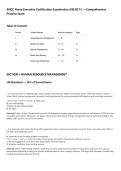
ANCC Nurse Executive Certification Examination (NE-BC®) — Comprehensive
Practice Exam
Table of Contents
Section Content Domain Question Numbers Page
I Human Resource Management 1 – 48 1
II Quality and Safety 49 – 69 13
III Business Management 70 – 89 18
IV Health Care Delivery 90 – 125 22
Answer Key & Rationales 1 – 125 28
SECTION I: HUMAN RESOURCE MANAGEMENT
(40 Questions — 32% of Scored Exam)
• 1. A nurse executive is implementing a major change in the electronic health record system across a 500-bed academic medical
center. Which change management framework is most appropriate for ensuring sustained staff adoption and minimizing resistance?
<font color="red">••</font> A. PDSA cycle
B. Lean methodology
C. Kotter's 8-Step Change Model
D. Six Sigma
Rationale: Kotter's 8-Step Change Model is specifically designed for leading organizational change and staff adoption. PDSA and Lean
are quality improvement frameworks; Six Sigma is for process improvement. Change management requires leadership strategies that
address staff resistance and build momentum.
• 2. A nurse executive notices declining staff engagement scores on the annual employee survey for three consecutive years. What is
the best initial leadership action?
A. Implement a new incentive program immediately
<font color="red">••</font> B. Conduct focus groups with staff to understand underlying concerns
C. Review engagement scores from other departments for benchmarking
D. Schedule mandatory team-building sessions
Rationale: Before implementing solutions, leadership must first understand the problem through direct staff input. Focus groups
demonstrate relationship building and provide qualitative data to inform strategic decisions. This aligns with principles of relationship
building and strategic planning methods.
,• 3. Which leadership theory emphasizes adapting leadership style based on team members' developmental level and task complexity?
A. Transformational leadership
<font color="red">••</font> B. Situational leadership
C. Transactional leadership
D. Servant leadership
Rationale: Situational leadership theory proposes that effective leaders adapt their style based on the development level of their team
members and the complexity of the task. Transformational leadership focuses on inspiring change; transactional leadership uses
rewards and consequences.
• 4. A nurse executive is developing a succession plan for key leadership positions. Which action is most appropriate for ensuring
organizational sustainability?
A. Identify external candidates for all leadership roles
<font color="red">••</font> B. Develop internal talent through mentorship and coaching
C. Wait until a position becomes vacant to begin planning
D. Focus only on C-suite executive roles
Rationale: Succession planning requires proactive development of internal talent through mentoring, coaching, and deliberate career
development. This ensures leadership pipeline sustainability and organizational stability.
• 5. A nurse manager is addressing a conflict between two staff nurses that is affecting unit morale. Which conflict resolution approach
is most likely to produce a sustainable outcome?
A. Directing the nurses to avoid each other
B. Issuing a formal disciplinary warning to both parties
<font color="red">••</font> C. Facilitating a collaborative problem-solving session
D. Transferring one nurse to a different unit
Rationale: Collaborative conflict resolution addresses root causes and builds mutual understanding. Avoidance and transfer do not
resolve underlying issues; discipline may escalate conflict. Win-win negotiation seeks mutually beneficial outcomes and builds
relationships.
• 6. The Family and Medical Leave Act (FMLA) guarantees eligible employees up to how many weeks of unpaid leave per 12-month
period for certain family and medical reasons?
A. 6 weeks
<font color="red">••</font> B. 12 weeks
C. 16 weeks
D. 24 weeks
Rationale: FMLA provides eligible employees with up to 12 weeks of unpaid, job-protected leave per year for specified family and
medical reasons. This is a foundational federal employment law that nurse executives must understand.
• 7. Which federal law prohibits discrimination based on race, color, religion, sex, or national origin in employment?
A. Americans with Disabilities Act (ADA)
<font color="red">••</font> B. Title VII of the Civil Rights Act of 1964
C. Age Discrimination in Employment Act (ADEA)
D. Fair Labor Standards Act (FLSA)
Rationale: Title VII of the Civil Rights Act of 1964 prohibits employment discrimination based on race, color, religion, sex, or national
origin. The ADA covers disability discrimination; ADEA covers age discrimination (40+); FLSA governs wage and hour standards.
,• 8. A nurse executive is implementing a shared governance model. Which element is essential for the success of this model?
A. Top-down decision-making authority
B. Elimination of all management positions
<font color="red">••</font> C. Empowered staff participation in clinical and operational decisions
D. Exclusive focus on quality improvement committees
Rationale: Shared governance empowers staff nurses to participate in decisions affecting their practice and work environment. It
distributes authority, accountability, and decision-making to the point of care while maintaining professional accountability.
• 9. What is the primary purpose of conducting exit interviews with departing staff members?
A. To convince employees to stay
<font color="red">••</font> B. To gather data on organizational strengths and areas for improvement
C. To document performance issues
D. To reduce unemployment insurance costs
Rationale: Exit interviews provide valuable qualitative data about organizational culture, management effectiveness, and reasons for
turnover. This information is essential for developing retention strategies and improving the work environment.
• 10. A nurse executive is reviewing the performance appraisal system. Which approach best supports employee development and
engagement?
A. Annual performance reviews with no ongoing feedback
B. Performance appraisals focused solely on disciplinary actions
<font color="red">••</font> C. Continuous feedback with regular coaching conversations and goal setting
D. Peer-only evaluations without manager input
Rationale: Effective performance management includes ongoing feedback, coaching conversations, and collaborative goal setting. This
approach supports employee development, engagement, and continuous improvement rather than relying solely on annual
summative evaluations.
• 11. Which leadership style is characterized by inspiring followers with a compelling vision and intellectual stimulation?
<font color="red">••</font> A. Transformational leadership
B. Transactional leadership
C. Laissez-faire leadership
D. Authoritarian leadership
Rationale: Transformational leadership inspires followers through vision, intellectual stimulation, and individualized consideration. It is
particularly effective in healthcare settings undergoing change and seeking innovation.
• 12. A nurse executive is planning a strategic initiative to improve nurse retention. What is the first step in the strategic planning
process?
A. Implement retention strategies immediately
<font color="red">••</font> B. Conduct a situation analysis (SWOT)
C. Allocate budget resources
D. Hire a consultant
Rationale: Strategic planning begins with a situation analysis (Strengths, Weaknesses, Opportunities, Threats) to understand the
current state before developing strategies. This ensures initiatives address root causes rather than symptoms.
, • 13. A nurse executive observes that a unit manager is using a transactional leadership style. Which behavior is characteristic of this
style?
A. Inspiring staff with a shared vision
B. Encouraging innovation and creativity
<font color="red">••</font> C. Rewarding staff for meeting performance targets
D. Mentoring staff for future leadership roles
Rationale: Transactional leadership focuses on exchanges between leader and followers, using rewards and consequences to motivate
performance. Inspiring vision and innovation are characteristic of transformational leadership.
• 14. Which federal law establishes minimum wage, overtime pay, recordkeeping, and child labor standards?
A. National Labor Relations Act (NLRA)
B. Occupational Safety and Health Act (OSHA)
<font color="red">••</font> C. Fair Labor Standards Act (FLSA)
D. Employee Retirement Income Security Act (ERISA)
Rationale: The Fair Labor Standards Act (FLSA) establishes minimum wage, overtime pay eligibility, recordkeeping, and child labor
standards. Nurse executives must ensure compliance with these requirements in staffing and compensation practices.
• 15. A nurse executive is addressing low morale on a medical-surgical unit. Which intervention has the strongest evidence for
improving employee engagement?
A. Increasing salaries across the board
<font color="red">••</font> B. Implementing regular recognition and appreciation programs
C. Reducing staffing ratios
D. Offering flexible scheduling options
Rationale: Recognition and appreciation programs have strong evidence for improving employee engagement and satisfaction. While
compensation and scheduling are important, meaningful recognition addresses intrinsic motivation and psychological needs.
• 16. Which of the following is an example of unlawful discrimination in hiring under federal EEO laws?
A. Requiring a nursing license for an RN position
B. Using standardized, job-related interview questions
<font color="red">••</font> C. Refusing to hire a qualified applicant based on age over 40
D. Conducting background checks for all finalists
Rationale: The Age Discrimination in Employment Act (ADEA) prohibits discrimination against individuals aged 40 and older. Requiring
a license is job-related; standardized questions and background checks are permissible if applied consistently.
• 17. A nurse executive is developing a diversity, equity, and inclusion (DEI) strategy. Which action best demonstrates cultural humility?
A. Mandating annual diversity training for all staff
B. Setting numerical diversity targets for hiring
<font color="red">••</font> C. Engaging in ongoing self-reflection and learning about one's own biases
D. Creating a diversity committee with no executive oversight
Rationale: Cultural humility involves ongoing self-reflection, lifelong learning, and recognition of power imbalances. It goes beyond
check-box training to embrace continuous personal and organizational growth in DEI.
Practice Exam
Table of Contents
Section Content Domain Question Numbers Page
I Human Resource Management 1 – 48 1
II Quality and Safety 49 – 69 13
III Business Management 70 – 89 18
IV Health Care Delivery 90 – 125 22
Answer Key & Rationales 1 – 125 28
SECTION I: HUMAN RESOURCE MANAGEMENT
(40 Questions — 32% of Scored Exam)
• 1. A nurse executive is implementing a major change in the electronic health record system across a 500-bed academic medical
center. Which change management framework is most appropriate for ensuring sustained staff adoption and minimizing resistance?
<font color="red">••</font> A. PDSA cycle
B. Lean methodology
C. Kotter's 8-Step Change Model
D. Six Sigma
Rationale: Kotter's 8-Step Change Model is specifically designed for leading organizational change and staff adoption. PDSA and Lean
are quality improvement frameworks; Six Sigma is for process improvement. Change management requires leadership strategies that
address staff resistance and build momentum.
• 2. A nurse executive notices declining staff engagement scores on the annual employee survey for three consecutive years. What is
the best initial leadership action?
A. Implement a new incentive program immediately
<font color="red">••</font> B. Conduct focus groups with staff to understand underlying concerns
C. Review engagement scores from other departments for benchmarking
D. Schedule mandatory team-building sessions
Rationale: Before implementing solutions, leadership must first understand the problem through direct staff input. Focus groups
demonstrate relationship building and provide qualitative data to inform strategic decisions. This aligns with principles of relationship
building and strategic planning methods.
,• 3. Which leadership theory emphasizes adapting leadership style based on team members' developmental level and task complexity?
A. Transformational leadership
<font color="red">••</font> B. Situational leadership
C. Transactional leadership
D. Servant leadership
Rationale: Situational leadership theory proposes that effective leaders adapt their style based on the development level of their team
members and the complexity of the task. Transformational leadership focuses on inspiring change; transactional leadership uses
rewards and consequences.
• 4. A nurse executive is developing a succession plan for key leadership positions. Which action is most appropriate for ensuring
organizational sustainability?
A. Identify external candidates for all leadership roles
<font color="red">••</font> B. Develop internal talent through mentorship and coaching
C. Wait until a position becomes vacant to begin planning
D. Focus only on C-suite executive roles
Rationale: Succession planning requires proactive development of internal talent through mentoring, coaching, and deliberate career
development. This ensures leadership pipeline sustainability and organizational stability.
• 5. A nurse manager is addressing a conflict between two staff nurses that is affecting unit morale. Which conflict resolution approach
is most likely to produce a sustainable outcome?
A. Directing the nurses to avoid each other
B. Issuing a formal disciplinary warning to both parties
<font color="red">••</font> C. Facilitating a collaborative problem-solving session
D. Transferring one nurse to a different unit
Rationale: Collaborative conflict resolution addresses root causes and builds mutual understanding. Avoidance and transfer do not
resolve underlying issues; discipline may escalate conflict. Win-win negotiation seeks mutually beneficial outcomes and builds
relationships.
• 6. The Family and Medical Leave Act (FMLA) guarantees eligible employees up to how many weeks of unpaid leave per 12-month
period for certain family and medical reasons?
A. 6 weeks
<font color="red">••</font> B. 12 weeks
C. 16 weeks
D. 24 weeks
Rationale: FMLA provides eligible employees with up to 12 weeks of unpaid, job-protected leave per year for specified family and
medical reasons. This is a foundational federal employment law that nurse executives must understand.
• 7. Which federal law prohibits discrimination based on race, color, religion, sex, or national origin in employment?
A. Americans with Disabilities Act (ADA)
<font color="red">••</font> B. Title VII of the Civil Rights Act of 1964
C. Age Discrimination in Employment Act (ADEA)
D. Fair Labor Standards Act (FLSA)
Rationale: Title VII of the Civil Rights Act of 1964 prohibits employment discrimination based on race, color, religion, sex, or national
origin. The ADA covers disability discrimination; ADEA covers age discrimination (40+); FLSA governs wage and hour standards.
,• 8. A nurse executive is implementing a shared governance model. Which element is essential for the success of this model?
A. Top-down decision-making authority
B. Elimination of all management positions
<font color="red">••</font> C. Empowered staff participation in clinical and operational decisions
D. Exclusive focus on quality improvement committees
Rationale: Shared governance empowers staff nurses to participate in decisions affecting their practice and work environment. It
distributes authority, accountability, and decision-making to the point of care while maintaining professional accountability.
• 9. What is the primary purpose of conducting exit interviews with departing staff members?
A. To convince employees to stay
<font color="red">••</font> B. To gather data on organizational strengths and areas for improvement
C. To document performance issues
D. To reduce unemployment insurance costs
Rationale: Exit interviews provide valuable qualitative data about organizational culture, management effectiveness, and reasons for
turnover. This information is essential for developing retention strategies and improving the work environment.
• 10. A nurse executive is reviewing the performance appraisal system. Which approach best supports employee development and
engagement?
A. Annual performance reviews with no ongoing feedback
B. Performance appraisals focused solely on disciplinary actions
<font color="red">••</font> C. Continuous feedback with regular coaching conversations and goal setting
D. Peer-only evaluations without manager input
Rationale: Effective performance management includes ongoing feedback, coaching conversations, and collaborative goal setting. This
approach supports employee development, engagement, and continuous improvement rather than relying solely on annual
summative evaluations.
• 11. Which leadership style is characterized by inspiring followers with a compelling vision and intellectual stimulation?
<font color="red">••</font> A. Transformational leadership
B. Transactional leadership
C. Laissez-faire leadership
D. Authoritarian leadership
Rationale: Transformational leadership inspires followers through vision, intellectual stimulation, and individualized consideration. It is
particularly effective in healthcare settings undergoing change and seeking innovation.
• 12. A nurse executive is planning a strategic initiative to improve nurse retention. What is the first step in the strategic planning
process?
A. Implement retention strategies immediately
<font color="red">••</font> B. Conduct a situation analysis (SWOT)
C. Allocate budget resources
D. Hire a consultant
Rationale: Strategic planning begins with a situation analysis (Strengths, Weaknesses, Opportunities, Threats) to understand the
current state before developing strategies. This ensures initiatives address root causes rather than symptoms.
, • 13. A nurse executive observes that a unit manager is using a transactional leadership style. Which behavior is characteristic of this
style?
A. Inspiring staff with a shared vision
B. Encouraging innovation and creativity
<font color="red">••</font> C. Rewarding staff for meeting performance targets
D. Mentoring staff for future leadership roles
Rationale: Transactional leadership focuses on exchanges between leader and followers, using rewards and consequences to motivate
performance. Inspiring vision and innovation are characteristic of transformational leadership.
• 14. Which federal law establishes minimum wage, overtime pay, recordkeeping, and child labor standards?
A. National Labor Relations Act (NLRA)
B. Occupational Safety and Health Act (OSHA)
<font color="red">••</font> C. Fair Labor Standards Act (FLSA)
D. Employee Retirement Income Security Act (ERISA)
Rationale: The Fair Labor Standards Act (FLSA) establishes minimum wage, overtime pay eligibility, recordkeeping, and child labor
standards. Nurse executives must ensure compliance with these requirements in staffing and compensation practices.
• 15. A nurse executive is addressing low morale on a medical-surgical unit. Which intervention has the strongest evidence for
improving employee engagement?
A. Increasing salaries across the board
<font color="red">••</font> B. Implementing regular recognition and appreciation programs
C. Reducing staffing ratios
D. Offering flexible scheduling options
Rationale: Recognition and appreciation programs have strong evidence for improving employee engagement and satisfaction. While
compensation and scheduling are important, meaningful recognition addresses intrinsic motivation and psychological needs.
• 16. Which of the following is an example of unlawful discrimination in hiring under federal EEO laws?
A. Requiring a nursing license for an RN position
B. Using standardized, job-related interview questions
<font color="red">••</font> C. Refusing to hire a qualified applicant based on age over 40
D. Conducting background checks for all finalists
Rationale: The Age Discrimination in Employment Act (ADEA) prohibits discrimination against individuals aged 40 and older. Requiring
a license is job-related; standardized questions and background checks are permissible if applied consistently.
• 17. A nurse executive is developing a diversity, equity, and inclusion (DEI) strategy. Which action best demonstrates cultural humility?
A. Mandating annual diversity training for all staff
B. Setting numerical diversity targets for hiring
<font color="red">••</font> C. Engaging in ongoing self-reflection and learning about one's own biases
D. Creating a diversity committee with no executive oversight
Rationale: Cultural humility involves ongoing self-reflection, lifelong learning, and recognition of power imbalances. It goes beyond
check-box training to embrace continuous personal and organizational growth in DEI.