

AM Modulation
AM modulation changes amplitude
Common applications:
● Broadcasting
● Communication between aircrafts
● Electromagnetic compatibility testing
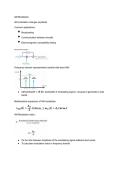
Standard AM modulator:
Frequency domain representation (double side band AM)
● AM bandwidth = 2B (B= bandwidth of modulating signal) - because it generates 2 side
bands
Mathematical expression of AM modulation
AM Modulation index :
● It’s the ratio between amplitude of the modulating signal sideband and carrier
● To calculate modulation index in frequency domain
,Power efficiency of AM:
● Pcarrier =
● Psideband =
● Ptotal = PCarrier + 2 x Psideband
● Efficiency : power in sidebands divided by total power consumed
Different variations of AM:
● Double side band AM (DSB-AM) - standard AM
● DSB-SC - double side band suppressed carrier
● SSB-SC - Single sideband
● VSB-SC - Vestigial sideband
Double side band AM :
● Multiplication of of carrier with modulating signal, with addition of carrier
Double side band suppressed carrier (DSB-SC)
● No addition of carrier therefore no power wasted on it
● Downside: difficult to demodulate (recover) the signal
● Application: transmission of colour info in TV signal
●
● Spectrum:
, ●
●
●
Single sideband suppressed carrier (SSB-SC)
● Suppressing carrier and one sideband to improve power efficiency and bandwidth usage
●
● First, DSB-SC generated
● Then one sideband isolated using bandpass filtering
●
● Only needs half the BW as DSB-SC and half transmitted power
Advantages of SSB:
1. Only uses half BW
2. Saves power
3. Reduces noise
4. Can be smaller and lighter
Disadvantage:
1. Harder to demodulate
2. Requires complex circuitry
Application: TV
Vestigial Sideband (VSB) AM:
AM modulation changes amplitude
Common applications:
● Broadcasting
● Communication between aircrafts
● Electromagnetic compatibility testing
Standard AM modulator:
Frequency domain representation (double side band AM)
● AM bandwidth = 2B (B= bandwidth of modulating signal) - because it generates 2 side
bands
Mathematical expression of AM modulation
AM Modulation index :
● It’s the ratio between amplitude of the modulating signal sideband and carrier
● To calculate modulation index in frequency domain
,Power efficiency of AM:
● Pcarrier =
● Psideband =
● Ptotal = PCarrier + 2 x Psideband
● Efficiency : power in sidebands divided by total power consumed
Different variations of AM:
● Double side band AM (DSB-AM) - standard AM
● DSB-SC - double side band suppressed carrier
● SSB-SC - Single sideband
● VSB-SC - Vestigial sideband
Double side band AM :
● Multiplication of of carrier with modulating signal, with addition of carrier
Double side band suppressed carrier (DSB-SC)
● No addition of carrier therefore no power wasted on it
● Downside: difficult to demodulate (recover) the signal
● Application: transmission of colour info in TV signal
●
● Spectrum:
, ●
●
●
Single sideband suppressed carrier (SSB-SC)
● Suppressing carrier and one sideband to improve power efficiency and bandwidth usage
●
● First, DSB-SC generated
● Then one sideband isolated using bandpass filtering
●
● Only needs half the BW as DSB-SC and half transmitted power
Advantages of SSB:
1. Only uses half BW
2. Saves power
3. Reduces noise
4. Can be smaller and lighter
Disadvantage:
1. Harder to demodulate
2. Requires complex circuitry
Application: TV
Vestigial Sideband (VSB) AM:


