

NSG 100 EXAM 4 – INTRODUCTION TO NURSING
CONCEPTS
Germanna Community College | Complete 200-
Question Test Bank | Verified Answers & Detailed
Rationales | 100% Pass Guarantee
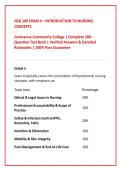
EXAM 4
Exam 4 typically covers the culmination of foundational nursing
concepts, with emphasis on:
Topic Area Percentage
Ethical & Legal Issues in Nursing 20%
Professional Accountability & Scope of
15%
Practice
Safety & Infection Control (PPE,
20%
Restraints, Falls)
Nutrition & Elimination 15%
Mobility & Skin Integrity 15%
Pain Management & End-of-Life Care 10%
,Topic Area Percentage
NGN Case Scenarios (Integrated) 5%
SECTION 1: ETHICAL & LEGAL ISSUES IN NURSING (Questions
1–40)
1. Which of the following best defines the nursing concept of
“accountability”?
A) Following a physician’s order without question
B) Taking responsibility for one’s own actions and professional
conduct
C) Delegating all patient care tasks to unlicensed assistive
personnel
D) Avoiding documentation of errors to protect one’s license
Answer: B) Taking responsibility for one’s own actions and
professional conduct
Rationale: Accountability means being answerable for one’s
nursing judgments, actions, and omissions. It is a core
professional value and includes accepting consequences of
one’s actions.
,2. Apatientwith limited English proficiency is admitted. Which
action demonstrates culturally competentcare?
A) Speakingloudly and slowly in English
B) Usingthepatient’s young childasaninterpreter
C) Arrangingforacertified medical interpreter
D) Havingthepatientwrite down all questions in English
Answer: C) Arrangingforacertified medical interpreter
Rationale: Professional medical interpreters improveaccuracy,
reduce errors, and maintainconfidentiality. Familymembers,
especially children, should notbe used as interpreters due to
possible mistranslation and embarrassment.
3. The nurse is caringforapatient who refuses to takea prescribed
medication. What is thenurse’s best action?
A) Crush themedication and hideit in applesauce
B) Explaintherisks and benefits, then document the refusal
C) Tellthe patient that refusal is notallowed
D) Administer the medication byinjection withoutconsent
Answer: B) Explaintherisks and benefits, then documentthe
refusal
Rationale: Patients havetheright to refuse treatment. The nurse
should educate thepatient about risks and benefits, explore the
patient’sperspective, and documentthe refusal.
, 4. A nurse administers a medication to thewrong patient. What is
the nurse’s legal and ethical responsibility?
A) Documentthatthe medication was given correctly
B) Reporttheerrorimmediately and completeanincidentreport
C) Hidethe error to avoid disciplinaryaction
D) Blamethe pharmacy fortheerror
Answer: B) Report the error immediately and completean
incidentreport
Rationale: Nurses areethically and legallyobligated to report
medication errors. Transparency promotes patient safety and
allows for system improvements. Documentation should be
factual and objective.
5. Apatient has alivingwillthat states theydonotwantlife-
sustaining treatment if theyareterminallyill. Thepatient is
currently unable to makedecisions. The nurse should:
A) Ignorethelivingwill
B) Followthe patient's wishes asstated in thelivingwill
C) Consult with thefamily to overridethelivingwill
D) Providelife-sustaining treatmentdespite thelivingwill
Answer: B) Followthe patient's wishes as stated in thelivingwill
Rationale: Alivingwill is a legaldocumentthat specifies the
patient's wishes regarding end-of-life care. The nurse should
honorthe patient's advancedirective.
CONCEPTS
Germanna Community College | Complete 200-
Question Test Bank | Verified Answers & Detailed
Rationales | 100% Pass Guarantee
EXAM 4
Exam 4 typically covers the culmination of foundational nursing
concepts, with emphasis on:
Topic Area Percentage
Ethical & Legal Issues in Nursing 20%
Professional Accountability & Scope of
15%
Practice
Safety & Infection Control (PPE,
20%
Restraints, Falls)
Nutrition & Elimination 15%
Mobility & Skin Integrity 15%
Pain Management & End-of-Life Care 10%
,Topic Area Percentage
NGN Case Scenarios (Integrated) 5%
SECTION 1: ETHICAL & LEGAL ISSUES IN NURSING (Questions
1–40)
1. Which of the following best defines the nursing concept of
“accountability”?
A) Following a physician’s order without question
B) Taking responsibility for one’s own actions and professional
conduct
C) Delegating all patient care tasks to unlicensed assistive
personnel
D) Avoiding documentation of errors to protect one’s license
Answer: B) Taking responsibility for one’s own actions and
professional conduct
Rationale: Accountability means being answerable for one’s
nursing judgments, actions, and omissions. It is a core
professional value and includes accepting consequences of
one’s actions.
,2. Apatientwith limited English proficiency is admitted. Which
action demonstrates culturally competentcare?
A) Speakingloudly and slowly in English
B) Usingthepatient’s young childasaninterpreter
C) Arrangingforacertified medical interpreter
D) Havingthepatientwrite down all questions in English
Answer: C) Arrangingforacertified medical interpreter
Rationale: Professional medical interpreters improveaccuracy,
reduce errors, and maintainconfidentiality. Familymembers,
especially children, should notbe used as interpreters due to
possible mistranslation and embarrassment.
3. The nurse is caringforapatient who refuses to takea prescribed
medication. What is thenurse’s best action?
A) Crush themedication and hideit in applesauce
B) Explaintherisks and benefits, then document the refusal
C) Tellthe patient that refusal is notallowed
D) Administer the medication byinjection withoutconsent
Answer: B) Explaintherisks and benefits, then documentthe
refusal
Rationale: Patients havetheright to refuse treatment. The nurse
should educate thepatient about risks and benefits, explore the
patient’sperspective, and documentthe refusal.
, 4. A nurse administers a medication to thewrong patient. What is
the nurse’s legal and ethical responsibility?
A) Documentthatthe medication was given correctly
B) Reporttheerrorimmediately and completeanincidentreport
C) Hidethe error to avoid disciplinaryaction
D) Blamethe pharmacy fortheerror
Answer: B) Report the error immediately and completean
incidentreport
Rationale: Nurses areethically and legallyobligated to report
medication errors. Transparency promotes patient safety and
allows for system improvements. Documentation should be
factual and objective.
5. Apatient has alivingwillthat states theydonotwantlife-
sustaining treatment if theyareterminallyill. Thepatient is
currently unable to makedecisions. The nurse should:
A) Ignorethelivingwill
B) Followthe patient's wishes asstated in thelivingwill
C) Consult with thefamily to overridethelivingwill
D) Providelife-sustaining treatmentdespite thelivingwill
Answer: B) Followthe patient's wishes as stated in thelivingwill
Rationale: Alivingwill is a legaldocumentthat specifies the
patient's wishes regarding end-of-life care. The nurse should
honorthe patient's advancedirective.

