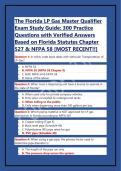
The Florida LP Gas Master Qualifier
Exam Study Guide: 300 Practice
Questions with Verified Answers
Based on Florida Statutes Chapter
527 & NFPA 58 [MOST RECENT!!]
Question 1: In which code book deals with Vehicular Transportation of
LP-Gas?
• A. NFPA 54
• B. NFPA 58 (NFPA 58 Chapter 9)
• C. Both NFPA 54 & NFPA 58
• D. None of the above
Question 2: When must a dispensing unit have a license to operate in
the state of Florida?
• A. When used only for private company vehicles.
• B. Only when connected to underground tanks.
• C. When selling to the public.
• D. Only when dispensing more than 500 gallons per day.
Question 3: Which piping material is NOT approved for LP gas
distribution in Florida according to NFPA 58?
• A. Copper tubing (Type K)
• B. Black steel pipe (Schedule 40)
• C. Polyethylene (PE) pipe rated for gas
• D. PVC pipe (Schedule 40)
Question 4: When sizing a gas pipe, the primary factor used to
determine pipe diameter is:
• A. The length of the pipe run only.
• B. The pressure drop across the system.
, • C. The color of the pipe.
• D. The age of the building.
Question 5: A Master Qualifier registration automatically expires if the
individual terminates active employment in their area of examination for
a period exceeding how many months, according to Florida Statutes?
• A. 12 months
• B. 18 months
• C. 24 months
• D. 36 months
Reference: According to the Florida Senate, qualifier registration
automatically expires if active employment is terminated for over 24
months.
Question 6: A category I dealer license in Florida may include up to how
many remote bulk storage locations?
• A. One
• B. Two
• C. Three
• D. Four
Reference: Florida law allows a category I license to include up
to two remote bulk storage locations.
Question 7: What is the maximum distance a remote bulk storage
location can be from the main licensed location?
• A. 50 miles
• B. 60 miles
• C. 75 miles
• D. 100 miles
Reference: Remote bulk storage locations must be located within 75
miles of the licensed location.
Question 8: Within how many days must a competency examination be
completed after the application has been accepted by the department?
• A. 30 days
• B. 60 days
, • C. 90 days
• D. 120 days
Reference: The Florida Senate states that the examination for
competency must be completed within 90 days after the application is
accepted.
Question 9: According to Florida law, a wholesaler cannot enter into
written agreements that allocate a total storage amount that exceeds the
wholesaler's total storage capacity minus how many gallons?
• A. 18,000 gallons
• B. 25,000 gallons
• C. 30,000 gallons
• D. 50,000 gallons
Reference: The statute specifies a wholesaler cannot allocate storage
that exceeds their total capacity minus 18,000 gallons.
Question 10: Who is responsible for enforcing the provisions of Chapter
527, Florida Statutes?
• A. The Florida Fire Marshal
• B. The Department of Agriculture and Consumer Services
• C. The Department of Environmental Protection
• D. Local Building Departments
Reference: The Florida Statutes grant the Department of Agriculture and
Consumer Services (DACS) the power to enforce Chapter 527.
Question 11: LP-Gas is stored in containers primarily in which physical
state?
• A. Solid
• B. Vapor
• C. Liquid under pressure
• D. Plasma
Reference: LP-Gas is stored as a liquid under pressure and vaporizes
when released.
Question 12: Which pressure relief device is required on LP-Gas
containers?
, • A. Manual shutoff valve
• B. Check valve
• C. Spring-loaded relief valve
• D. Needle valve
Reference: Spring-loaded relief valves protect containers from excessive
internal pressure.
Question 13: What is the primary hazard associated with LP-Gas leaks?
• A. Toxic inhalation
• B. Corrosion
• C. Fire and explosion
• D. Radiation
Reference: LP-Gas is highly flammable and forms explosive mixtures
with air.
Question 14: Is LP-Gas vapor heavier or lighter than air?
• A. Lighter
• B. Heavier
• C. Equal weight
• D. Variable
Reference: Propane vapor is heavier than air and can collect in low
areas.
Question 15: What is the minimum horizontal separation generally
required between an above-ground ASME LP-Gas tank and an ignition
source?
• A. 1 foot
• B. 5 feet
• C. 10 feet
• D. 25 feet
Reference: NFPA 58 establishes minimum separation distances of 5
feet to reduce ignition risk.
Question 16: Which location is generally prohibited for LP-Gas cylinder
storage?
• A. Outdoors
Exam Study Guide: 300 Practice
Questions with Verified Answers
Based on Florida Statutes Chapter
527 & NFPA 58 [MOST RECENT!!]
Question 1: In which code book deals with Vehicular Transportation of
LP-Gas?
• A. NFPA 54
• B. NFPA 58 (NFPA 58 Chapter 9)
• C. Both NFPA 54 & NFPA 58
• D. None of the above
Question 2: When must a dispensing unit have a license to operate in
the state of Florida?
• A. When used only for private company vehicles.
• B. Only when connected to underground tanks.
• C. When selling to the public.
• D. Only when dispensing more than 500 gallons per day.
Question 3: Which piping material is NOT approved for LP gas
distribution in Florida according to NFPA 58?
• A. Copper tubing (Type K)
• B. Black steel pipe (Schedule 40)
• C. Polyethylene (PE) pipe rated for gas
• D. PVC pipe (Schedule 40)
Question 4: When sizing a gas pipe, the primary factor used to
determine pipe diameter is:
• A. The length of the pipe run only.
• B. The pressure drop across the system.
, • C. The color of the pipe.
• D. The age of the building.
Question 5: A Master Qualifier registration automatically expires if the
individual terminates active employment in their area of examination for
a period exceeding how many months, according to Florida Statutes?
• A. 12 months
• B. 18 months
• C. 24 months
• D. 36 months
Reference: According to the Florida Senate, qualifier registration
automatically expires if active employment is terminated for over 24
months.
Question 6: A category I dealer license in Florida may include up to how
many remote bulk storage locations?
• A. One
• B. Two
• C. Three
• D. Four
Reference: Florida law allows a category I license to include up
to two remote bulk storage locations.
Question 7: What is the maximum distance a remote bulk storage
location can be from the main licensed location?
• A. 50 miles
• B. 60 miles
• C. 75 miles
• D. 100 miles
Reference: Remote bulk storage locations must be located within 75
miles of the licensed location.
Question 8: Within how many days must a competency examination be
completed after the application has been accepted by the department?
• A. 30 days
• B. 60 days
, • C. 90 days
• D. 120 days
Reference: The Florida Senate states that the examination for
competency must be completed within 90 days after the application is
accepted.
Question 9: According to Florida law, a wholesaler cannot enter into
written agreements that allocate a total storage amount that exceeds the
wholesaler's total storage capacity minus how many gallons?
• A. 18,000 gallons
• B. 25,000 gallons
• C. 30,000 gallons
• D. 50,000 gallons
Reference: The statute specifies a wholesaler cannot allocate storage
that exceeds their total capacity minus 18,000 gallons.
Question 10: Who is responsible for enforcing the provisions of Chapter
527, Florida Statutes?
• A. The Florida Fire Marshal
• B. The Department of Agriculture and Consumer Services
• C. The Department of Environmental Protection
• D. Local Building Departments
Reference: The Florida Statutes grant the Department of Agriculture and
Consumer Services (DACS) the power to enforce Chapter 527.
Question 11: LP-Gas is stored in containers primarily in which physical
state?
• A. Solid
• B. Vapor
• C. Liquid under pressure
• D. Plasma
Reference: LP-Gas is stored as a liquid under pressure and vaporizes
when released.
Question 12: Which pressure relief device is required on LP-Gas
containers?
, • A. Manual shutoff valve
• B. Check valve
• C. Spring-loaded relief valve
• D. Needle valve
Reference: Spring-loaded relief valves protect containers from excessive
internal pressure.
Question 13: What is the primary hazard associated with LP-Gas leaks?
• A. Toxic inhalation
• B. Corrosion
• C. Fire and explosion
• D. Radiation
Reference: LP-Gas is highly flammable and forms explosive mixtures
with air.
Question 14: Is LP-Gas vapor heavier or lighter than air?
• A. Lighter
• B. Heavier
• C. Equal weight
• D. Variable
Reference: Propane vapor is heavier than air and can collect in low
areas.
Question 15: What is the minimum horizontal separation generally
required between an above-ground ASME LP-Gas tank and an ignition
source?
• A. 1 foot
• B. 5 feet
• C. 10 feet
• D. 25 feet
Reference: NFPA 58 establishes minimum separation distances of 5
feet to reduce ignition risk.
Question 16: Which location is generally prohibited for LP-Gas cylinder
storage?
• A. Outdoors