

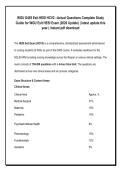
WGU D455 Exit HESI HCV2 –Actual Questions Complete Study
Guide for WGU Exit HESI Exam (2026 Update) | latest update this
year | instant pdf download
The HESI Exit Exam (HCV2) is a comprehensive, standardized assessment administered
to nursing students at WGU as part of the D455 course. It evaluates readiness for the
NCLEX-RN by testing nursing knowledge across the lifespan in various clinical settings. The
exam consists of 150-200 questions with a 4-hour time limit. The questions are
distributed across nine clinical areas and six process categories.
Exam Structure & Content Areas:
Clinical Areas:
Clinical Area Approx. %
Medical-Surgical 31%
Maternity 10%
Pediatrics 10%
Psychiatric/Mental Health 8%
Pharmacology 15%
Fundamentals 12%
Geriatrics 5%
,Clinical Area Approx. %
Management of Care 5%
Community Health 4%
Process Categories:
Process Category Approx. %
Assessment 13%
Analysis/Diagnosis 7%
Planning 13%
Implementation 31%
Evaluation 15%
Client Needs - Safe, Effective Care Environment 21%
Section 1: Cardiovascular Disorders (Questions 1-20)
1. A 72-year-old patient with chronic heart failure is prescribed furosemide (Lasix) 40
mg twice daily. Which laboratory value should the nurse monitor most closely?
A) Serum sodium
B) Serum potassium
,C) Serum calcium
D) Serum magnesium
Answer: B
Rationale: Furosemide is a loop diuretic that causes potassium wasting. Hypokalemia is a
significant side effect and can precipitate cardiac arrhythmias, especially in patients on
digitalis or with underlying heart disease.
2. A 65-year-old patient presents with sudden onset of sharp chest pain that worsens
with deep inspiration and is relieved by leaning forward. ECG shows diffuse ST-
segment elevation. Which condition is most likely?
A) Acute myocardial infarction
B) Pericarditis
C) Unstable angina
D) Pulmonary embolism
Answer: B
Rationale: Pericarditis presents with sharp, pleuritic chest pain that is worse lying flat and
improves with sitting and leaning forward. Diffuse ST-segment elevation in all leads
distinguishes it from MI.
, 3. A patient with heart failure has crackles in both lung bases, jugular venous
distention, and 3+ pitting edema of the lower extremities. Which nursing intervention
should be implemented first?
A) Elevate the patient's legs
B) Administer furosemide (Lasix) as prescribed
C) Place the patient in high Fowler's position
D) Apply oxygen via nasal cannula
Answer: B
Rationale: Furosemide is a loop diuretic used to reduce fluid volume. This directly
addresses the excess fluid causing crackles, edema, and JVD.
4. A 78-year-old patient is prescribed digoxin (Lanoxin) for heart failure. Which
finding indicates digoxin toxicity?
A) Hyperkalemia
B) Hypokalemia
C) Tachycardia
D) Visual disturbances (blurred or yellow vision)
Answer: D
Guide for WGU Exit HESI Exam (2026 Update) | latest update this
year | instant pdf download
The HESI Exit Exam (HCV2) is a comprehensive, standardized assessment administered
to nursing students at WGU as part of the D455 course. It evaluates readiness for the
NCLEX-RN by testing nursing knowledge across the lifespan in various clinical settings. The
exam consists of 150-200 questions with a 4-hour time limit. The questions are
distributed across nine clinical areas and six process categories.
Exam Structure & Content Areas:
Clinical Areas:
Clinical Area Approx. %
Medical-Surgical 31%
Maternity 10%
Pediatrics 10%
Psychiatric/Mental Health 8%
Pharmacology 15%
Fundamentals 12%
Geriatrics 5%
,Clinical Area Approx. %
Management of Care 5%
Community Health 4%
Process Categories:
Process Category Approx. %
Assessment 13%
Analysis/Diagnosis 7%
Planning 13%
Implementation 31%
Evaluation 15%
Client Needs - Safe, Effective Care Environment 21%
Section 1: Cardiovascular Disorders (Questions 1-20)
1. A 72-year-old patient with chronic heart failure is prescribed furosemide (Lasix) 40
mg twice daily. Which laboratory value should the nurse monitor most closely?
A) Serum sodium
B) Serum potassium
,C) Serum calcium
D) Serum magnesium
Answer: B
Rationale: Furosemide is a loop diuretic that causes potassium wasting. Hypokalemia is a
significant side effect and can precipitate cardiac arrhythmias, especially in patients on
digitalis or with underlying heart disease.
2. A 65-year-old patient presents with sudden onset of sharp chest pain that worsens
with deep inspiration and is relieved by leaning forward. ECG shows diffuse ST-
segment elevation. Which condition is most likely?
A) Acute myocardial infarction
B) Pericarditis
C) Unstable angina
D) Pulmonary embolism
Answer: B
Rationale: Pericarditis presents with sharp, pleuritic chest pain that is worse lying flat and
improves with sitting and leaning forward. Diffuse ST-segment elevation in all leads
distinguishes it from MI.
, 3. A patient with heart failure has crackles in both lung bases, jugular venous
distention, and 3+ pitting edema of the lower extremities. Which nursing intervention
should be implemented first?
A) Elevate the patient's legs
B) Administer furosemide (Lasix) as prescribed
C) Place the patient in high Fowler's position
D) Apply oxygen via nasal cannula
Answer: B
Rationale: Furosemide is a loop diuretic used to reduce fluid volume. This directly
addresses the excess fluid causing crackles, edema, and JVD.
4. A 78-year-old patient is prescribed digoxin (Lanoxin) for heart failure. Which
finding indicates digoxin toxicity?
A) Hyperkalemia
B) Hypokalemia
C) Tachycardia
D) Visual disturbances (blurred or yellow vision)
Answer: D

