

Escrito por estudiantes que aprobaron Inmediatamente disponible después del pago Leer en línea o como PDF ¿Documento equivocado? Cámbialo gratis 4,6 TrustPilot
logo-home
Document preview thumbnail
Vista previa 4 fuera de 47 páginas
Examen

NR 302 Chapter 1 Evidence-Based Practice 2026/2027 – 40+ Questions & Answers, Health Assessment, Nursing Process, Diagnostic Reasoning & Clinical Prioritie

Document preview thumbnail
Vista previa 4 fuera de 47 páginas

This NR 302 Chapter 1 Evidence-Based Practice 2026/2027 study guide is a 47-page nursing review containing 40+ questions, answers, definitions, rationales, multiple-response items and priority-setting exercises. It focuses on the foundations of health assessment and evidence-based nursing practice, including subjective and objective data, patient databases, diagnostic reasoning, cue recognition, hypothesis formulation, data validation and clinical decision-making. The document defines evidence-based practice as a systematic approach that integrates the best available evidence, clinician expertise, and patient preferences and values when making decisions about care and treatment. A central section examines the six phases of the nursing process: assessment, diagnosis, outcome identification, planning, implementation and evaluation. Students learn how health histories, interviews and physical examinations contribute to assessment; how accurate nursing diagnoses guide interventions; and how actual outcomes are compared with expected outcomes during evaluation. The material also explores diagnostic reasoning, including attending to clinical cues, formulating hypotheses, gathering additional information and evaluating hypotheses to reach appropriate conclusions. Questions require students to distinguish diagnostic hypotheses from nursing diagnoses and recognize how clustering related assessment findings can reveal clinically meaningful patterns. The guide provides detailed preparation on clinical judgment and nursing priority setting. First-level priorities are identified as emergent or immediately life-threatening problems involving airway, breathing and circulation; second-level priorities require prompt intervention to prevent deterioration, such as acute pain, altered mental status or abnormal laboratory findings; and third-level priorities include important but less urgent concerns such as education and family coping. Applied scenarios reinforce this hierarchy by requiring students to prioritize respiratory distress ahead of confusion and patient-teaching needs. Another important component covers nursing expertise and critical-thinking development. The resource differentiates novice, proficient and expert nurses, explaining that novice practitioners commonly rely on structured rules and tasks, while proficient nurses recognize patient situations as integrated wholes. Expert nurses increasingly use pattern recognition and an intuitive grasp of clinical situations. Students also review data validation, distinguishing relevant from irrelevant findings, identifying missing information and clustering related cues—for example, grouping wheezing, cough, dyspnea and respiratory-rate findings during respiratory assessment. The chapter also explores the different health-assessment databases used according to the patient's situation. These include the complete database for comprehensive history and physical examination, focused or problem-centered database for a limited concern, follow-up database for monitoring identified acute or chronic problems, and emergency database for rapidly gathering crucial information while lifesaving interventions are occurring. Clinical examples involving home health, outpatient respiratory complaints, blood-pressure follow-up and multiple-trauma emergencies reinforce when each database should be selected. Students additionally review holistic health, health promotion, disease prevention and culturally responsive assessment. The document describes holistic health as recognizing the interdependence of mind, body, spirit and environment, while health promotion emphasizes helping individuals choose healthier lifestyles. Cultural beliefs and practices are presented as essential considerations when collecting meaningful assessment information and delivering culturally sensitive, appropriate nursing care. The material closely corresponds with concepts presented in Jarvis, Physical Examination & Health Assessment, particularly Chapter 1 concepts involving evidence-based assessment, subjective and objective data, diagnostic reasoning, priority setting, nursing expertise, database selection, holistic health and cultural considerations. The evidence-based practice principles are also consistent with the widely accepted model described by Melnyk and Fineout-Overholt, in which research evidence is integrated with clinical expertise and patient preferences to support healthcare decisions. These references provide useful academic context, while the uploaded NR 302 material should remain the primary guide for the exact terminology and questions expected in this chapter. This document is especially relevant for NR 302 students, health assessment students, BSN students, pre-licensure nursing students, registered nursing students, nursing fundamentals students and learners studying evidence-based practice, physical assessment, diagnostic reasoning, clinical judgment, priority setting, nursing-process questions and culturally responsive care. It is particularly useful for students preparing for NR 302 Chapter 1 quizzes, exams, competency checks and health-assessment coursework. The uploaded material does not identify a university, so the institution is listed as University Not Specified rather than attributing the document to an unsupported school. Keywords: NR 302 Chapter 1, NR 302 evidence based practice, NR 302 questions and answers, NR 302 study guide, NR 302 exam , evidence based practice nursing, EBP nursing questions, health assessment nursing, nursing assessment questions, subjective and objective data, patient database nursing, diagnostic reasoning nursing, clinical reasoning nursing, clinical judgment nursing, nursing process ADOPIE, nursing process questions, assessment diagnosis planning implementation evaluation, nursing priority setting, ABC nursing priorities, first level priority nursing, second level priority nursing, third level priority nursing, nursing diagnosis, diagnostic hypothesis, cue clustering nursing, data validation nursing, novice proficient expert nurse, nursing intuition, complete health database, focused database nursing, follow up database, emergency database nursing, holistic health nursing, health promotion nursing, disease prevention nursing, cultural assessment nursing, culturally sensitive nursing care, physical examination nursing, Jarvis health assessment, BSN health assessment

Vista previa del contenido

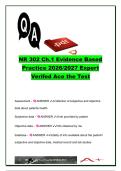
NR 302 Ch.1 Evidence Based
Practice 2026/2027 Expert
Verifed Ace the Test


Assessment - ANSWER ✔✔collection of subjective and objective

data about patients health


Subjective data - ANSWER ✔✔Info provided by patient


Objective data - ANSWER ✔✔info obtained by me


database - ANSWER ✔✔totality of info available about the patient=

subjective and objective data, medical record and lab studies

,diagnostic reasoning - ANSWER ✔✔process of analyzing health data

and drawing conclusions to identify diagnoses


4 components of diagnostic reasoning - ANSWER ✔✔attending to

cues= pieces of info, signs, symptoms, lab data


formulating hypothesis= explanation for a cue


gathering data


evaluating hypothesis= final diagnosis


Nursing process 6 phases - ANSWER ✔✔ADOPIE


Assessment

Diagnosis

Outcome identification

Planning

Implementation

,Evaluation

Novice nurses usually adhere to what for their performance -

ANSWER ✔✔Rules and task oriented because of no experience


Proficient nurses understands patient situations because - ANSWER

✔✔They see them as a whole rather than a list of tasks, attends to an

assessment data pattern and acts w.o consciously labeling it.


Expert nurses processes how - ANSWER ✔✔With intuitive grasp of

clinical situations and zeroes on accurate solution


What is first level priority problem and an example - ANSWER

✔✔emergent, life threatening and immediate


Ex: est an airway or supporting breathing


Second level priority and example - ANSWER ✔✔Next in urgency,

requiring prompt intervention to prevent further deterioration


Ex: mental status change, acute pain, or abnormal lab values


3
COPYRIGHT©JOSHCLAY 2025/2026. YEAR PUBLISHED 2026. COMPANY REGISTRATION NUMBER: 619652435. TERMS OF USE. PRIVACY
STATEMENT. ALL RIGHTS RESERVED

, Third level priority and example - ANSWER ✔✔Important to the

patients health but can be addressed after more urgent problems.


Ex: lack of knowledge or family coping


Collaborative problems - ANSWER ✔✔Physiologic conditions in

which approach to treatment involves multiple disciplines


Evidence based practice - ANSWER ✔✔systemic approach ti

practice that uses best evidence from clinicians experience and patients

preferences and values to make decisions about care and treatment


What are 4 types of database - ANSWER ✔✔Complete database


Focused database

Followup database

Emergency database


complete database - ANSWER ✔✔Complete health history and full

physical examination


focused database - ANSWER ✔✔Problem centered, used for limited

or short term problem. More targeted than complete database

Información del documento

Subido en
7 de agosto de 2026
Número de páginas
47
Escrito en
2026/2027
Tipo
Examen
Contiene
Preguntas y respuestas
$18.99

¿Documento equivocado? Cámbialo gratis Dentro de los 14 días posteriores a la compra y antes de descargarlo, puedes elegir otro documento. Puedes gastar el importe de nuevo.
Escrito por estudiantes que aprobaron
Inmediatamente disponible después del pago
Leer en línea o como PDF

Seller avatar
Los indicadores de reputación están sujetos a la cantidad de artículos vendidos por una tarifa y las reseñas que ha recibido por esos documentos. Hay tres niveles: Bronce, Plata y Oro. Cuanto mayor reputación, más podrás confiar en la calidad del trabajo del vendedor.
JOSHCLAY
3.5
(83)
Vendido
384
Seguidores
16
Artículos
20324
Última venta
2 horas hace


Por qué los estudiantes eligen Stuvia

Creado por compañeros estudiantes, verificado por reseñas

Calidad en la que puedes confiar: escrito por estudiantes que aprobaron y evaluado por otros que han usado estos resúmenes.

¿No estás satisfecho? Elige otro documento

¡No te preocupes! Puedes elegir directamente otro documento que se ajuste mejor a lo que buscas.

Paga como quieras, empieza a estudiar al instante

Sin suscripción, sin compromisos. Paga como estés acostumbrado con tarjeta de crédito y descarga tu documento PDF inmediatamente.

Student with book image

“Comprado, descargado y aprobado. Así de fácil puede ser.”

Alisha Student

Preguntas frecuentes
