

Escrito por estudiantes que aprobaron Inmediatamente disponible después del pago Leer en línea o como PDF ¿Documento equivocado? Cámbialo gratis 4,6 TrustPilot
logo-home
Document preview thumbnail
Vista previa 2 fuera de 10 páginas
Examen

CNDV 5326 Addictions Counseling Final Exam 2026/2027 | 180+ Exam Questions & Verified Answers | Addiction Models, Motivational Interviewing, Relapse Prevention, Group Counseling, 12-Step Recovery & Substance Use Disorders

Document preview thumbnail
Vista previa 2 fuera de 10 páginas

Prepare for the CNDV 5326 Addictions Counseling Final Exam with this comprehensive collection of 180+ expertly verified exam questions and answers covering the foundational theories, assessment methods, counseling approaches, ethical principles, and evidence-based interventions used in addictions counseling. This high-yield study guide provides in-depth coverage of the Syndrome Model of Addiction, Moral Model, Biological Models, Disease Model, Cognitive-Behavioral Models, substance use disorder assessment, screening validity and reliability, sensitivity and specificity, withdrawal complications, comorbidity, levels of care, managed care, accreditation, motivational interviewing (MI), solution-focused therapy, contingency management, relapse prevention, brief interventions, abstinence-based treatment, family counseling, group counseling, confidentiality, boundary management, pharmacotherapy, recovery support systems, 12-Step programs, Alcoholics Anonymous (AA), Narcotics Anonymous (NA), SMART Recovery, Al-Anon, Alateen, Codependents Anonymous, LGBTQ+ considerations in addiction counseling, psychosocial assessment, advocacy, cultural diversity, disability considerations, gender differences, and the historical development of addiction policy and legislation. The material is presented in a structured question-and-answer format that closely reflects graduate counseling examinations, making it an outstanding resource for quizzes, midterm examinations, comprehensive final exams, and professional counseling certification preparation. This exam review is designed to strengthen clinical reasoning, reinforce counseling theories, and promote active recall through concise, exam-focused questions covering the full continuum of addiction treatment and recovery. Students will deepen their understanding of evidence-based counseling interventions, therapeutic relationships, relapse prevention planning, family systems, ethical decision-making, counselor self-care, multicultural competence, addiction neuroscience, recovery-oriented systems of care, and professional practice standards. Its organized format makes this resource ideal for graduate counseling coursework, addictions counseling programs, substance use disorder certification, counselor licensure preparation, and behavioral health examinations. Recommended for Students: CNDV 5326 students, Clinical Mental Health Counseling students, Addiction Counseling students, Substance Use Disorder Counseling students, Counselor Education students, Rehabilitation Counseling students, Psychology students, Social Work students, Human Services students, Marriage and Family Therapy students, Behavioral Health students, Graduate Counseling students, CADC certification candidates, and professionals preparing for addiction counseling licensure or behavioral health certification examinations. APA 7th Edition References: American Society of Addiction Medicine. (2020). The ASAM National Practice Guideline for the Treatment of Opioid Use Disorder: 2020 Focused Update. Journal of Addiction Medicine, 14(2S), 1–91. Miller, W. R., & Rollnick, S. (2023). Motivational Interviewing: Helping People Change and Grow (4th ed.). Guilford Press. Substance Abuse and Mental Health Services Administration. (2020). Treatment Improvement Protocol (TIP) 35: Enhancing Motivation for Change in Substance Use Disorder Treatment. U.S. Department of Health and Human Services. American Counseling Association. (2014). ACA Code of Ethics. American Counseling Association. Keywords CNDV 5326, Addictions counseling, Addiction counseling final exam, Substance use disorder, SUD, Addiction models, Syndrome model of addiction, Moral model, Biological model, Disease model, Cognitive behavioral model, Motivational interviewing, MI, Solution-focused therapy, Contingency management, Brief intervention, Relapse prevention, Relapse triggers, Abstinence, Recovery, Recovery support, Pharmacotherapy, Group counseling, Family counseling, Confidentiality, Counseling ethics, Counselor boundaries, Boundary violations, Counselor self-care, Compassion fatigue, Burnout prevention, 12-Step program, Alcoholics Anonymous, AA, Narcotics Anonymous, NA, SMART Recovery, SOS, Al-Anon, Alateen, Codependents Anonymous, Levels of care, Managed care, Accreditation, Screening tools, Validity, Reliability, Sensitivity, Specificity, Comorbidity, Withdrawal, Self-efficacy, Denial, Rationalization, Visitor relationship, Complainant relationship, Customer relationship, LGBTQ+ counseling, Psychosocial assessment, Advocacy, Multicultural counseling, Substance abuse in disabilities, Gender differences, Telescoping effect, Addiction policy, Food and Drug Act, Mental Health Parity and Addiction Equity Act, Addiction neuroscience, Limbic system, Neurotransmitters, Acetylcholine, Graduate counseling, Behavioral health, Counseling exam questions, CADC exam, Counseling study guide

Vista previa del contenido

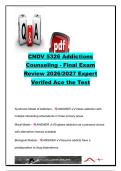
CNDV 5326 Addictions
Counseling - Final Exam
Review 2026/2027 Expert
Verifed Ace the Test


Syndrome Model of Addiction - ANSWER ✔✔Views addiction with

multiple interacting antecedents in three primary areas


Moral Model - ANSWER ✔✔Explains addiction as a personal choice

with alternative choices available


Biological Models - ANSWER ✔✔Assume addicts have a

predisposition to drug dependence

, Disease Model - ANSWER ✔✔Posits addiction as an incurable

primary disease


Cognitive-Behavioral Models - ANSWER ✔✔Suggest various

motivations and reinforcers for drug use


The three primary areas of addiction antecedents: - ANSWER

✔✔Neurobiological, Shared psychosocial, and shared experiences and

consequences


Withdrawal Complications - ANSWER ✔✔Serious issues that arise

with long-term substance use cessation


Validity - ANSWER ✔✔Degree to which a screening tool accurately

assesses its intended measure


Reliability - ANSWER ✔✔Consistency of results produced by a

screening tool


Sensitivity - ANSWER ✔✔Ratio of correctly identified positive cases

in a screening for a disorder


Specificity - ANSWER ✔✔Proportion of accurately identified negative

cases in a screening

Información del documento

Subido en
6 de agosto de 2026
Número de páginas
10
Escrito en
2026/2027
Tipo
Examen
Contiene
Preguntas y respuestas
$18.99

¿Documento equivocado? Cámbialo gratis Dentro de los 14 días posteriores a la compra y antes de descargarlo, puedes elegir otro documento. Puedes gastar el importe de nuevo.
Escrito por estudiantes que aprobaron
Inmediatamente disponible después del pago
Leer en línea o como PDF

Seller avatar
Los indicadores de reputación están sujetos a la cantidad de artículos vendidos por una tarifa y las reseñas que ha recibido por esos documentos. Hay tres niveles: Bronce, Plata y Oro. Cuanto mayor reputación, más podrás confiar en la calidad del trabajo del vendedor.
NinjaNerd
3.4
(76)
Vendido
395
Seguidores
6
Artículos
15309
Última venta
15 horas hace


Por qué los estudiantes eligen Stuvia

Creado por compañeros estudiantes, verificado por reseñas

Calidad en la que puedes confiar: escrito por estudiantes que aprobaron y evaluado por otros que han usado estos resúmenes.

¿No estás satisfecho? Elige otro documento

¡No te preocupes! Puedes elegir directamente otro documento que se ajuste mejor a lo que buscas.

Paga como quieras, empieza a estudiar al instante

Sin suscripción, sin compromisos. Paga como estés acostumbrado con tarjeta de crédito y descarga tu documento PDF inmediatamente.

Student with book image

“Comprado, descargado y aprobado. Así de fácil puede ser.”

Alisha Student

Preguntas frecuentes
