

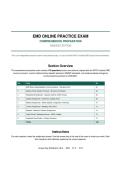
EMD ONLINE PRACTICE EXAM
COMPREHENSIVE PREPARATION
2026/2027 EDITION
This is an independent practice exam for educational study; it is not an official APCO Institute EMD course final examination.
Section Overview
This comprehensive practice exam contains 150 questions across nine sections, aligned with the APCO Institute EMD
course curriculum, current medical priority dispatch protocols, NAEMD standards, and evidence-based emergency
communications practices for 2026/2027.
Sec Topic Qs
1 EMD Roles, Responsibilities & Communications - Call-taking, DLS 20
2 Medical Priority Dispatch Protocols - BLS/ALS, Prioritization 20
3 Respiratory Emergencies - Dyspnea, Asthma, COPD, Airway 20
4 Cardiac Emergencies - Chest Pain, Cardiac Arrest 20
5 Medical Emergencies - Stroke, Diabetic, Anaphylaxis, Poisoning 15
6 Trauma Emergencies - Bleeding, Falls, MVCs 15
7 Obstetric, Pediatric & Geriatric Emergencies 15
8 Legal, Ethical & Operational Issues - HIPAA, Liability 10
9 Integrated Case Studies - Complex Scenarios 15
TOTAL 150
Instructions
For each question, select the single best answer. Use the answer key at the end of the exam to check your work. Each
item includes a brief rationale explaining the correct response.
Answer Key Distribution: 38 A · 38 B · 37 C · 37 D
, Section 1: EMD Roles, Responsibilities & Communications - Call-taking, Interrogation,
and Dispatch Life Support
Q1: The fundamental purpose of the Emergency Medical Dispatcher (EMD) is to:
A. Diagnose the patient's medical condition
B. Transport the patient to the hospital
C. Manage the call, dispatch appropriate resources, and provide instructions to help the caller and patient [CORRECT]
D. Provide hands-on medical treatment
Correct Answer: C
Rationale: The EMD manages the call, dispatches resources, and gives instructions. They do not diagnose, transport, or provide
hands-on care.
Q2: 'Dispatch Life Support' (DLS) refers to the:
A. Physical care provided by paramedics
B. Equipment used by responders
C. Hospital-based treatment
D. Instructions given by the EMD to the caller to help the patient before responders arrive [CORRECT]
Correct Answer: D
Rationale: DLS is the telephone instructions the EMD gives to help the patient until responders arrive. It is not hands-on care or
hospital treatment.
Q3: Which element is part of 'critical EMD information' (CEI)?
A. The caller's favorite color
B. The patient's income
C. The caller's phone number and the location of the emergency [CORRECT]
D. The caller's opinion
Correct Answer: C
Rationale: CEI includes essential elements such as the callback number, location, and chief complaint. The other options are not CEI.
Q4: The 'sender-receiver' model of communication emphasizes that:
A. Only the sender matters
B. Feedback is optional
C. The sender must ensure the message is understood, with feedback from the receiver [CORRECT]
D. The receiver should not respond
Correct Answer: C
Rationale: The sender ensures the message is understood and the receiver provides feedback. The other options misstate the model.
Q5: When a caller is hysterical, the EMD should:
A. Speak quietly with no direction
B. Hang up
C. Use a calm, firm, authoritative voice and redirect the caller to key questions [CORRECT]
D. Argue with the caller
Correct Answer: C
Rationale: Call control uses a calm, firm, authoritative tone to redirect the caller. Hanging up, arguing, or lacking direction is not
effective.
Q6: The purpose of telephone interrogation is to:
A. Delay the response
B. Entertain the caller
C. Gather critical information to determine the appropriate response and instructions [CORRECT]
D. Collect billing data
Correct Answer: C
Rationale: Interrogation gathers critical information to determine the response and instructions. It is not for delay or billing.
Q7: The first priority when answering a 911 call is to:
A. Ask the caller's name only
B. Confirm the location of the emergency [CORRECT]
EMD Online Practice Exam - 2026/2027 Page 2
, C. Diagnose the problem
D. Dispatch without questions
Correct Answer: B
Rationale: Confirming the location is the first priority so help can be sent. Other information follows.
Q8: Post-dispatch instructions (PDI) are given to the caller:
A. After resources are dispatched, to help the patient until they arrive [CORRECT]
B. Before any information is gathered
C. Only for non-emergencies
D. Never
Correct Answer: A
Rationale: PDI are given after dispatch to help the caller until responders arrive. They are an important EMD function.
Q9: A 'hot' response (lights and sirens) is appropriate when:
A. The call is clearly non-emergent
B. The caller requests it
C. The call is life-threatening and time-critical [CORRECT]
D. No one is injured
Correct Answer: C
Rationale: A hot response is used for life-threatening, time-critical calls. Non-emergent calls do not warrant lights and sirens.
Q10: Active listening by an EMD includes:
A. Speaking over the caller
B. Interrupting frequently
C. Summarizing what the caller said to confirm understanding [CORRECT]
D. Guessing the caller's meaning
Correct Answer: C
Rationale: Active listening includes clarifying and summarizing to confirm understanding. The other actions are not active listening.
Q11: The EMD should give instructions to a caller using:
A. Medical jargon
B. Rapid, rushed speech
C. Clear, simple, step-by-step language [CORRECT]
D. Only if the caller asks
Correct Answer: C
Rationale: Instructions should be clear, simple, and step-by-step. Jargon and rushed speech confuse callers.
Q12: If a caller provides incomplete information, the EMD should:
A. Accept the incomplete information
B. End the call
C. Guess
D. Ask specific, focused questions to gather the needed information [CORRECT]
Correct Answer: D
Rationale: Focused, specific questions gather needed information. Accepting incomplete information or guessing is unsafe.
Q13: A 'cold' response (no lights and sirens) is appropriate when:
A. The call is non-life-threatening [CORRECT]
B. The patient is in cardiac arrest
C. There is a mass casualty
D. There is airway compromise
Correct Answer: A
Rationale: A cold response is used for non-life-threatening calls. Life-threatening calls require a hot response.
Q14: The EMD's tone should be:
A. Calm, professional, and in control [CORRECT]
B. Anxious
C. Angry
D. Uninterested
EMD Online Practice Exam - 2026/2027 Page 3
COMPREHENSIVE PREPARATION
2026/2027 EDITION
This is an independent practice exam for educational study; it is not an official APCO Institute EMD course final examination.
Section Overview
This comprehensive practice exam contains 150 questions across nine sections, aligned with the APCO Institute EMD
course curriculum, current medical priority dispatch protocols, NAEMD standards, and evidence-based emergency
communications practices for 2026/2027.
Sec Topic Qs
1 EMD Roles, Responsibilities & Communications - Call-taking, DLS 20
2 Medical Priority Dispatch Protocols - BLS/ALS, Prioritization 20
3 Respiratory Emergencies - Dyspnea, Asthma, COPD, Airway 20
4 Cardiac Emergencies - Chest Pain, Cardiac Arrest 20
5 Medical Emergencies - Stroke, Diabetic, Anaphylaxis, Poisoning 15
6 Trauma Emergencies - Bleeding, Falls, MVCs 15
7 Obstetric, Pediatric & Geriatric Emergencies 15
8 Legal, Ethical & Operational Issues - HIPAA, Liability 10
9 Integrated Case Studies - Complex Scenarios 15
TOTAL 150
Instructions
For each question, select the single best answer. Use the answer key at the end of the exam to check your work. Each
item includes a brief rationale explaining the correct response.
Answer Key Distribution: 38 A · 38 B · 37 C · 37 D
, Section 1: EMD Roles, Responsibilities & Communications - Call-taking, Interrogation,
and Dispatch Life Support
Q1: The fundamental purpose of the Emergency Medical Dispatcher (EMD) is to:
A. Diagnose the patient's medical condition
B. Transport the patient to the hospital
C. Manage the call, dispatch appropriate resources, and provide instructions to help the caller and patient [CORRECT]
D. Provide hands-on medical treatment
Correct Answer: C
Rationale: The EMD manages the call, dispatches resources, and gives instructions. They do not diagnose, transport, or provide
hands-on care.
Q2: 'Dispatch Life Support' (DLS) refers to the:
A. Physical care provided by paramedics
B. Equipment used by responders
C. Hospital-based treatment
D. Instructions given by the EMD to the caller to help the patient before responders arrive [CORRECT]
Correct Answer: D
Rationale: DLS is the telephone instructions the EMD gives to help the patient until responders arrive. It is not hands-on care or
hospital treatment.
Q3: Which element is part of 'critical EMD information' (CEI)?
A. The caller's favorite color
B. The patient's income
C. The caller's phone number and the location of the emergency [CORRECT]
D. The caller's opinion
Correct Answer: C
Rationale: CEI includes essential elements such as the callback number, location, and chief complaint. The other options are not CEI.
Q4: The 'sender-receiver' model of communication emphasizes that:
A. Only the sender matters
B. Feedback is optional
C. The sender must ensure the message is understood, with feedback from the receiver [CORRECT]
D. The receiver should not respond
Correct Answer: C
Rationale: The sender ensures the message is understood and the receiver provides feedback. The other options misstate the model.
Q5: When a caller is hysterical, the EMD should:
A. Speak quietly with no direction
B. Hang up
C. Use a calm, firm, authoritative voice and redirect the caller to key questions [CORRECT]
D. Argue with the caller
Correct Answer: C
Rationale: Call control uses a calm, firm, authoritative tone to redirect the caller. Hanging up, arguing, or lacking direction is not
effective.
Q6: The purpose of telephone interrogation is to:
A. Delay the response
B. Entertain the caller
C. Gather critical information to determine the appropriate response and instructions [CORRECT]
D. Collect billing data
Correct Answer: C
Rationale: Interrogation gathers critical information to determine the response and instructions. It is not for delay or billing.
Q7: The first priority when answering a 911 call is to:
A. Ask the caller's name only
B. Confirm the location of the emergency [CORRECT]
EMD Online Practice Exam - 2026/2027 Page 2
, C. Diagnose the problem
D. Dispatch without questions
Correct Answer: B
Rationale: Confirming the location is the first priority so help can be sent. Other information follows.
Q8: Post-dispatch instructions (PDI) are given to the caller:
A. After resources are dispatched, to help the patient until they arrive [CORRECT]
B. Before any information is gathered
C. Only for non-emergencies
D. Never
Correct Answer: A
Rationale: PDI are given after dispatch to help the caller until responders arrive. They are an important EMD function.
Q9: A 'hot' response (lights and sirens) is appropriate when:
A. The call is clearly non-emergent
B. The caller requests it
C. The call is life-threatening and time-critical [CORRECT]
D. No one is injured
Correct Answer: C
Rationale: A hot response is used for life-threatening, time-critical calls. Non-emergent calls do not warrant lights and sirens.
Q10: Active listening by an EMD includes:
A. Speaking over the caller
B. Interrupting frequently
C. Summarizing what the caller said to confirm understanding [CORRECT]
D. Guessing the caller's meaning
Correct Answer: C
Rationale: Active listening includes clarifying and summarizing to confirm understanding. The other actions are not active listening.
Q11: The EMD should give instructions to a caller using:
A. Medical jargon
B. Rapid, rushed speech
C. Clear, simple, step-by-step language [CORRECT]
D. Only if the caller asks
Correct Answer: C
Rationale: Instructions should be clear, simple, and step-by-step. Jargon and rushed speech confuse callers.
Q12: If a caller provides incomplete information, the EMD should:
A. Accept the incomplete information
B. End the call
C. Guess
D. Ask specific, focused questions to gather the needed information [CORRECT]
Correct Answer: D
Rationale: Focused, specific questions gather needed information. Accepting incomplete information or guessing is unsafe.
Q13: A 'cold' response (no lights and sirens) is appropriate when:
A. The call is non-life-threatening [CORRECT]
B. The patient is in cardiac arrest
C. There is a mass casualty
D. There is airway compromise
Correct Answer: A
Rationale: A cold response is used for non-life-threatening calls. Life-threatening calls require a hot response.
Q14: The EMD's tone should be:
A. Calm, professional, and in control [CORRECT]
B. Anxious
C. Angry
D. Uninterested
EMD Online Practice Exam - 2026/2027 Page 3

