

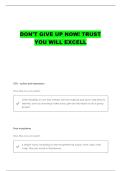
UDL - action and expression
Give this one a try later!
Offer flexibility in how kids interact with the material and show what they've
learned, such as choosing to take a test, give an oral report or do a group
project.
Free morpheme
Give this one a try later!
a simple word, consisting of one morpheme eg house, work, high, chair,
wrap. They are words in themselves.
,Cognitive - 2 years
Give this one a try later!
Finds things even when hidden under two or three covers,Begins to sort
shapes and colors, Completes sentences and rhymes in familiar books,
Plays simple make-believe games, Builds towers of 4 or more blocks, Might
use one hand more than the other, Follows two-step instructions such as
"Pick up your shoes and put them in the closet.", Names items in a picture
book such as a cat, bird, or dog
Strategies for TBI
Give this one a try later!
patience and compassion, hand gestures, expressions, etc.
Motor/Physical - 9 months
Give this one a try later!
Stands, holding on, Can get into sitting position, Sits without support, Pulls
to stand, Crawls
Solitary play
Give this one a try later!
, From three to 18 months; children are very busy with play and they may not
seem to notice other children sitting or playing nearby; begins in infancy
and is common in toddlers. This is because of toddlers' limited social,
cognitive,
and physical skills
Content
Give this one a try later!
what the student needs to learn or how the student will get access to the
information
Developmental spelling
Give this one a try later!
refers to young children's attempts to use what they already know about
letters and sounds to write words
Cognitive - 1 1/2 years
Give this one a try later!
, Knows what ordinary things are for; for example, telephone, brush, spoon,
Points to get the attention of others, Shows interest in a doll or stuffed
animal by pretending to feed, Points to one body part, Scribbles on his
own, Can follow 1-step verbal commands without any gestures; for
example, sits when you say "sit down"
Physical Development - 1 1/2 years
Give this one a try later!
Walks alone, May walk up steps and run, Pulls toys while walking, Can help
undress herself, Drinks from a cup, Eats with a spoon
Unaided AAC system
Give this one a try later!
don't need anything other than your body, ex. gestures, body language,
facial expression, and sign language
Other health impairment (OHI)
Give this one a try later!
means having limited strength, vitality or alertness,
including a heightened sensitivity to environmental stimuli, that result in
limited alertness with respect to the educational environment, that is due to
acute health problems such as asthma, attention deficit disorder or
attention deficit hyperactivity
disorder, diabetes, epilepsy, a heart condition, hemophilia, lead poisoning,
Give this one a try later!
Offer flexibility in how kids interact with the material and show what they've
learned, such as choosing to take a test, give an oral report or do a group
project.
Free morpheme
Give this one a try later!
a simple word, consisting of one morpheme eg house, work, high, chair,
wrap. They are words in themselves.
,Cognitive - 2 years
Give this one a try later!
Finds things even when hidden under two or three covers,Begins to sort
shapes and colors, Completes sentences and rhymes in familiar books,
Plays simple make-believe games, Builds towers of 4 or more blocks, Might
use one hand more than the other, Follows two-step instructions such as
"Pick up your shoes and put them in the closet.", Names items in a picture
book such as a cat, bird, or dog
Strategies for TBI
Give this one a try later!
patience and compassion, hand gestures, expressions, etc.
Motor/Physical - 9 months
Give this one a try later!
Stands, holding on, Can get into sitting position, Sits without support, Pulls
to stand, Crawls
Solitary play
Give this one a try later!
, From three to 18 months; children are very busy with play and they may not
seem to notice other children sitting or playing nearby; begins in infancy
and is common in toddlers. This is because of toddlers' limited social,
cognitive,
and physical skills
Content
Give this one a try later!
what the student needs to learn or how the student will get access to the
information
Developmental spelling
Give this one a try later!
refers to young children's attempts to use what they already know about
letters and sounds to write words
Cognitive - 1 1/2 years
Give this one a try later!
, Knows what ordinary things are for; for example, telephone, brush, spoon,
Points to get the attention of others, Shows interest in a doll or stuffed
animal by pretending to feed, Points to one body part, Scribbles on his
own, Can follow 1-step verbal commands without any gestures; for
example, sits when you say "sit down"
Physical Development - 1 1/2 years
Give this one a try later!
Walks alone, May walk up steps and run, Pulls toys while walking, Can help
undress herself, Drinks from a cup, Eats with a spoon
Unaided AAC system
Give this one a try later!
don't need anything other than your body, ex. gestures, body language,
facial expression, and sign language
Other health impairment (OHI)
Give this one a try later!
means having limited strength, vitality or alertness,
including a heightened sensitivity to environmental stimuli, that result in
limited alertness with respect to the educational environment, that is due to
acute health problems such as asthma, attention deficit disorder or
attention deficit hyperactivity
disorder, diabetes, epilepsy, a heart condition, hemophilia, lead poisoning,


