

PNUR1243 (Pathophysiology & Pharmacotherapeutics) Test 2
Study online at https://quizlet.com/_fwfqik
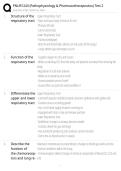
1. Structure of the Upper Respiratory Tract:
respiratory tract -Nose and nasal cavity (entrance for air)
-Pharynx (throat)
-Larynx (voice box)
Lower Respiratory Tract:
-Trachea (windpipe)
-Bronchi and Bronchioles (directs air into parts of the lungs)
-Lungs (where gas exchanges occurs)
2. Function of the -Supplies oxygen to cells and tissues
respiratory tract -Works at exhaling CO2 from the body and prevents microbes from entering the
body
-Regulation of acid-base balance
-Allows us to speak by vocal cords
-Sinuses provide sense of smell
-Sinuses filter out particles and humidifies it
3. Differentiate the Upper Respiratory Tract:
upper and lower -Lined with pseudo stratified ciliated columnar epithelium with goblet cells
respiratory tract -Contains mucus-secreting glands
-Has a rich blood supply to warm incoming air
-Equipped with cilia to trap and remove particles
Lower Respiratory Tract:
-Epithelium changes as airways become smaller
-Contains alveoli for gas exchange
-Has surfactant-producing cells (reduces surface tension)
-Forms the air-blood barrier in alveoli
4. Describe the Maintains homeostasis by responding to changes in blood gas levels and me-
function of chanical conditions within the lungs
the chemorecep- -Chemoreceptors detect changes in chemical composition of blood (O2, CO2 and
tors and lung re- pH)
, PNUR1243 (Pathophysiology & Pharmacotherapeutics) Test 2
Study online at https://quizlet.com/_fwfqik
ceptors in the -Lung receptors include mechanoreceptors that provides feedback about me-
regulation of chanical state of the lungs
breathing
5. Explain the Her- Important protective mechanism that helps prevent over-inflation of the lungs
ing Breuer re- -Triggered when pulmonary stretch receptors in walls of bronchi and bronchioles
flex? are activated by excessive lung inflation
-Receptors send signals via vagus nerve to respiratory centres in medulla and
pons
-Input inhibits the inspiratory area in medulla and pons, terminating inspiration
and allowing expiration
6. Explain the hy- -Refers to the stimulation of breathing in response to low oxygen levels (hypoxia)
poxic drive for in blood
respirations -Mechanism is mediated by peripheral chemoreceptors located in carotid or
aortic bodies
-When arterial oxygen levels fall, receptors send signals to the respiratory centres
in the brainstem in increase ventilation
7. Describe the pur- -Protection of the lungs
pose and func- -Removal of debris
tion of the mu- -Maintenance of airway hygiene
cociliary clear- -Prevention of infections
ance mechanism
8. Define sneezing Involuntary explosion of air from the nose and mouth due to irritation of one's
nostril
9. Define coughing Expelling air from the lungs with a sudden sharp harsh noise
10. Define adventi- Abnormal breath sounds
tious sounds
, PNUR1243 (Pathophysiology & Pharmacotherapeutics) Test 2
Study online at https://quizlet.com/_fwfqik
11. Define dyspnea Clinical sign of hypoxia and manifest as breathlessness
12. Define cyanosis Blue discolouration of the skin and mucous membranes caused by presence of
desaturated hemoglobin in capillaries
13. Define hypoxia Inadequate tissue oxygenation at the cellular level
14. Define hypox- Reduced oxygen level in blood
emia
15. Define bron- Construction of the airways in the lungs due to tightening of surrounding smooth
choconstriction muscle with. consequent coughing, wheezing and SOB
16. Identify common -Spirometry-pulmonary function testing (tests pulmonary volumes, measures vol-
diagnostic tests ume and airflow times)
used with respi- -ABG determinations (used to check O2, CO2, bicarbonate levels and serum pH)
ratory conditions -Oximeters (mesures oxygen saturation)
-Radiography (evaluates tumours or infections)
-Bronchoscopy (used for biopsy, checking sit of lesion or bleeding)
-C&S tests (identifies pathogens in exudates and assists in determining appropri-
ate therapy
17. Define arterial These measurements evaluate a patient's acid-base status, ventilation and oxy-
blood gases and genation, which helps to diagnose and manage respiratory conditions.
their relation- -pH (indicates acidity or alkalinity of blood)
ship to respirato- -PaO2 (partial pressure of oxygen measures the amount of O2 dissolved in arterial
ry distress blood)
-PaCO2 (partial pressure of carbon dioxide measure the amount of CO2 dissolved
in arterial blood)
-HCO3 (bicarbonate reflects the metabolic component of acid-base balance)
-SaO2 (oxygen saturation is the percentage of hemoglobin molecules carrying
oxygen)
, PNUR1243 (Pathophysiology & Pharmacotherapeutics) Test 2
Study online at https://quizlet.com/_fwfqik
18. What is the venti- 1. The brainstem stimulates the phrenic and intercostal nerves
lation process? 2. The diaphragm and external intercostal muscles contract
3. Thoracic volume increases
4. Intrapulmonary pressure decreases
5. Air moves into lungs
6. The diaphragm and external intercostal muscles relax
7. Thoracic volume decreases
8. Intrapulmonary pressure increases
9. Air moves out of the lungs
19. Define infectious Infectious Rhinitis:
rhinitis (common -Acute viral infection which affects the upper respiratory tract
cold) and influen- -Symptoms include runny nose, nasal congestion, sneezing, sore throat, cough,
za (flu) mild fatigue
-Mild and self-limiting, lasting 7-10 days
-Spreads through droplet or contact
Influenza (flu):
-Acute viral illness caused by influenza A and B viruses
-Symptoms include fever, chills, headache, muscle aches, fatigue, cough, sore
throat and nasal congestion
-Can lead to serious complications (pneumonia)
-Spread through droplets
-Preventable through annual vaccination
20. Contrast the Cold:
signs and symp- -Onset. (gradual)
toms of a cold -Fever (rare, usually mild)
and flu -Headache (rare)
-General aches, Pains (slight)
-Fatigue, Weakness (sometimes, mild and brief)
-Extreme Exhaustion (never)
-Cough (hacking, productive)
Study online at https://quizlet.com/_fwfqik
1. Structure of the Upper Respiratory Tract:
respiratory tract -Nose and nasal cavity (entrance for air)
-Pharynx (throat)
-Larynx (voice box)
Lower Respiratory Tract:
-Trachea (windpipe)
-Bronchi and Bronchioles (directs air into parts of the lungs)
-Lungs (where gas exchanges occurs)
2. Function of the -Supplies oxygen to cells and tissues
respiratory tract -Works at exhaling CO2 from the body and prevents microbes from entering the
body
-Regulation of acid-base balance
-Allows us to speak by vocal cords
-Sinuses provide sense of smell
-Sinuses filter out particles and humidifies it
3. Differentiate the Upper Respiratory Tract:
upper and lower -Lined with pseudo stratified ciliated columnar epithelium with goblet cells
respiratory tract -Contains mucus-secreting glands
-Has a rich blood supply to warm incoming air
-Equipped with cilia to trap and remove particles
Lower Respiratory Tract:
-Epithelium changes as airways become smaller
-Contains alveoli for gas exchange
-Has surfactant-producing cells (reduces surface tension)
-Forms the air-blood barrier in alveoli
4. Describe the Maintains homeostasis by responding to changes in blood gas levels and me-
function of chanical conditions within the lungs
the chemorecep- -Chemoreceptors detect changes in chemical composition of blood (O2, CO2 and
tors and lung re- pH)
, PNUR1243 (Pathophysiology & Pharmacotherapeutics) Test 2
Study online at https://quizlet.com/_fwfqik
ceptors in the -Lung receptors include mechanoreceptors that provides feedback about me-
regulation of chanical state of the lungs
breathing
5. Explain the Her- Important protective mechanism that helps prevent over-inflation of the lungs
ing Breuer re- -Triggered when pulmonary stretch receptors in walls of bronchi and bronchioles
flex? are activated by excessive lung inflation
-Receptors send signals via vagus nerve to respiratory centres in medulla and
pons
-Input inhibits the inspiratory area in medulla and pons, terminating inspiration
and allowing expiration
6. Explain the hy- -Refers to the stimulation of breathing in response to low oxygen levels (hypoxia)
poxic drive for in blood
respirations -Mechanism is mediated by peripheral chemoreceptors located in carotid or
aortic bodies
-When arterial oxygen levels fall, receptors send signals to the respiratory centres
in the brainstem in increase ventilation
7. Describe the pur- -Protection of the lungs
pose and func- -Removal of debris
tion of the mu- -Maintenance of airway hygiene
cociliary clear- -Prevention of infections
ance mechanism
8. Define sneezing Involuntary explosion of air from the nose and mouth due to irritation of one's
nostril
9. Define coughing Expelling air from the lungs with a sudden sharp harsh noise
10. Define adventi- Abnormal breath sounds
tious sounds
, PNUR1243 (Pathophysiology & Pharmacotherapeutics) Test 2
Study online at https://quizlet.com/_fwfqik
11. Define dyspnea Clinical sign of hypoxia and manifest as breathlessness
12. Define cyanosis Blue discolouration of the skin and mucous membranes caused by presence of
desaturated hemoglobin in capillaries
13. Define hypoxia Inadequate tissue oxygenation at the cellular level
14. Define hypox- Reduced oxygen level in blood
emia
15. Define bron- Construction of the airways in the lungs due to tightening of surrounding smooth
choconstriction muscle with. consequent coughing, wheezing and SOB
16. Identify common -Spirometry-pulmonary function testing (tests pulmonary volumes, measures vol-
diagnostic tests ume and airflow times)
used with respi- -ABG determinations (used to check O2, CO2, bicarbonate levels and serum pH)
ratory conditions -Oximeters (mesures oxygen saturation)
-Radiography (evaluates tumours or infections)
-Bronchoscopy (used for biopsy, checking sit of lesion or bleeding)
-C&S tests (identifies pathogens in exudates and assists in determining appropri-
ate therapy
17. Define arterial These measurements evaluate a patient's acid-base status, ventilation and oxy-
blood gases and genation, which helps to diagnose and manage respiratory conditions.
their relation- -pH (indicates acidity or alkalinity of blood)
ship to respirato- -PaO2 (partial pressure of oxygen measures the amount of O2 dissolved in arterial
ry distress blood)
-PaCO2 (partial pressure of carbon dioxide measure the amount of CO2 dissolved
in arterial blood)
-HCO3 (bicarbonate reflects the metabolic component of acid-base balance)
-SaO2 (oxygen saturation is the percentage of hemoglobin molecules carrying
oxygen)
, PNUR1243 (Pathophysiology & Pharmacotherapeutics) Test 2
Study online at https://quizlet.com/_fwfqik
18. What is the venti- 1. The brainstem stimulates the phrenic and intercostal nerves
lation process? 2. The diaphragm and external intercostal muscles contract
3. Thoracic volume increases
4. Intrapulmonary pressure decreases
5. Air moves into lungs
6. The diaphragm and external intercostal muscles relax
7. Thoracic volume decreases
8. Intrapulmonary pressure increases
9. Air moves out of the lungs
19. Define infectious Infectious Rhinitis:
rhinitis (common -Acute viral infection which affects the upper respiratory tract
cold) and influen- -Symptoms include runny nose, nasal congestion, sneezing, sore throat, cough,
za (flu) mild fatigue
-Mild and self-limiting, lasting 7-10 days
-Spreads through droplet or contact
Influenza (flu):
-Acute viral illness caused by influenza A and B viruses
-Symptoms include fever, chills, headache, muscle aches, fatigue, cough, sore
throat and nasal congestion
-Can lead to serious complications (pneumonia)
-Spread through droplets
-Preventable through annual vaccination
20. Contrast the Cold:
signs and symp- -Onset. (gradual)
toms of a cold -Fever (rare, usually mild)
and flu -Headache (rare)
-General aches, Pains (slight)
-Fatigue, Weakness (sometimes, mild and brief)
-Extreme Exhaustion (never)
-Cough (hacking, productive)

